
February – March, 2019
We had toured the cliff dwellings at Mesa Verde National Park in Southwestern Colorado several years ago, and we had found it amazing that the Anasazi peoples were able to construct their pueblo homes in rock cutouts on the edge of such deep ravines, were able to carry water and food up the steep cliffs, and were able to thrive in spite of all of the demands that such a life gave them. The Anasazi eventually deserted Mesa Verde. There is speculation but no evidence as to the reason they moved on.
Unexpectedly, we had the chance to add to our knowledge of the history of the Anasazi peoples during our visit to the Tonto National Monument.

Starting in Mesa, it’s a beautiful 95-mile drive through the Superstition Mountains to reach the Tonto National Monument. What a glorious day: bright sunshine, wispy clouds in the sky and the temperature in the low 70’s – not bad for being officially winter!
This area of the country lies on the northeastern edge of the Sonoran Desert. A rare, year-round source of water, the Salt River runs through the area, and it was dammed in the 1930s to create Roosevelt Lake (reservoir). Roosevelt Lake has become a popular camping, recreation and fishing spot.


The Anasazi, O’odham, Hopi, and Zuni peoples (ancestors of these tribes have been called the Hohokam) living together here came to be called the Salado culture. Archeologists and anthropologists estimate that the Salado culture existed from the 13th century into the early 15th century. As with the Anasazi of Mesa Verde, no one is sure why these ancestoral peoples moved from this location; why the Salado culture ceased to exist.
The Upper Cliff Dwelling is a moderate 1.5-mile hike through the Tonto Forest Basin and up a gradual slope. The Dwelling is multi-story with more than 40 rooms built into a large shallow cave near the crest of the mountain. This architectural marvel was built in 1300 CE, with construction continuing until its residents abandoned the area sometime in the early 15th century.
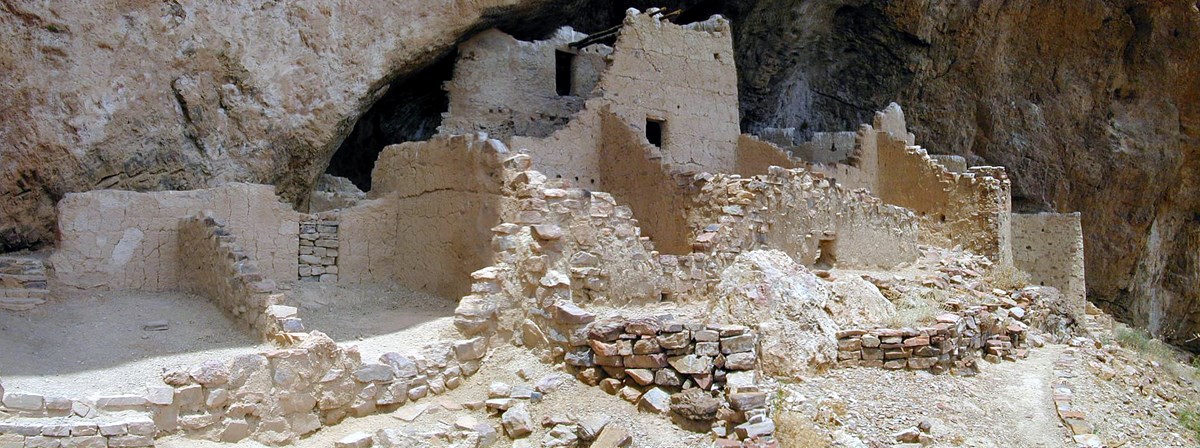
The Lower Cliff Dwelling can be reached by enjoying a strenuous half-mile uphill hike along a narrow paved path with numerous switchbacks. For safety’s sake only 3-4 rooms can be explored.


Estimated to be more than a mile from the cliff dwellings, the Salado peoples farmed in the Salt River Valley. Their diet was supplemented by hunting and gathering native plants. They were fine craftspeople, and they produced some of the Southwest’s earliest examples of polychrome pottery.


For more than 650 years The Casa Grande has stood as a landmark in the Sonoran desert.

The Casa Grande Ruins National Monument pays tribute to the innovative farming community that was built by ancient Sonoran Desert Peoples (ancestors of the O’odham, Hopi, and Zuni). A very knowledgeable NPS Ranger guided us on a fascinating tour of the ruins which included the Great House (Casa Grande), 5 other dwellings that were probably homes, a sports arena, and ruins of a wall that surrounded the compound.
Since the ancient Sonoran Desert People who built it left no written language behind, written historic accounts of The Casa Grande begin with the journal entries of Padre Eusebio Francisco Kino when he visited the ruins in 1694. He was the one who named the ruins The Casa Grande. Archeologists working the site have discovered evidence that the residents of the compound also developed a wide-scale irrigation system to support their farming, and they had extensive trade connections which researchers believe lasted over a thousand years.
Now here’s the curious part. The closest source of water is more than 9 miles away from the compound. Tending the corn, squash, bean, cotton and tobacco crops as well as keeping the village supplied with water had to be a labor-intensive, long-distance hands-on job.
Now here’s the tough part. The area immediately surrounding the compound does not support hardwood forest, and The Casa Grande was built with hardwood timbers. The closest hardwood forest is estimated to have been been 90 miles away. Somehow those timbers were found and then moved from there to here. Whew!
The effort to construct The Casa Grande had to be tremendous and points to the importance of the compound. But for what purpose was it built? Our NPS Ranger told us that the 3 holes in the exterior walls align with phases of the moon and the sun depending on the season, and perhaps these were used as a “clock” for planting and harvesting – or – maybe they were for viewing the crops in the field and to spot anyone approaching the compound?
So why was The Casa Grande built here and not closer to the water source? Why were hardwood beams used? What was The Casa Grande’s purpose and function? There’s no cemetery or burial area, and no human bones have been discovered on-site. Why did the people who lived here leave? Where did the people who lived here go? There’s no recorded history from those who lived here so long ago. Any guesses?


Although there are so many unanswered questions, The Tonto National Monument Cliff Dwellings and The Casa Grande Ruins National Monument are examples of the successes of the human spirit during ancient times – fabulous!
Barbara and Brian

 Aimless Wanderings
Happy to find a blog like yours to live through vicariously until we can return our own vagabond lifestyle. We hope to someday do it long-term like you. Happy travels!
Erin
LikeLike
Thanks Erin…may that time come soon for you!
LikeLike
What a fascinating place. Many mysteries…thanks for this post!
LikeLike
Hi Kea,
Glad you enjoyed the blog on the ancients of the Mesa region…can’t help wondering where the next stop on their journey took them.
LikeLike