
August, 2019
For the uninitiated the building of Interstate 40, running across the country from Wilmington, North Carolina to Barstow, California, ended an era of leisurely trans-continental travel along Route 66. For many, Brian included, there’s a sense of romance and fond remembrance of the Mother Road; the lively small towns along the route, the night sky lit up by the florescent lights of the motels and restaurants, and the tourists driving along the route as if clamoring to be part of the history of the Main Street of America.
Pulling out of our Raton Pass campground we headed southward and downhill 160 miles through beautiful high desert scenery until reaching Interstate 40 and its miles and miles and miles of flat, desolate and arid desert. Seventy-five miles or so later we arrived at our campground just a few miles east of Tucumcari, New Mexico and right on Route 66.

In 1957, the New York Block family drove 3,000 miles across country as Daddy Block (aka “Dead Ted”) had accepted a job with RCA Victor in LA. Tucumcari is the one stop Brian remembers, more than likely because Daddy Block, who was a committed photographer, took a picture of a Tucumcari motel with swimming pool and spring-loaded horses kids could ride (was Brian riding a horse in the picture?) that became part of the family slide show that was shown anytime there was a family slide show! It didn’t hurt that Mama Block (aka “The El”) mentioned Tucumcari randomly (and without reference) throughout the years.
Tucumcari has tried to preserve the glamour of the old days, but honestly it could use an update. However, many of the original motels are still serving guests; their florescent lights adding an exclamation point to the night.


Tucumcari is a pretty small town in eastern New Mexico. As we took time to drive around neighborhoods we found some pretty terrific murals…nice!


As we were looking at these next 4 murals, a gentleman came out of the art gallery across the street and engaged us in conversation about the murals and artists, and as someone who had lived in Tucumcari for at least the past 25 years, he shared his version of the town’s history and hope for its future…much appreciated!


Roswell, New Mexico is 2 hours south of Tucumcari, and, honestly, visiting here was one of the reasons Brian wanted to be this far east in New Mexico. Although there is no “true” evidence that a UFO crashed near Roswell in 1947 believers firmly hold that a close encounter of the third kind did occur, and that a government conspiracy has concealed the truth for generations. A visit was a must, but as we discovered, Roswell is as glitchy and touristy about aliens as Punxsutawney is about ground hogs or Hannibal, Missouri is about Mark Twain and Tom Sawyer.


We found ourselves a parking space and made our way into the UFO Museum.
The museum presents evidence leading one to believe that on June 14, 1947 aliens crash landed on the Foster homestead about 30 miles north of Roswell. William Brazel, a foreman working on the homestead noticed foreign looking clusters of debris, reported his find, and within a day all hell broke loose. The military as well as US government agents took over the site, and from there it is believed a purposeful cover-up was underway. The museum has numerous signed affidavits affirming the find and furthering the cover-up.
In a separate display, pictures alleged to be UFO sightings and evidence of other “close encounters of the third kind” are exhibited.
All-in-all a fun afternoon!


The original 1926 alignment took Route 66 through Santa Fe, but in 1937 the “Santa Fe Cut-Off” shortened the Mother Road by linking the town of Santa Rosa directly with Albuquerque. We made Santa Fe home for a couple of weeks while we explored this section of Route 66 – the historic city, Taos, and Albuquerque.
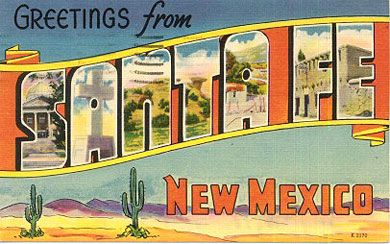
Barbara had fond memories of times in Santa Fe and Taos, and was eager to share these enchanting cities with Brian.
Established in 1610, Santa Fe, New Mexico is the third oldest city founded by European colonists in the United States (can you name the second?). Spanish explorers built the city upon the ruins of an abandoned Tanoan Indian village. The San Miguel Chapel, constructed around 1610, is the oldest church in the continental United States, and the Palace of the Governors, built between 1610 and 1612, is the oldest government building in the country. The Pecos and Santa Fe trails turned the city into a weigh-station to re-supply travelers, and was a major stop for cattle drives. The completion of the Atchison, Topeka and Santa Fe Railroad caused a rapid increase in jobs and therefore population. As we saw in its uniquely quaint downtown area Santa Fe has never lost its roots – the blending of cultures and traditions of Native Americans, Spanish explorers, and settlers from the east.


When the Loretto Chapel was completed in 1878, there was no way to access the choir loft twenty-two feet above. Carpenters were called in to address the problem, but they all concluded access to the loft would have to be via ladder as a staircase would interfere with the interior space of the small Chapel.


Three mysteries surround the spiral staircase in the Loretto Chapel: the identity of its builder, the type of wood used, and the physics of its construction.
Legend says that to find a solution to the seating problem, the Sisters of the Chapel made a novena to St. Joseph, the patron saint of carpenters. On the ninth and final day of prayer, a man appeared at the Chapel with a donkey and a toolbox looking for work. Months later, the elegant circular staircase was completed, and the carpenter disappeared without pay or thanks. After searching for the man (an ad even ran in the local newspaper) and finding no trace of him, some concluded that he was St. Joseph himself, having come in answer to the sisters’ prayers. And here’s the kicker…the staircase has two 360 degree turns and no visible means of support.


Walking around historic downtown Santa Fe looking for the San Miguel Chapel, we found some incredible sculptures on the grounds of the State House.


Tucked away on a small side street we found the San Miguel Chapel.


Following her formal art education at the School of the Art Institute of Chicago, and a brief period of time teaching school in North Carolina and Texas “The Mother of American Modernism,” Georgia O’Keeffe, made Santa Fe her home. Surrounded by pinon and apricot trees, the Georgia O’Keeffe Museum offers the visitor a wonderful exhibit of her development as an artist. Barbara’s been a huge fan for a long time, and we had framed poster art of O’Keeffe’s work in our Bethlehem home.


75 miles south of Santa Fe Route 66 ambles its way past Tijeras, New Mexico (population 541). Why bother finding Tijeras you ask? Well – on a quarter-mile section of the highway, the rumble strips have been engineered to create the song “America the Beautiful.” The “Musical Highway” was installed in 2014 as part of a partnership between the New Mexico Department of Transportation and the National Geographic Channel, and was designed to encourage drivers on the otherwise unremarkable stretch of the historic road to slow down and adhere to the speed limit. We had to keep our speed to exactly 45 miles per hour to hear the vibrations. Despite turning around and going over the rumble strips 3 times we could only make out “from sea to shining sea.”


On our way to the “Musical Highway” and 10 miles south of Santa Fe we chanced upon the Turquoise Trail Sculpture Garden and Studio in Cerrillos, New Mexico. Their permanent exhibit is “Origami in the Garden” or OiG. Origami is the Japanese word for folding paper, and OiG is an outdoor sculpture exhibition created by American artists Jennifer and Kevin Box that captures the delicate nature of this paper art form in museum quality metals. The exhibition features Box’s own compositions as well as collaborations with world-renowned origami artists Te Jui Fu, Beth Johnson, Michael G. LaFosse and Robert J. Lang. We found ourselves mesmerized by the sculptures, and we highly recommend a visit to anyone in the area.


Taos is 70 miles northeast of Santa Fe. Along the way, Barbara wanted to stop in Chimayo, an artists’ community in the hills. She fondly remembered a dinner trip years ago, at which she first had sopapillas. She wanted to show Brian the community, and wanted him to have the chance to try the famous chimayo chili. The chili grows only, well, in Chimayo, and is known for its sweet smoky flavor and lingering burn. Much has changed in the 40 years since she had last been in the area; the town has lost most of its attraction, and no chili’s were to be found. However, before descending into Taos we were able to have a magnificent view of the surrounding valley from the top of the pass.


We hit Taos just about lunchtime.

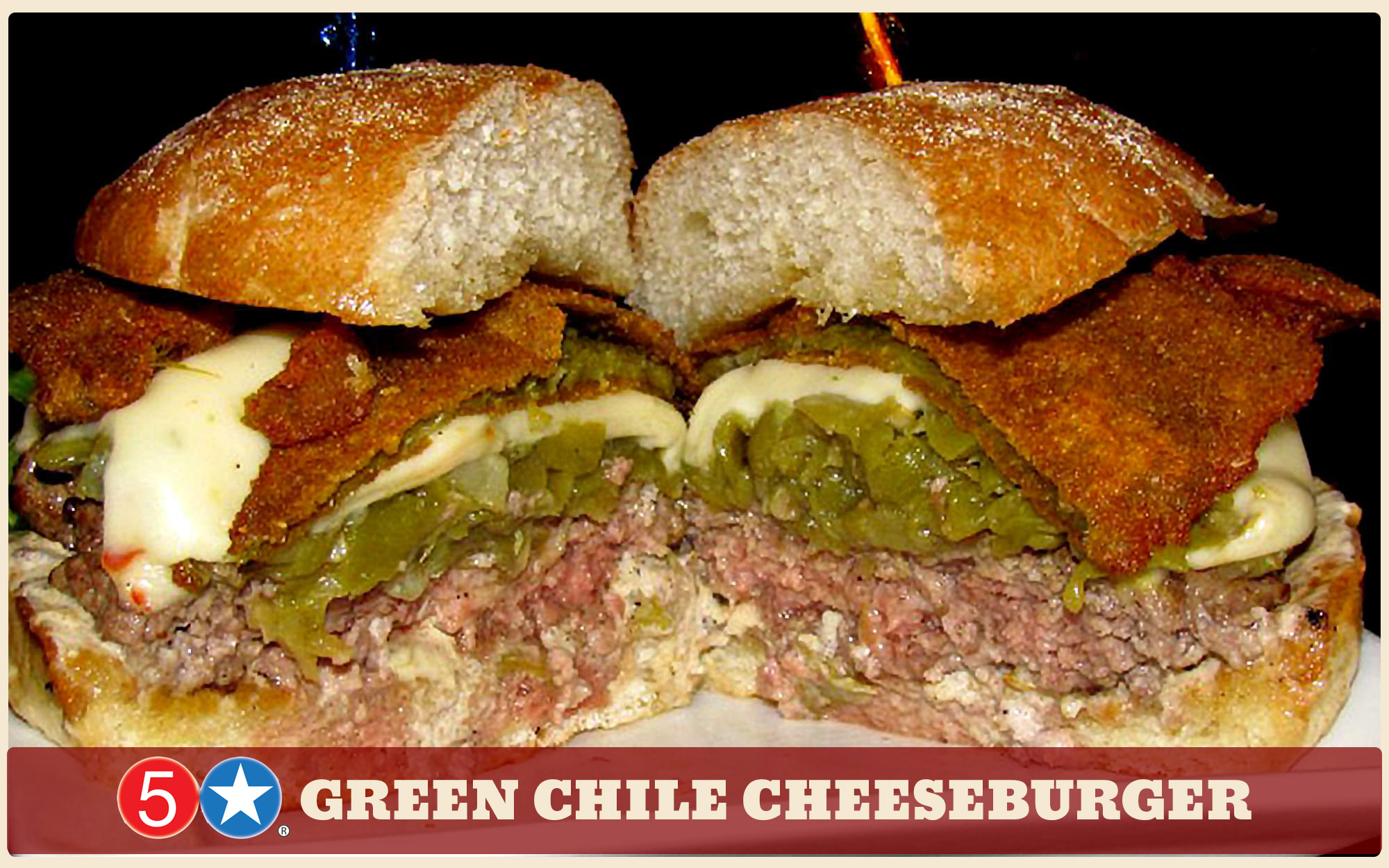
Entering Taos our first order of business was to feed our hunger with a green chili cheeseburger. The green chili cheeseburger is stuff of legend, and being rated as one of the best is a high culinary honor – really! A great burger starts with meat that has enough fat to stay artery-clogging juicy, a cook that knows a charred sear, a single flip, and not “stepping on” the meat while cooking; add a slice or two of American or pepper jack cheese. But the trick to the dish is the addition of roasted and diced Hatch green chilis as the major topping. Pile on onion, tomato, lettuce, and/or pickle if you wish…maybe a little yellow mustard if you must.
We had our first green chili cheese burger at 5 Star Burgers…delicious.
Taos is a true artists’ community, and the downtown is quite quaint. We didn’t know that Kit Carson was from Taos, and we took some time for a walk through the family’s beautiful garden…

…and discovered an insect like none we had ever seen. Turns out to be a hummingbird hawk moth.


1 mile north of downtown is Taos Pueblo.


Taos Pueblo is the only living Native American community designated both a World Heritage Site by UNESCO and a National Historic Landmark. The Taos Indians have lived in these multi-story adobe buildings continuously for over a 1,000 years. The main part of the present buildings were most likely constructed between 1000 and 1450 A.D, and appeared much as they do today when the first Spanish explorers arrived in Northern New Mexico in 1540 (and believed that the Pueblo was one of the fabled golden cities of Cibola).
The Pueblo is made entirely of adobe — earth mixed with water and straw, then either poured into forms or made into sun-dried bricks. The walls are frequently several feet thick. The roofs of each of the five stories are supported by vigas — large timbers hauled down from the mountain forests. Smaller pieces of wood — pine or aspen latillas — are placed side-by-side on top of the vigas; the whole roof is covered with packed dirt. The outside surfaces of the Pueblo are continuously maintained by re-plastering with thin layers of mud. Interior walls are carefully coated with thin washes of white earth to keep them clean and bright.
A young adult Taos Indian proudly served as tour guide, discussing how the community maintains its heritage and traditions and continues its investment in the pueblo itself. Following the tour we were free to explore the grounds, enjoy food made by the community, and shop. Barbara found a beautiful necklace that met her favor.


On the way back to our campground in Santa Fe we turned off of the highway to traverse the Rio Grande del Norte National Monument..

The Río Grande del Norte National Monument is comprised of rugged, wide open plains at an average elevation of 7,000 feet, dotted by volcanic cones, and cut by steep canyons with rivers tucked away in their depths. The Rio Grande carves an 800-foot deep gorge through layers of volcanic basalt flows and ash. Among the volcanic cones in the Monument, Ute Mountain is the highest, reaching to 10,093 feet. This area has attracted human activity since prehistoric times.


…and to cross the gorge…


While exploring the site we came across a plant never before ever seen by these 4 eyes…

Route 66 is turning out to have more experiences than we had originally thought, and oh, the sites we have seen. But there’s more to come from our journey across New Mexico and into Arizona.
Barbara and Brian

 Aimless Wanderings
Don’t forget the song “Willin” by Little Feat and its mention of Tucomcari .❤️
LikeLiked by 1 person
Holy cow! This post covered SO MUCH STUFF! I don’t know how to respond to it all. I’m all in on museums (O’Keefe!), street art, statues … ALIENS! Love all the pictures, as always – and the stories that wind between them.
LikeLiked by 1 person
Barbara sez…”come to the west! It’s hard to imagine that the west is as cool as it is, but it is”…does that make any sense?
LikeLiked by 1 person