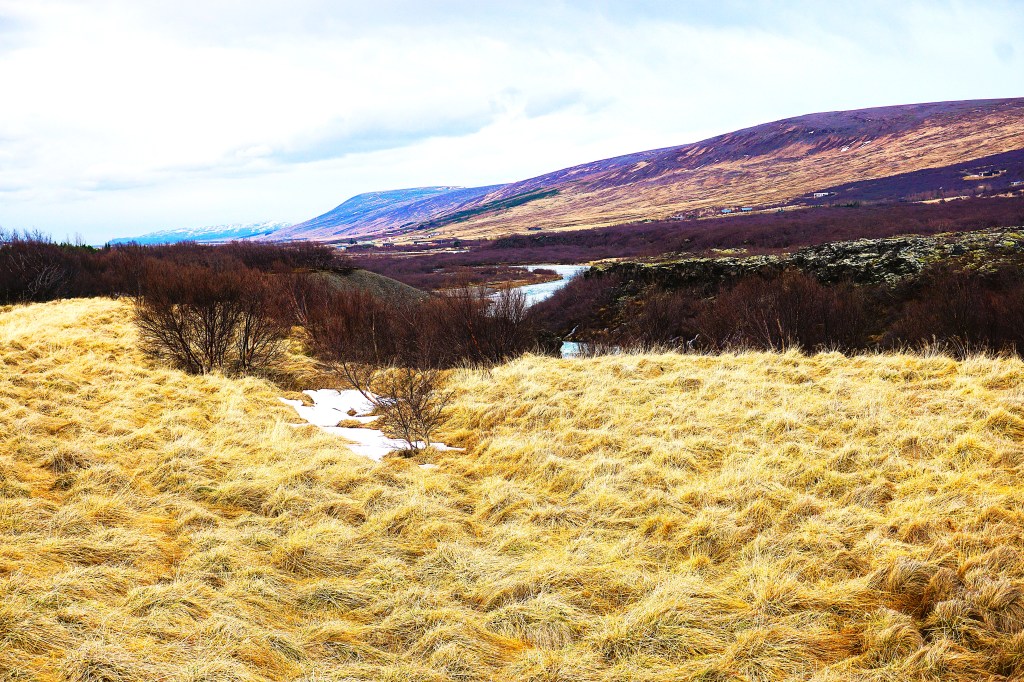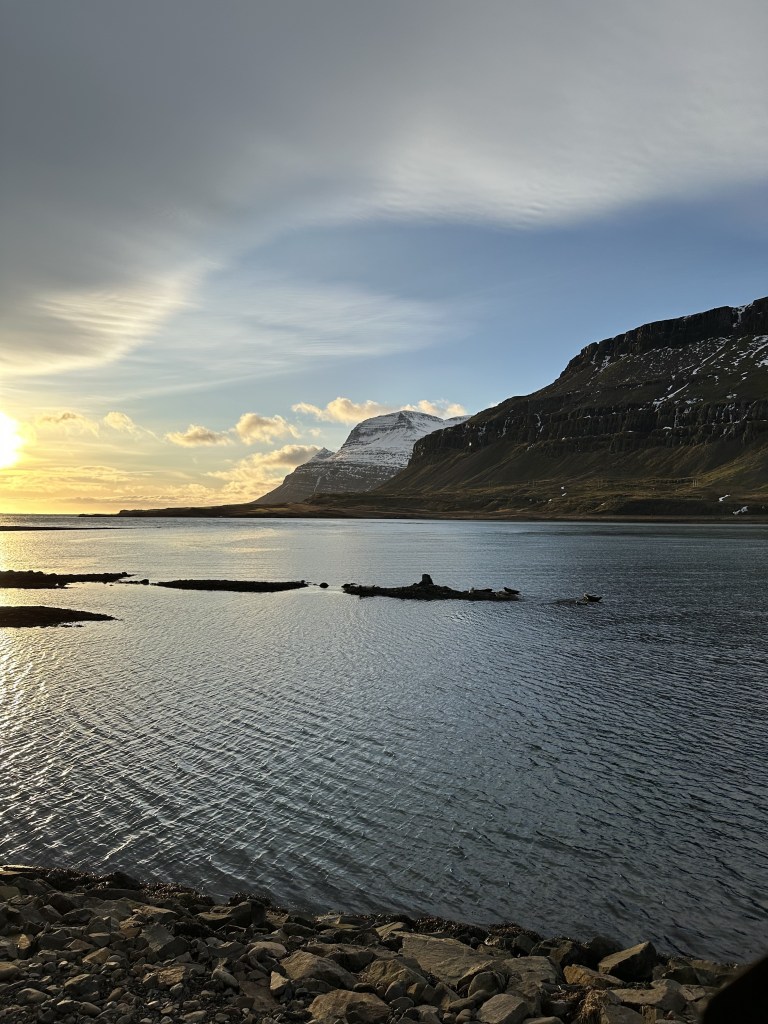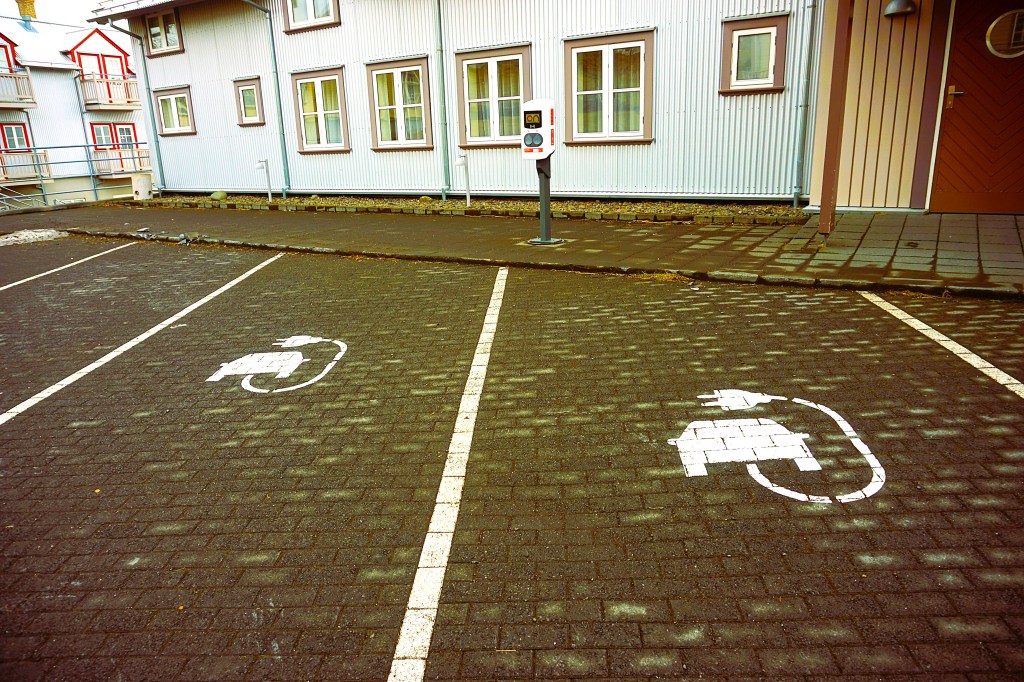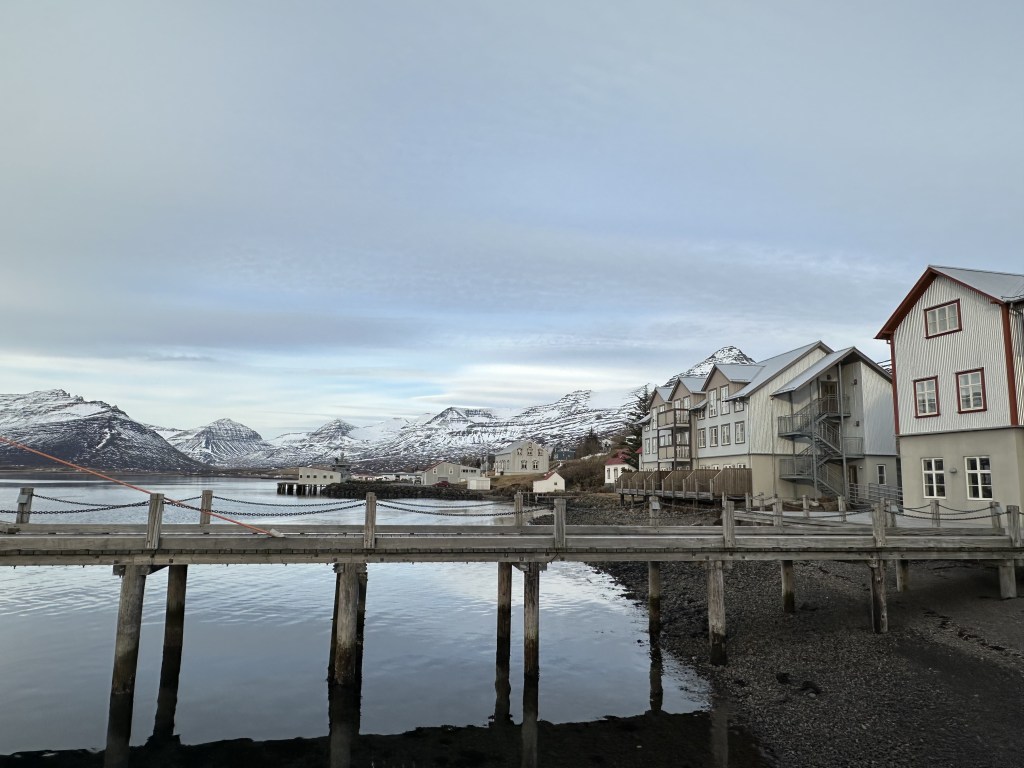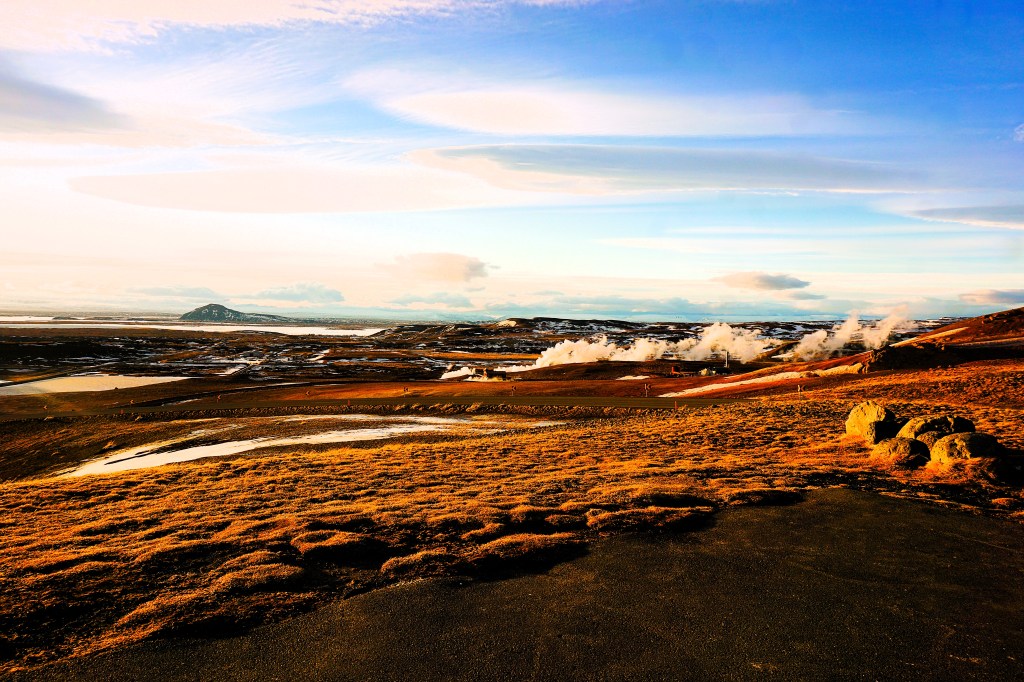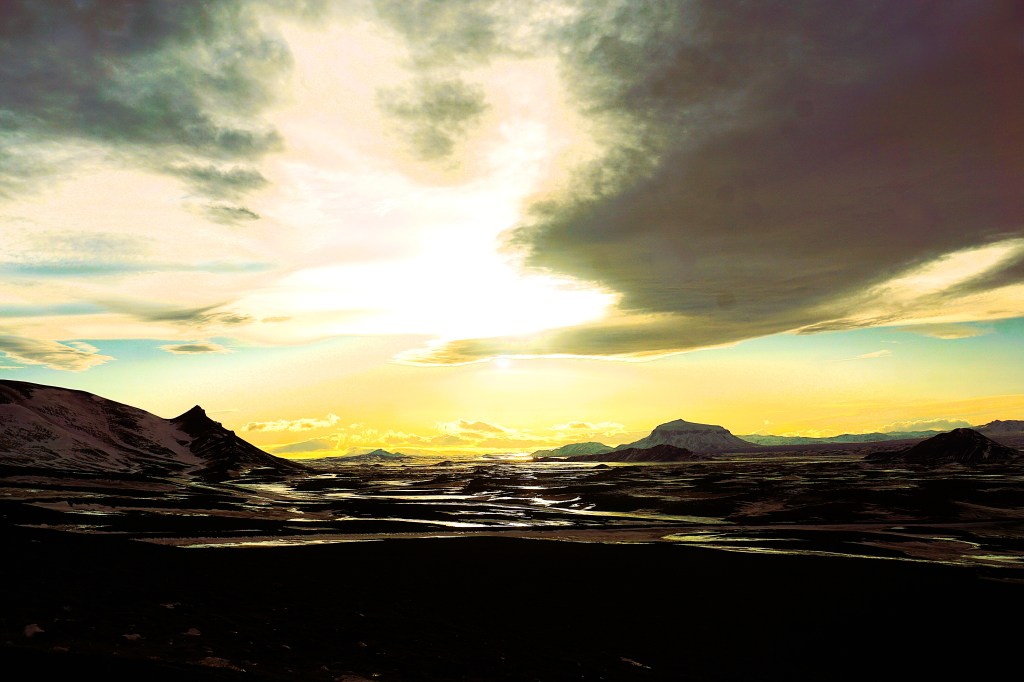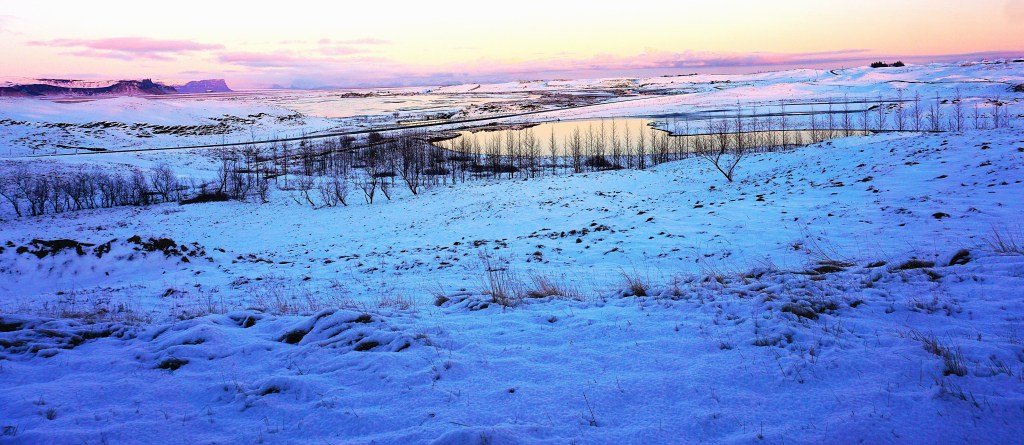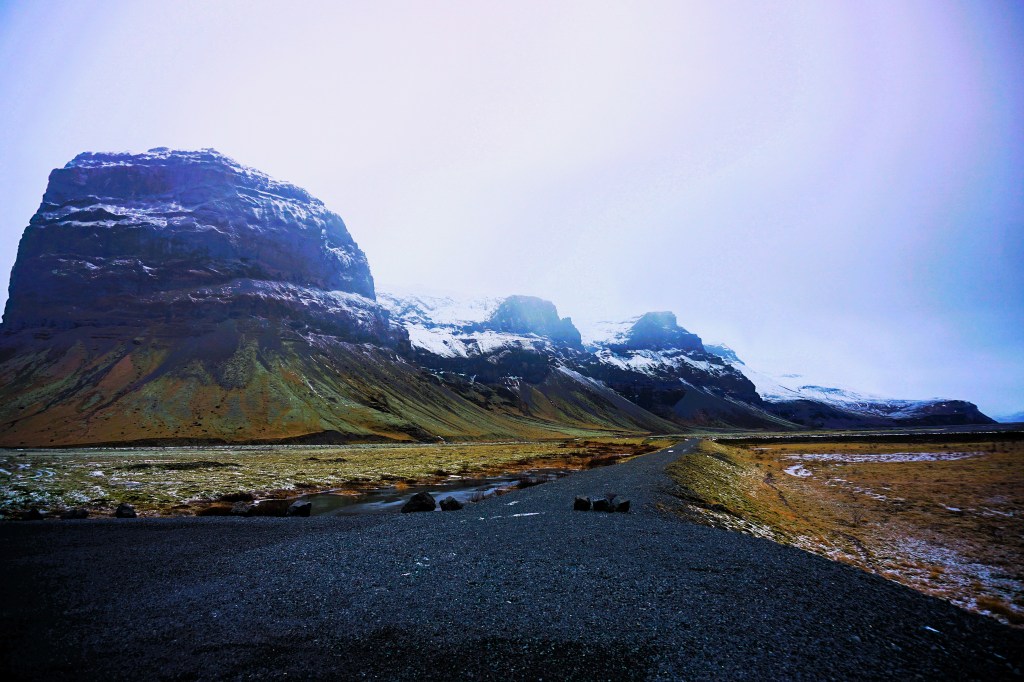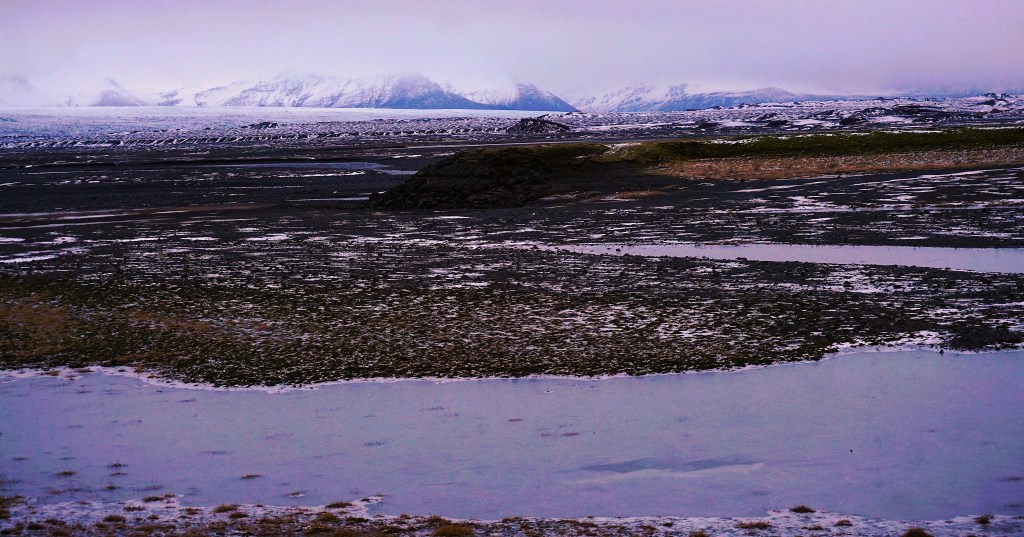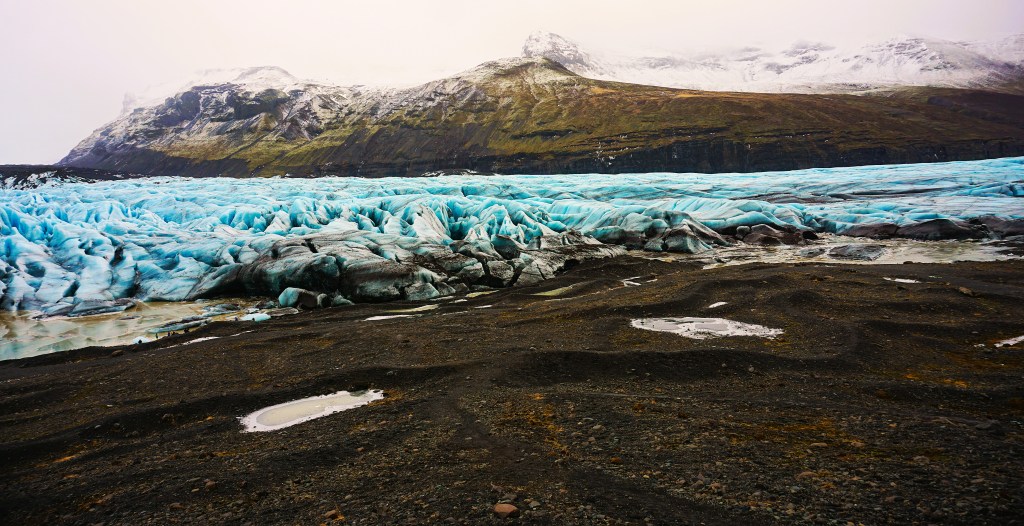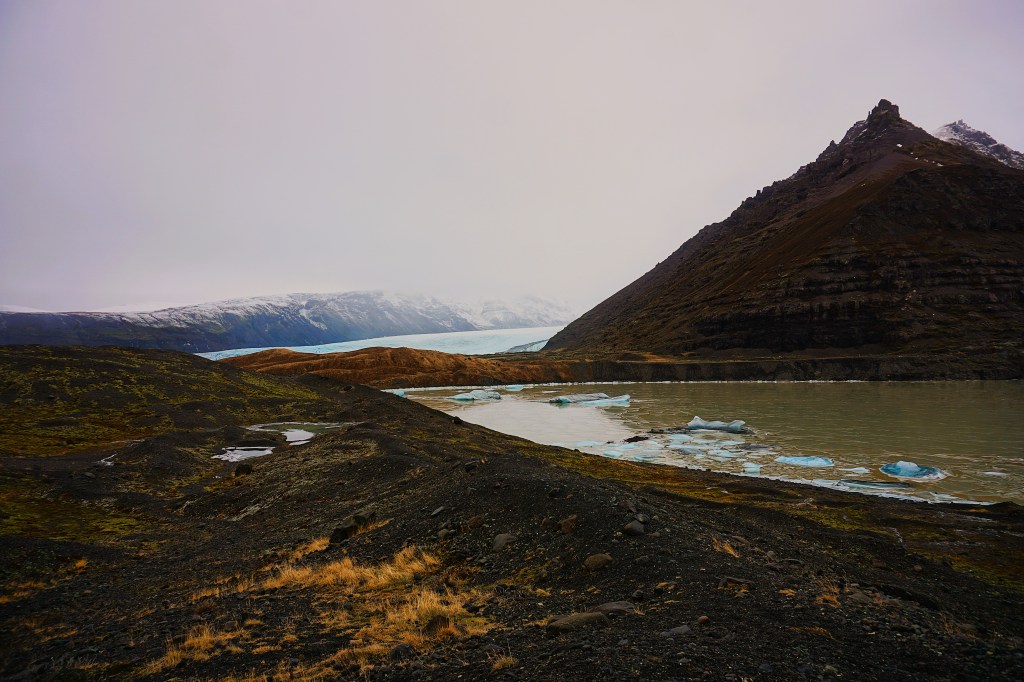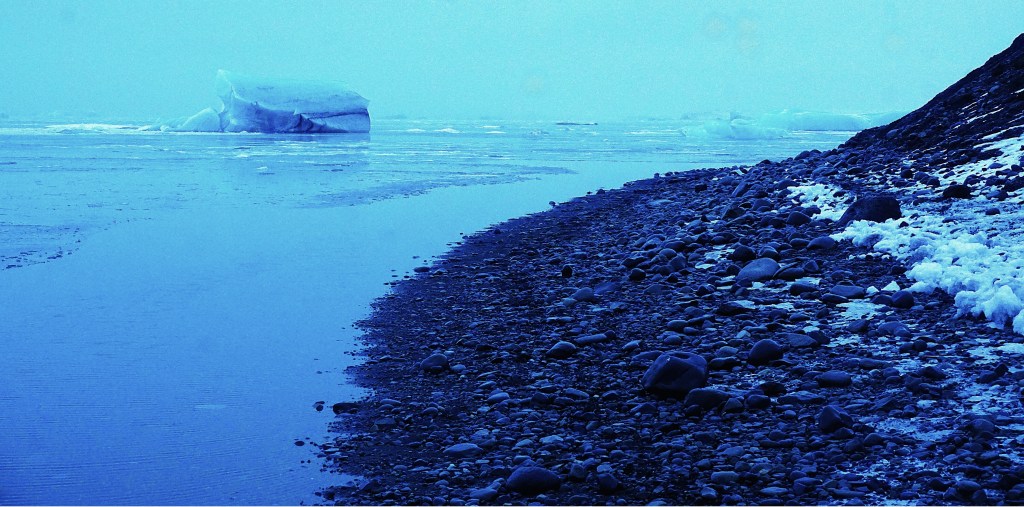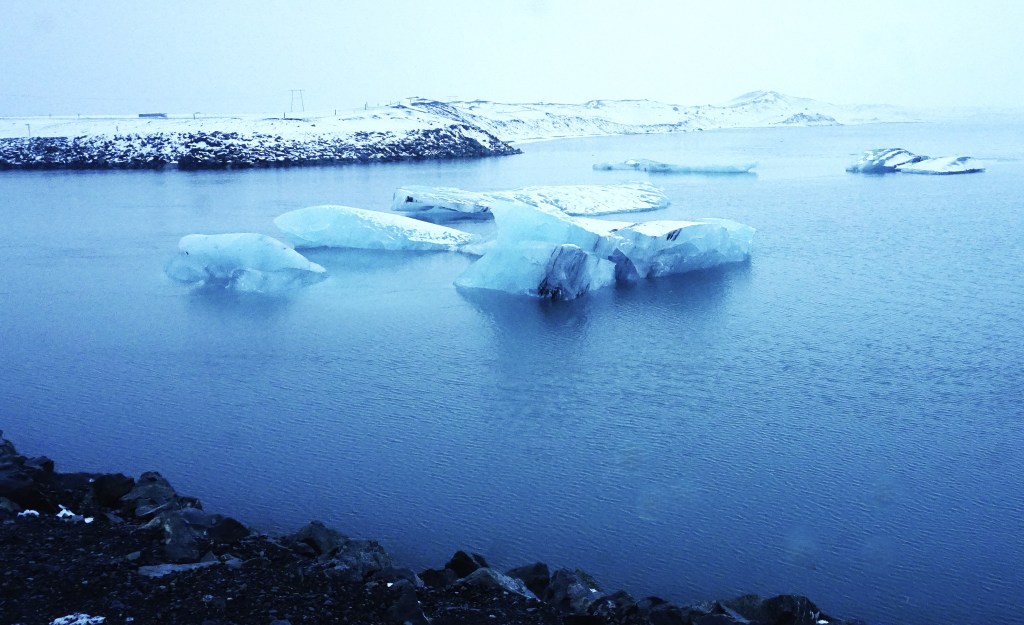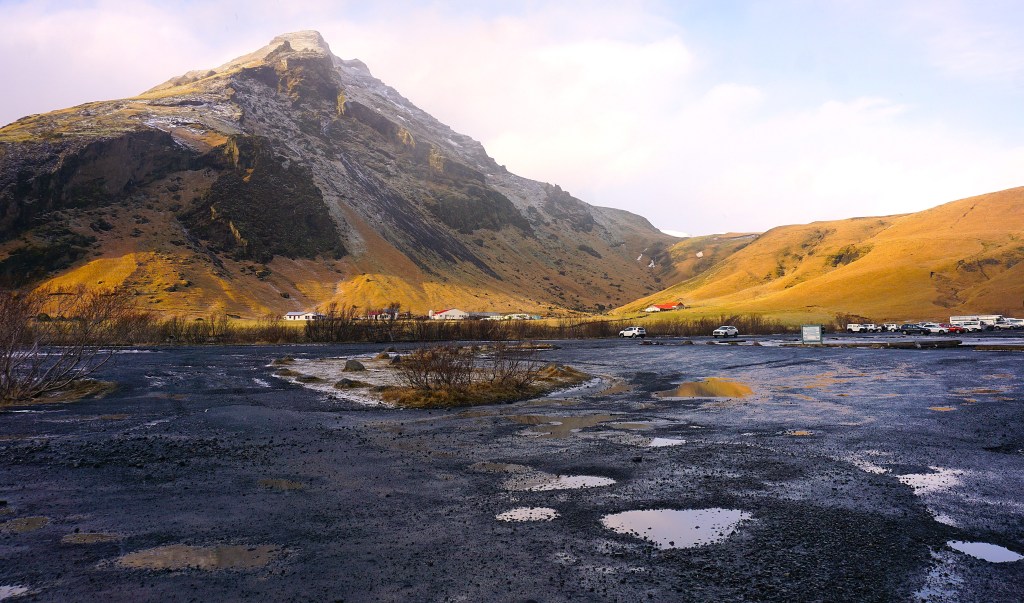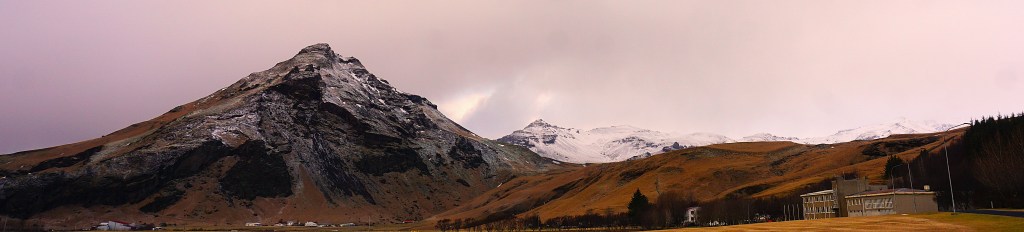
REYKJAVIK

February, 2025

Reykjavik, in the southwestern region of the country, is the capital of Iceland, and the northernmost capital city in the world. The city and surrounding suburbs are home to more than two-thirds of the country’s 389,444 citizen’s; most of the remaining population resides along the Ring Road. Reykjavík is believed to be the location of the first permanent settlement in Iceland, which was established in 874 CE. The city was officially founded in 1786 as a trading town and grew steadily over the following decades, as it transformed into a regional and later national center of commerce, population, and governmental activities. Long a protectorate of Denmark, and while Iceland’s constitution was ratified in 1874, the country didn’t gain its independence as a sovereign state until 1918.

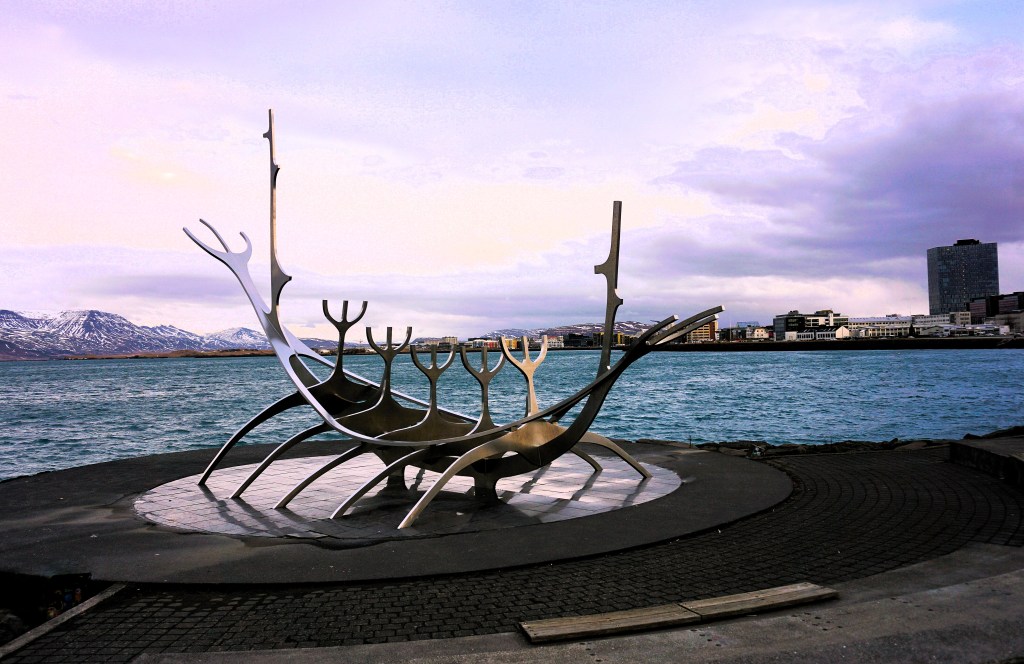
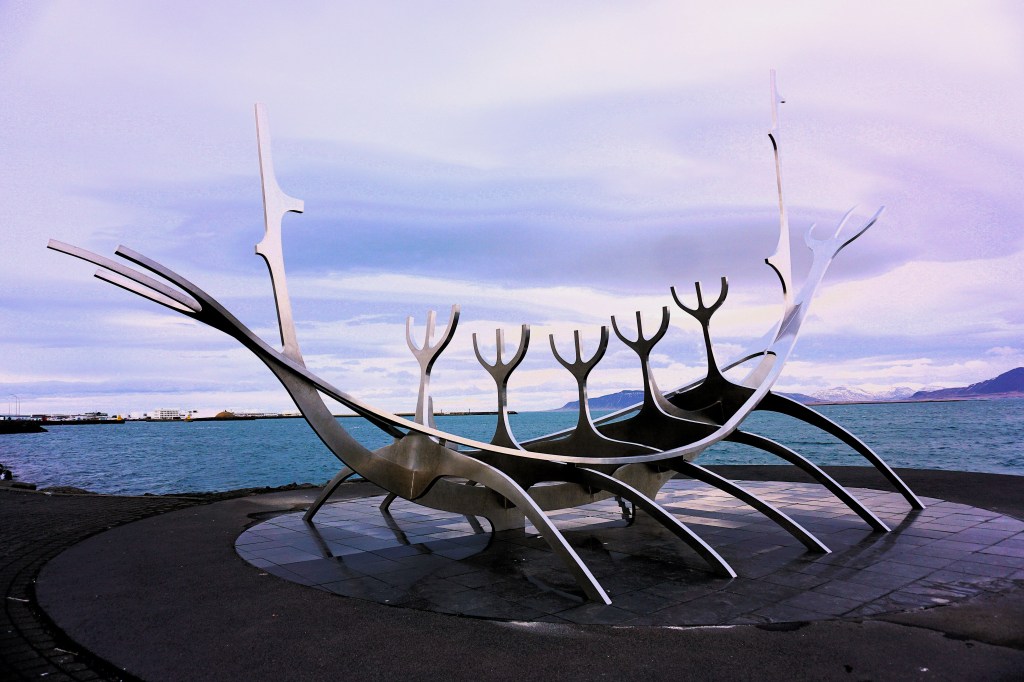
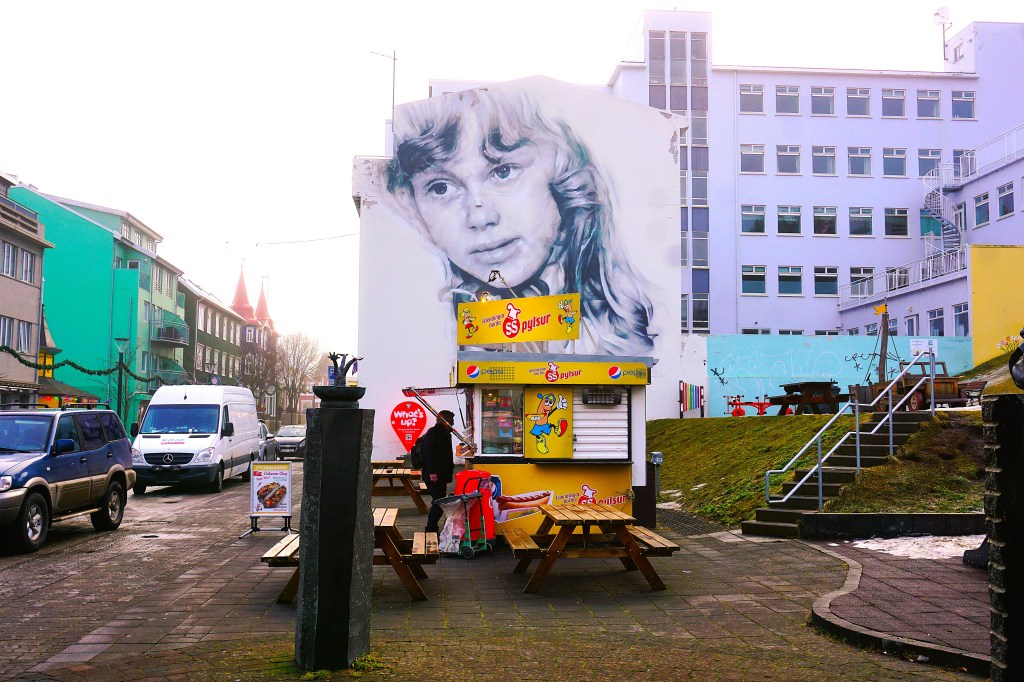
Metropolitan by design with the charming feel of a small-town, Reykjavik has something for everyone. Check out Atlas Obscura and you’ll be directed to, amongst others, the Icelandic Phallological Museum, the Elf School, Iceland Punk Museum, monument to the unknown bureaucrat, and the baejarins beztu pylsur stand serving Icelanders’ preferred snack, lamb hot dogs. Not to be missed are the Sun Voyager sculpture, Harpa Concert Hall, Hallgrimskirkja Lutheran Church and its Cathedral Bells, the Einar Jónsson sculpture garden, Rainbow Street, and if you take a look around, the street art is abundant. For the more adventuresome eaters, head to Cafe Loki where you can try what some call the national food of Iceland, Hakarl or fermented shark. If you want to keep to simpler tastes, enjoy lamb, cod, artic char, hearty rye bread, some of the best pastries you’ll find most anywhere and licorice flavored ice cream. For your sweet tooth head to a local market and indulge yourself with a variety of licorice products – the Icelanders love their licorice!
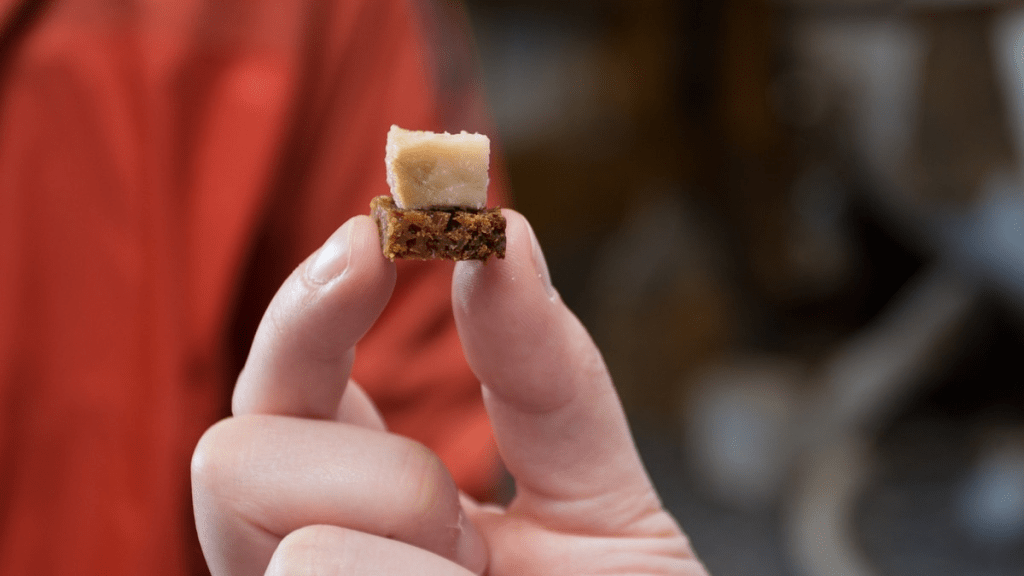
Hakarl…Best Enjoyed (?) With A Bracing Shot Of Your Favorite Hard Liquor

By the way I asked Icelander’s time and again whether or not they enjoyed fermented shark. There’s a resounding: “never tried it-never will!” or “it’s an old person’s tradition” or just a “to what are you referring?” What’s anti-yum?

After Boga dropped us off at our hotel and we had the chance to make our good-byes, we set out on foot, on a very windy day (did I mention the wind never stops in Iceland? It’s just a matter of how strong it is at any given moment) to walk a significant portion of the harbor shoreline.

Fisherman Monument – Commemorates Drowned and Missing Fishermen
Ancient Icelandic Crest Tied To An Anchor
Statue Of A Musician Outside of Harpa Performing Arts Center
Harpa Performing Arts Center – Opened 2011
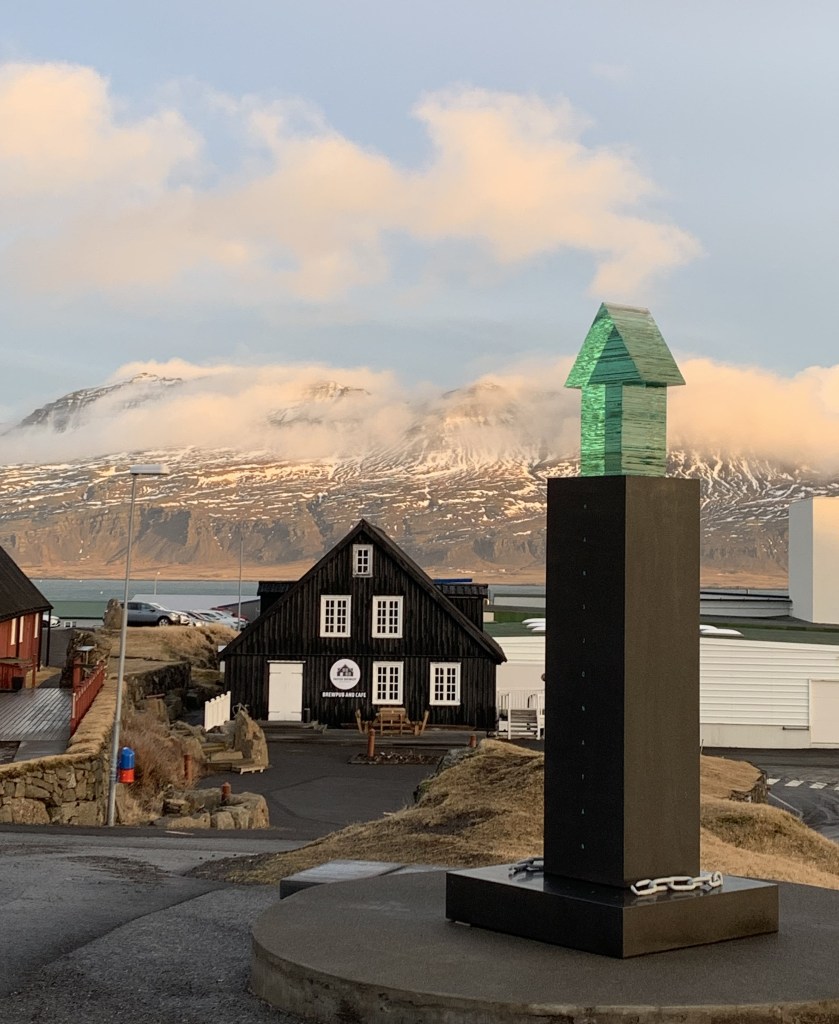
So0lfar: The Sun Voyager Commemorating Reykjavik’s Bicentennial

The next morning we had time to roam downtown Reykjavik before our – “Funky History Walking Tour in Reykjavik – With Local Storyteller” Lalli began. Check out the sites…
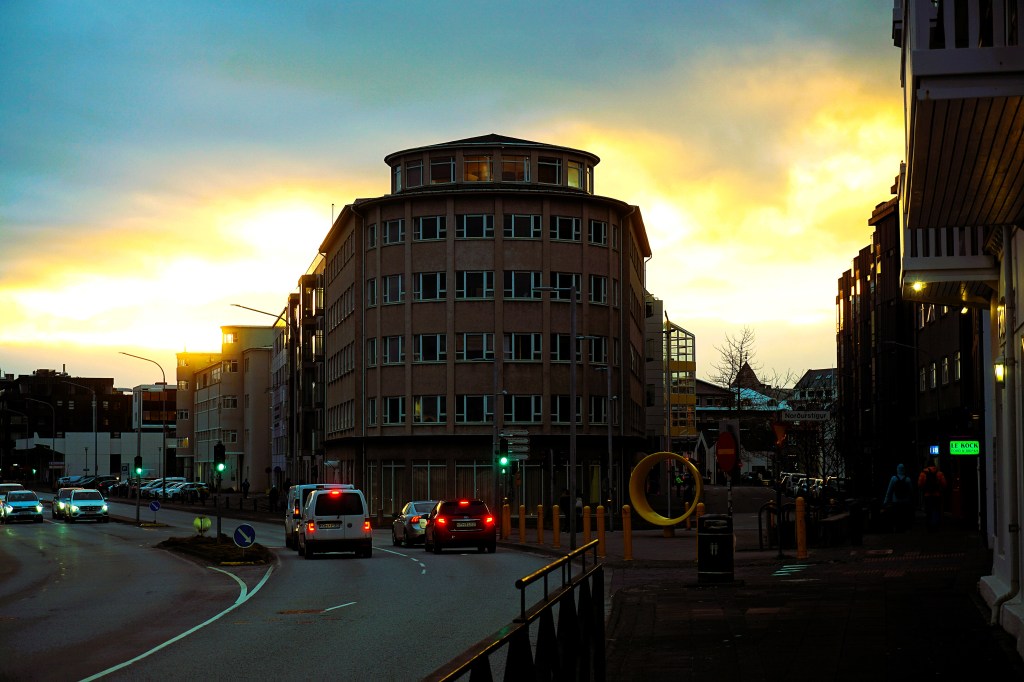
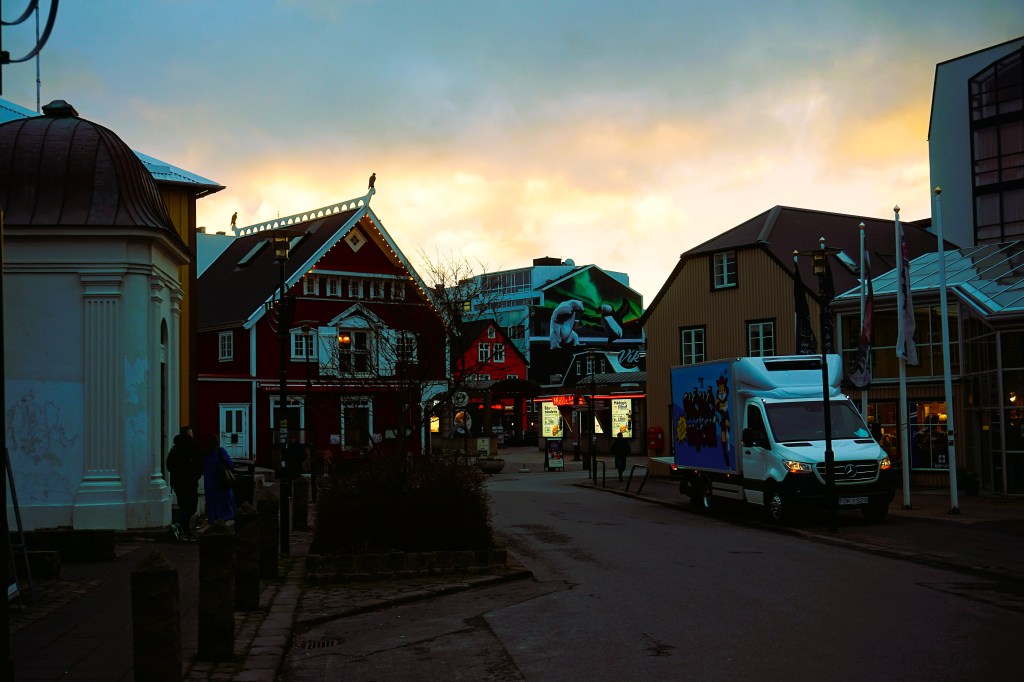
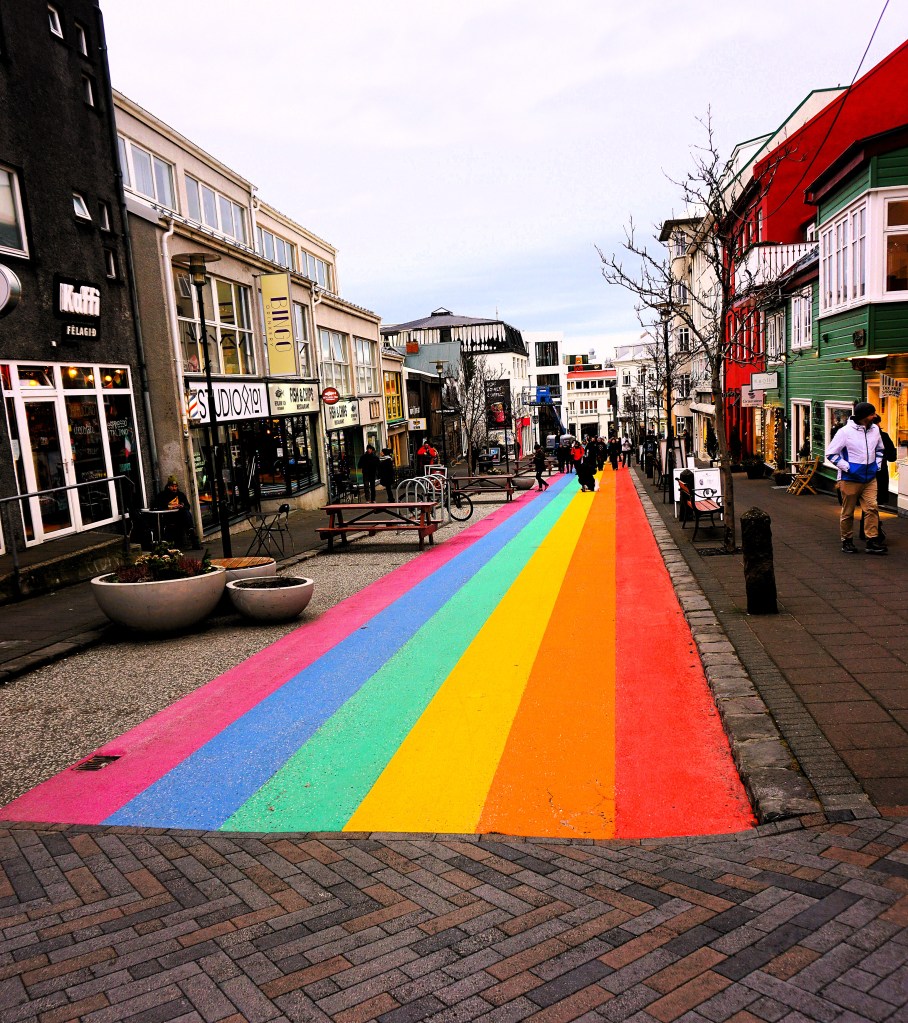
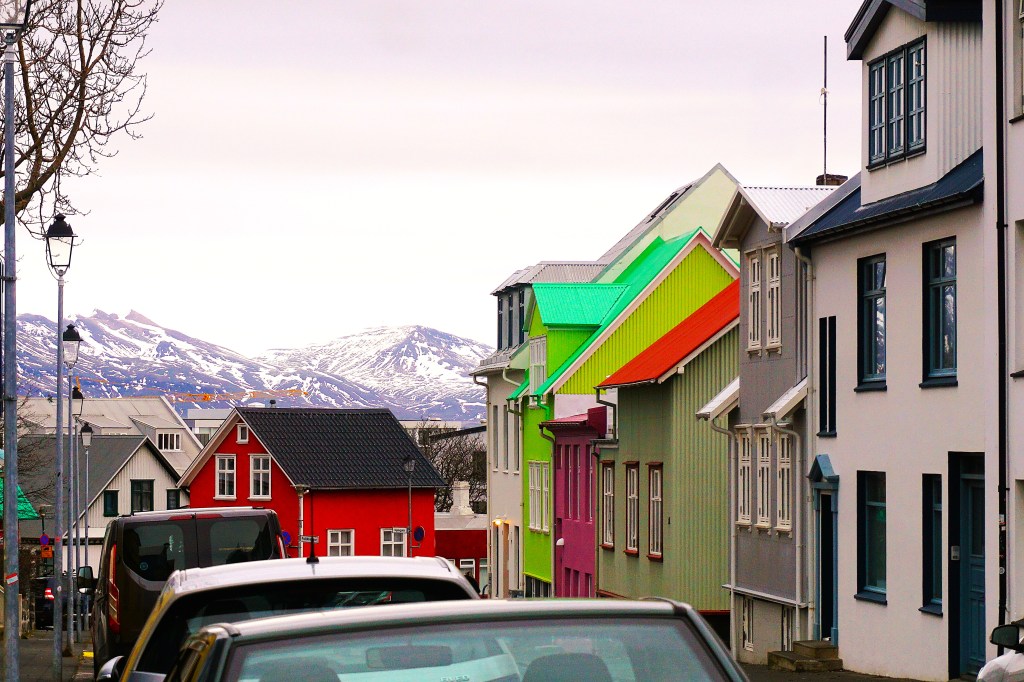
The Rainbow Street is a vibrant and colorful street located in the heart of Reykjavik. The street runs from the famous Hallgrímskirkja Church down to the main shopping street, Laugavegur. The Rainbow Street is also a cultural hub of the city, and home to several annual festivals and events, such as the Reykjavik Pride Parade, which celebrates LGBTQ+ rights and diversity.
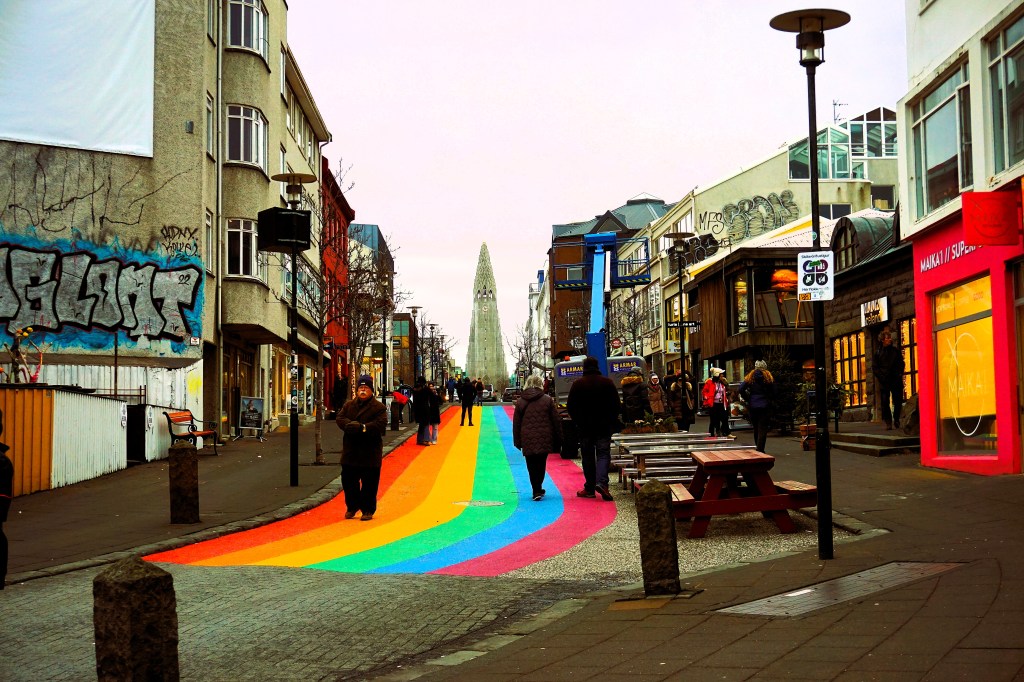
The Rainbow Street
Love The Colorful Houses

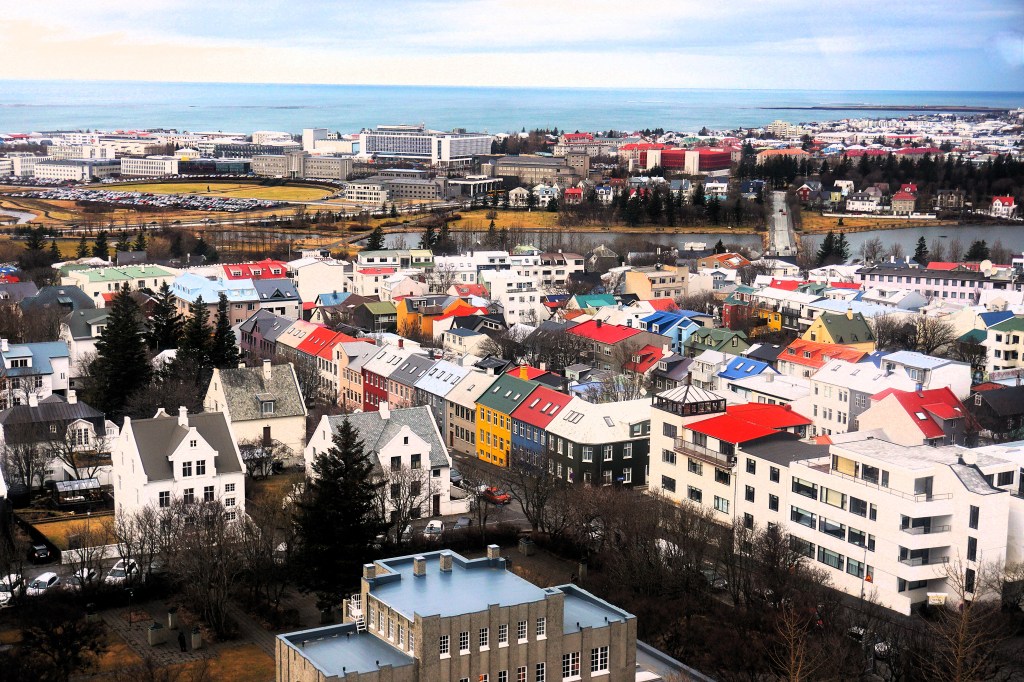
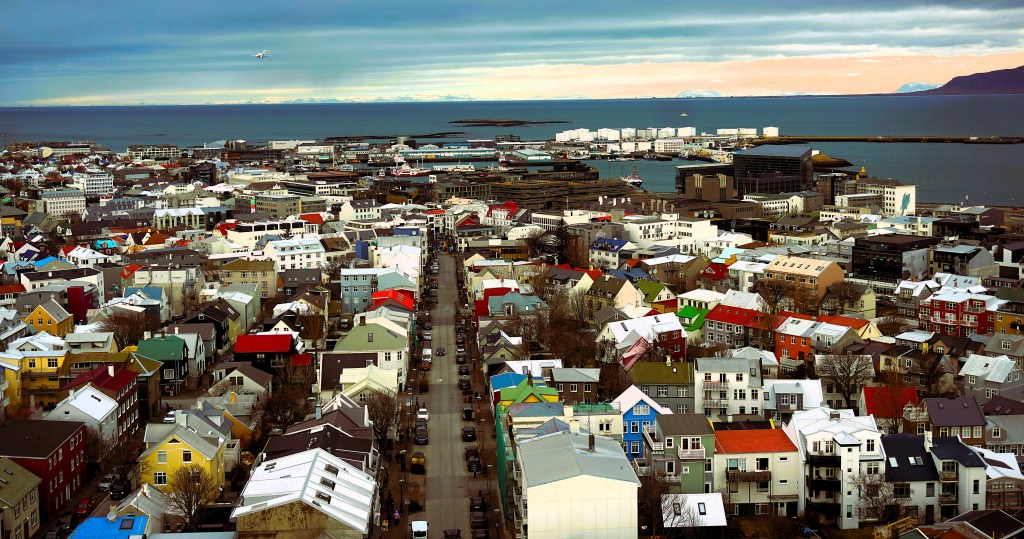
Situated on the hilltop Skólavörðuholt near the center of Reykjavík, Hallgrímskirkja Church is one of the city’s best-known landmarks and is visible throughout the city. It is a Protestant Lutheran Church of Iceland parish church commissioned in 1945 and completed 41 years later in1986. At 244 feet tall, it is the largest church in Iceland and among the tallest structures in the country. Architecturally, Hallgrímskirkja Church consists of four parts: the tower with its carillon bells which ring every 15 minutes; the distinctly curved side wings which house service facilities; a nave in more traditional architecture, and a sanctuary at the other end of the nave, whose cylindrical shape has been described as evoking Viking war helmets.

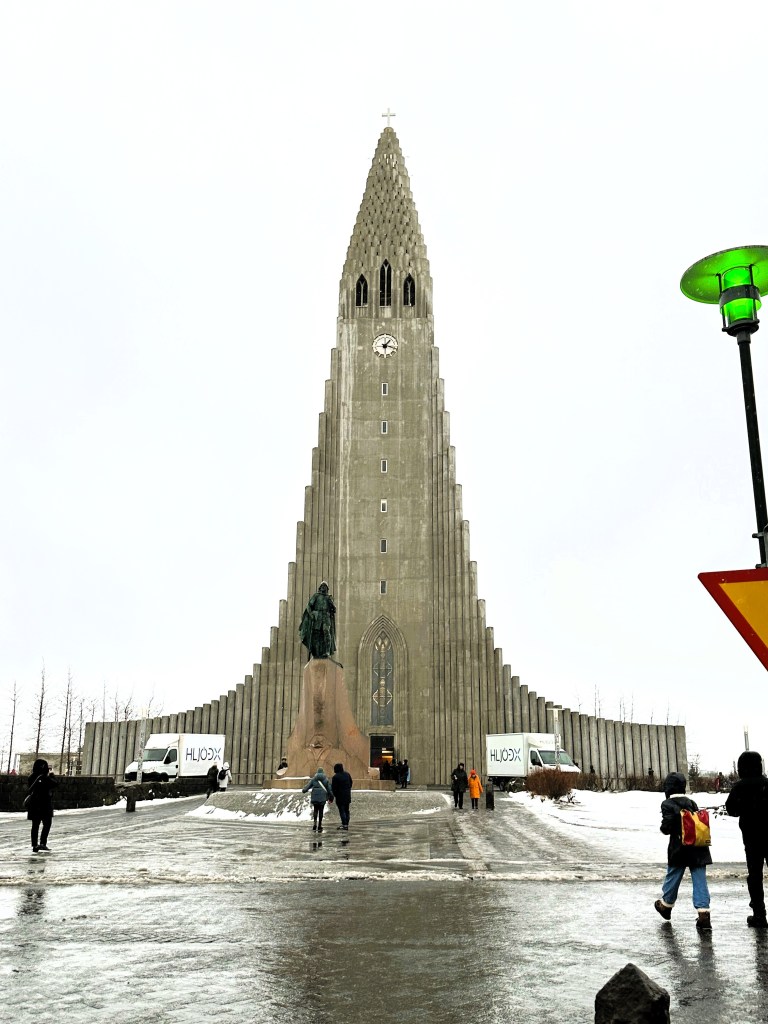
Hallgrímskirkja Church
View of Reykjavik From The Bell Tower
Russian Inspired Architecture

Our Funky History Walking Tour was fabulous, and one of those activities we can highly recommend – not to be missed when in the neighborhood. Our tour guide, Lalli, who founded the company with his best friend, is also a head nurse at the city hospital. Nursing pays the bills; the tour company is a labor of love.

A native Icelander, born, bred, raised and educated in Iceland’s history and sagas Lalli is proud to be Icelandic, but not so foolish as to not realistically portray the good and the bad about the country. During our two-hour tour walking about Reykjavik’s “old town” neighborhoods we learned of the country’s founding, the heinous Viking Eric the Red and his beloved son, Leif Eiriksson, the founding of a true functioning democratic Parliament and the impactful protests of the citizens, and the conversion (sorta, kinda) to Christianity. We visited a most powerful sculpture garden and were treated to a pylsur.
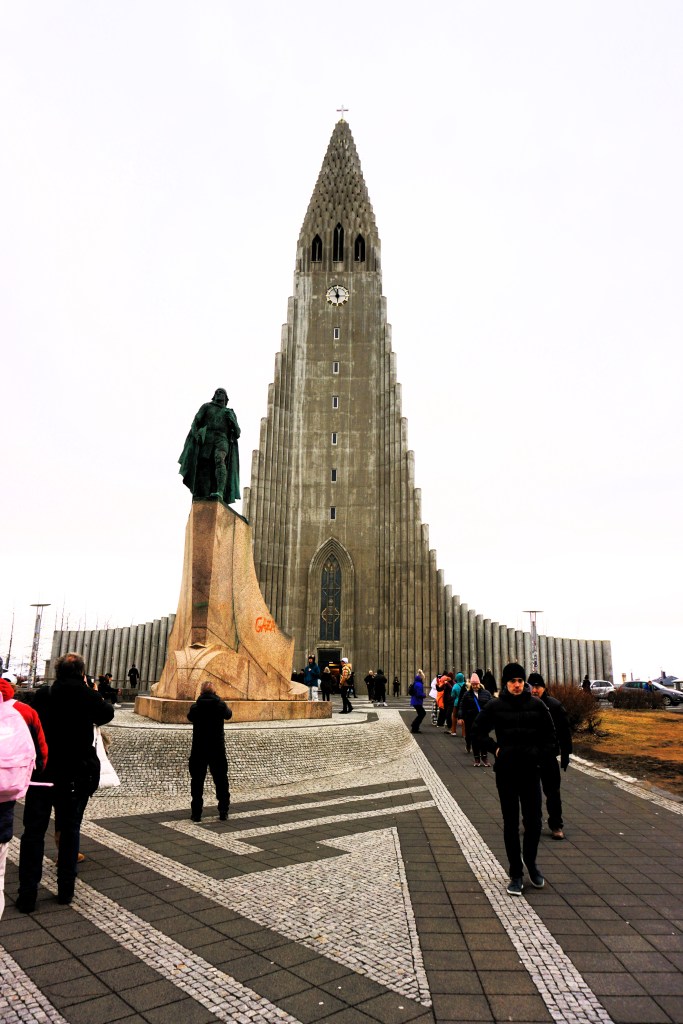
Calder Monument To Leif Eiriksson In Front Of The Hallgrímskirkja Church.
Given To Iceland By The United States In Honor Of The 1,000 Anniversary Of Iceland’s Parliament
Leif Eiriksson

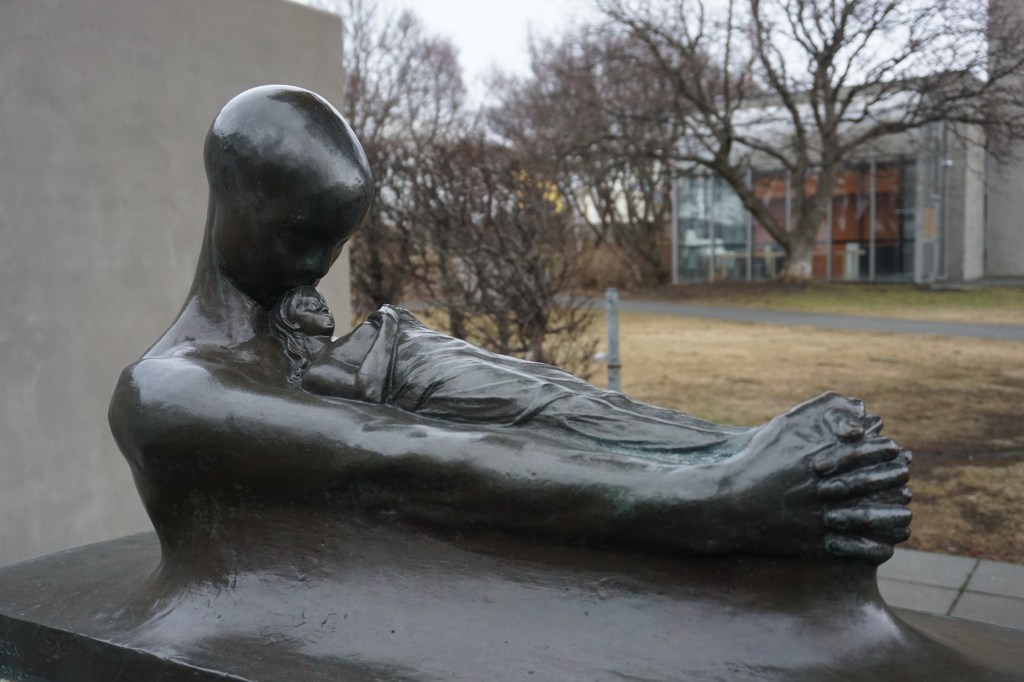
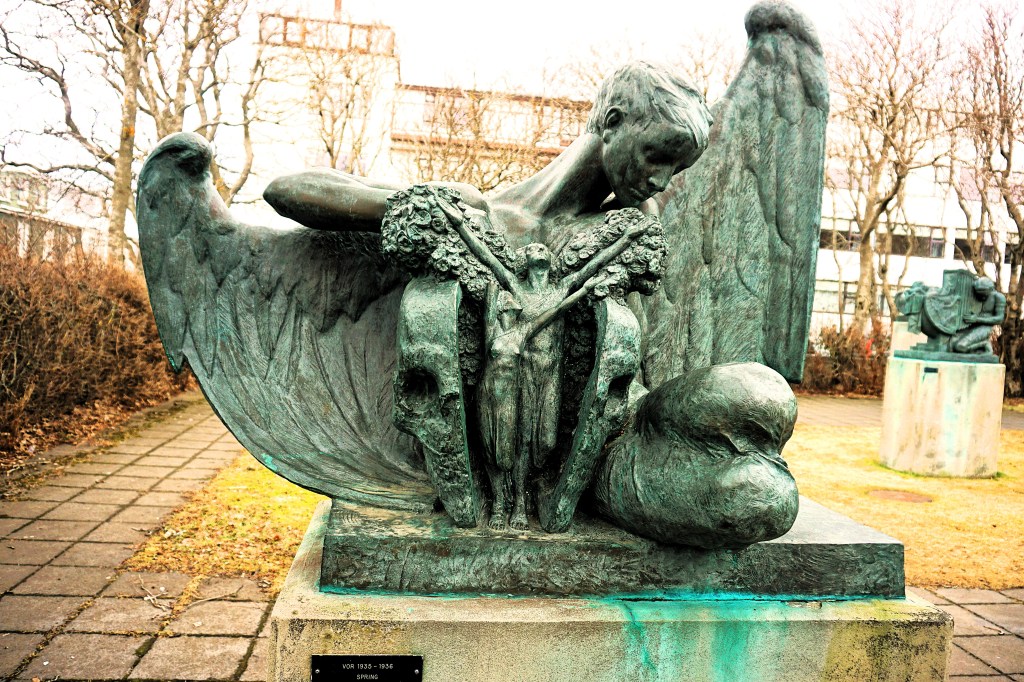
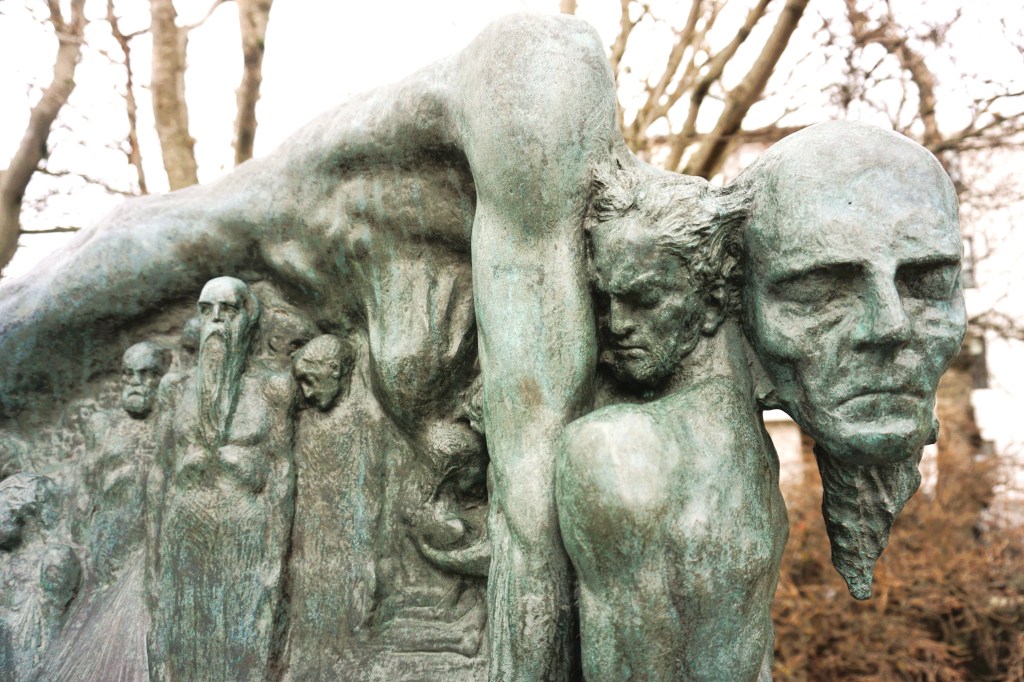
Highlighting the “Funky Walking Tour” was a far too brief stop at The Einar Jonsson Sculpture Garden. Einar Jonsson is considered Iceland´s first sculptor. He attended the Royal Danish Academy of Fine Arts in Copenhagen from 1896 to 1899 and spent two years studying in Rome before striking out with his own vision of sculpting using Icelandic folklore, mystical and religious motifs. There are 26 bronze casts of Einar Josson’s work to view in the garden.

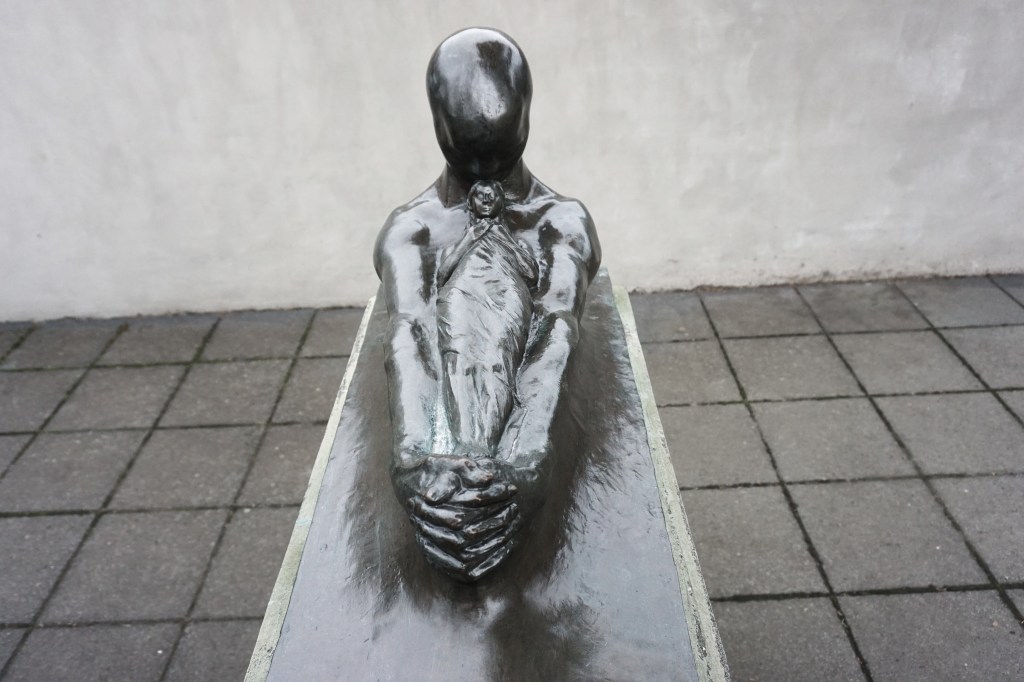
Icelandic governmental traditions of listening to the people date back to more than 1,000 years ago. We weren’t sure if this government of the people, for the people and pledged to listen to the people has been successful for so long because most Icelanders are related to most other Icelanders or for other reasons…but it works. Even when disagreement between the government and the people occurs, and the people prevail, the “state” is willing to commemorate the people’s will.

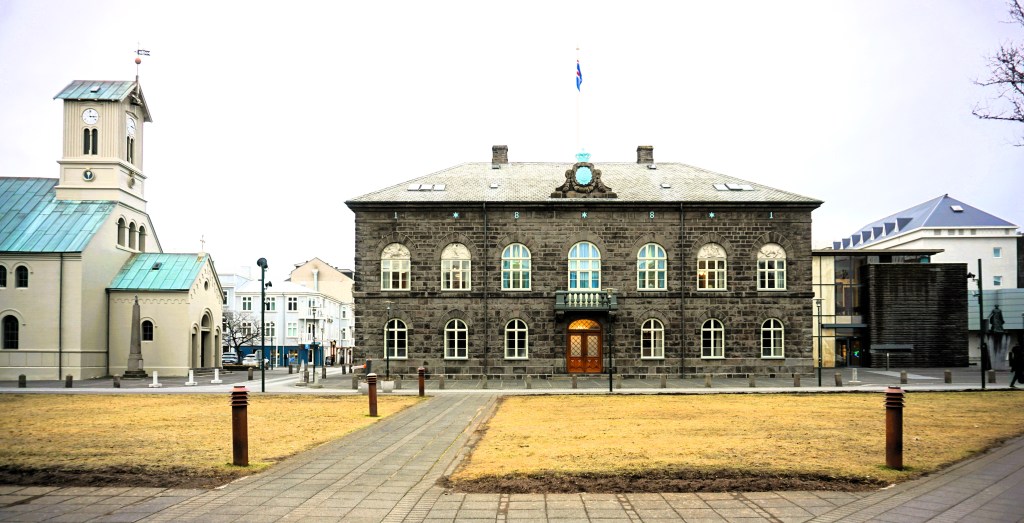
Parliament Building – Built Between 1880-1881

 A huge piece of rock sits in front of the parliament building with a black cone of a noticeable size calmly stuck atop it, cracking it in half. It bears a plaque that contains a quote from the Declaration of the Rights of Man and of the Citizen: “When the government violates the rights of the people, insurrection is for the people and for each portion of the people the most sacred of rights and the most indispensable of duties.” The sculpture commemorates protests that took place between 2009 and 2011 in the wake of the Icelandic financial crisis and the government’s poor handling of the situation. Considered the largest-scale protest in Icelandic history, thousands of people gathered before the parliament and demanded changes to the old system. And change came – over the following 10 years or so Iceland dug its way out of financial ruin as it committed itself to the tourism industry.

A pylsur is, quite simply, a hot dog. Made of lamb, but seasoned to taste like any other similar sausage it is not served with the usual toppings. No, no chili or coney sauce. No, no mustard, sauerkraut and caramelized onions. No, no poppy seed bun, yellow mustard, emerald green sweet pickle relish, chopped onion, pickle spear, tomato slices, sport peppers and celery salt. A pylsur is served on a hot dog bun with ketchup, non-vinegary mustard, raw chopped onion and crispy fried onions. Don’t pass up this snack…it’s delicious!

Reykjavik Pylsur Stand. The Fellow In The Red Jacket Is Our Tour Guide, Lalli.
…And, Yes That’s Barbara With A Chunk Of Pylsur In Her Cheek!

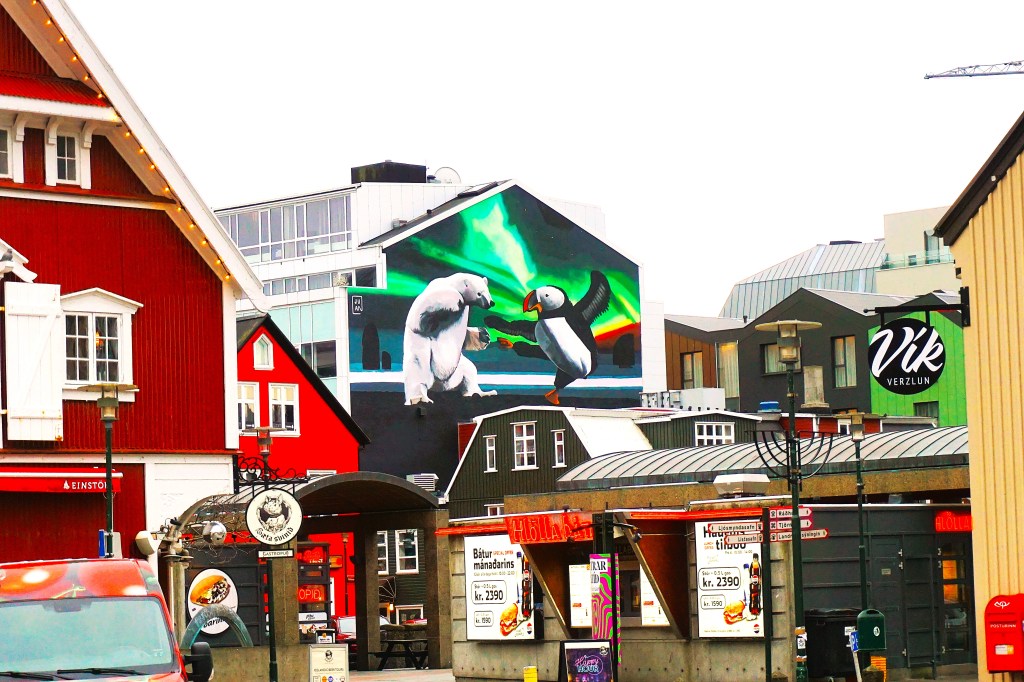
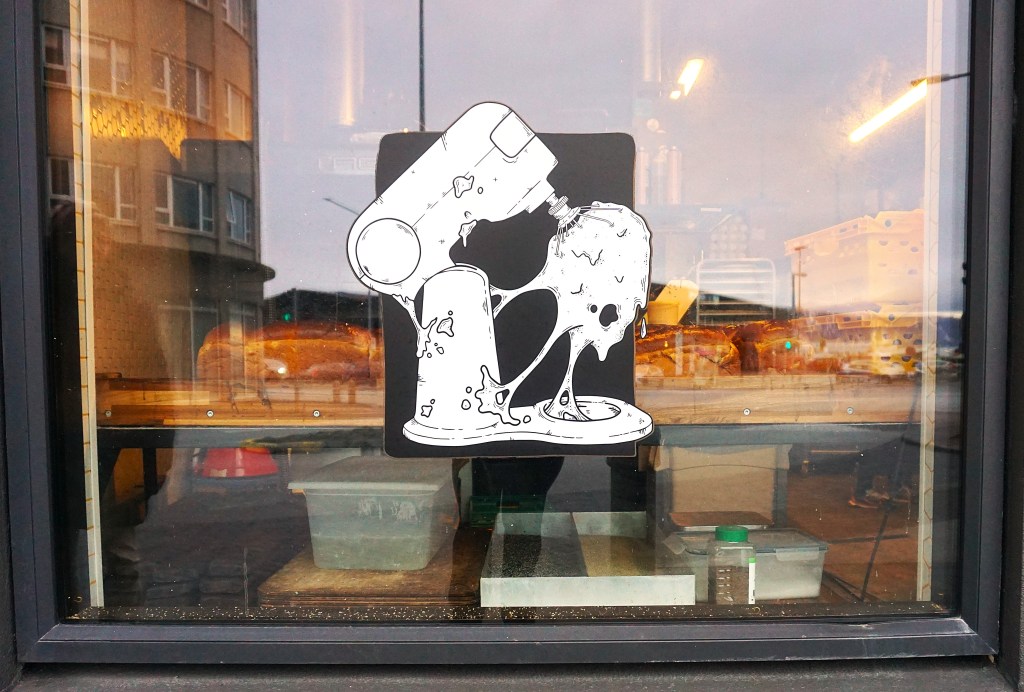
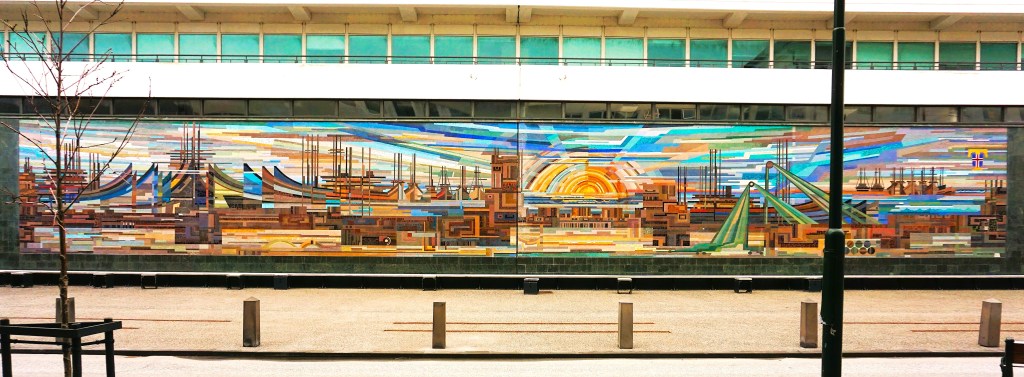
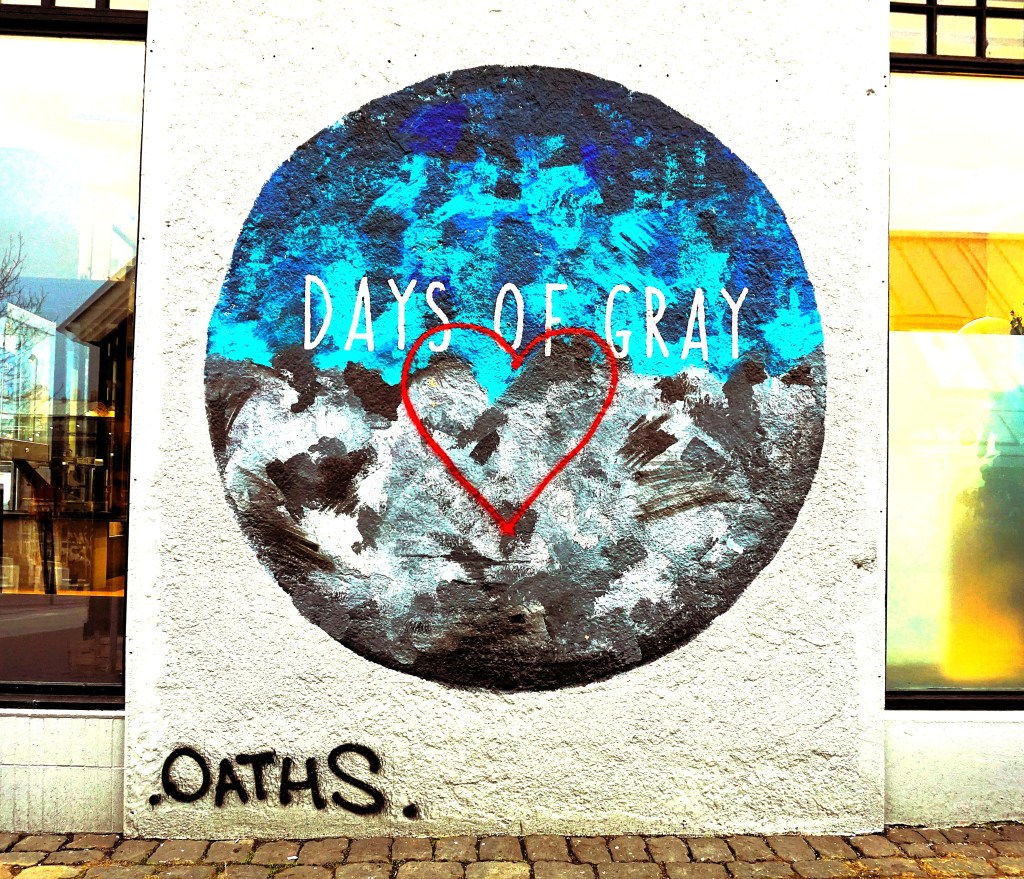
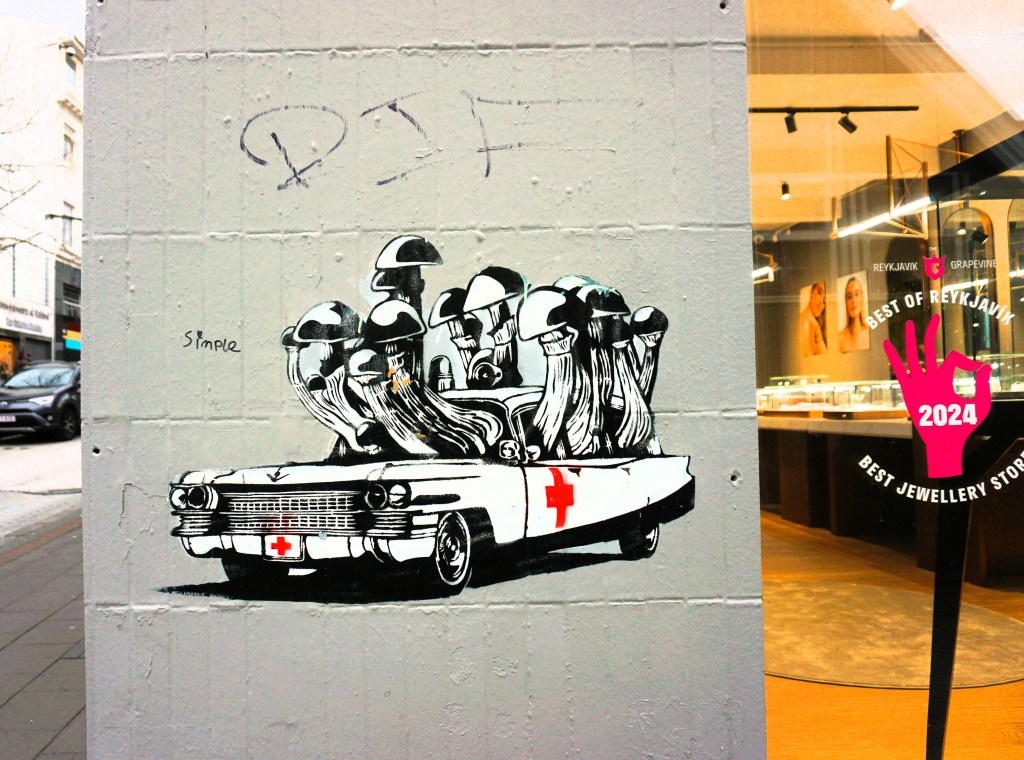
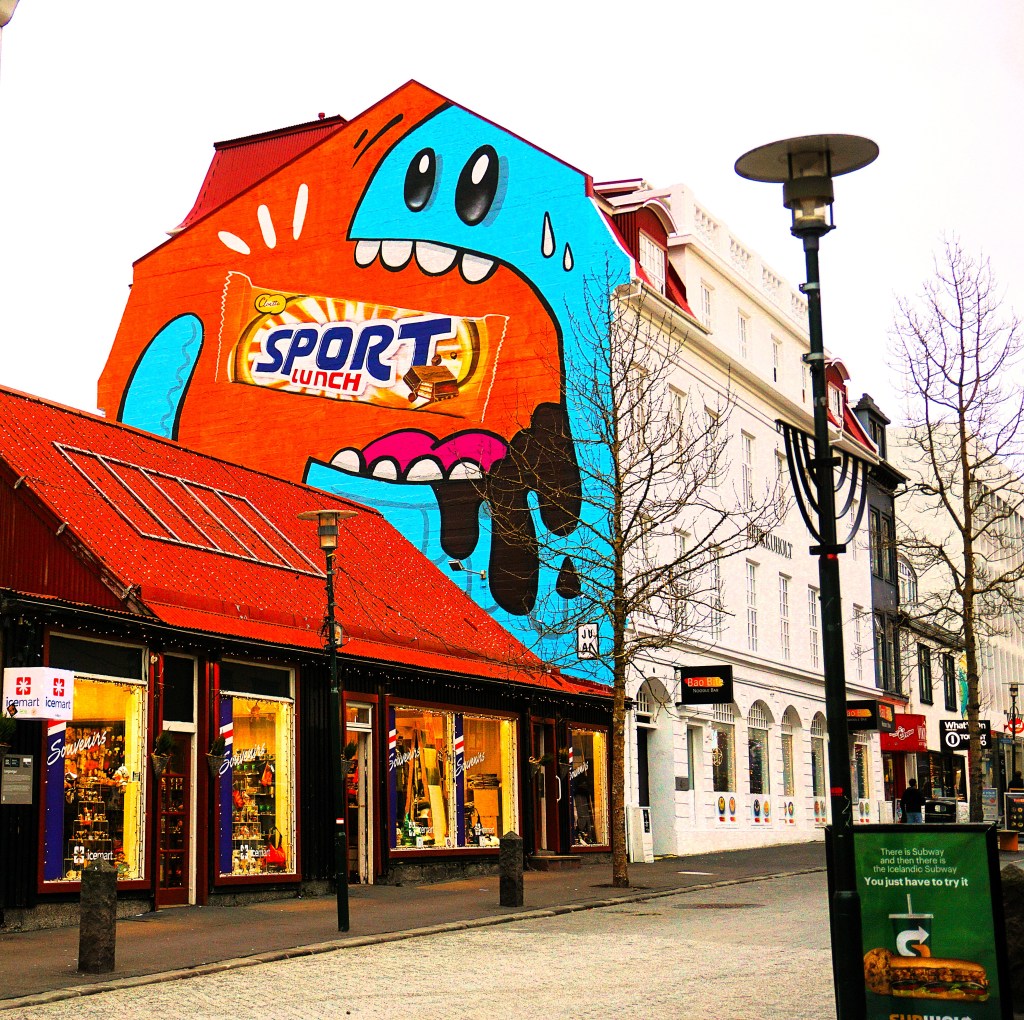
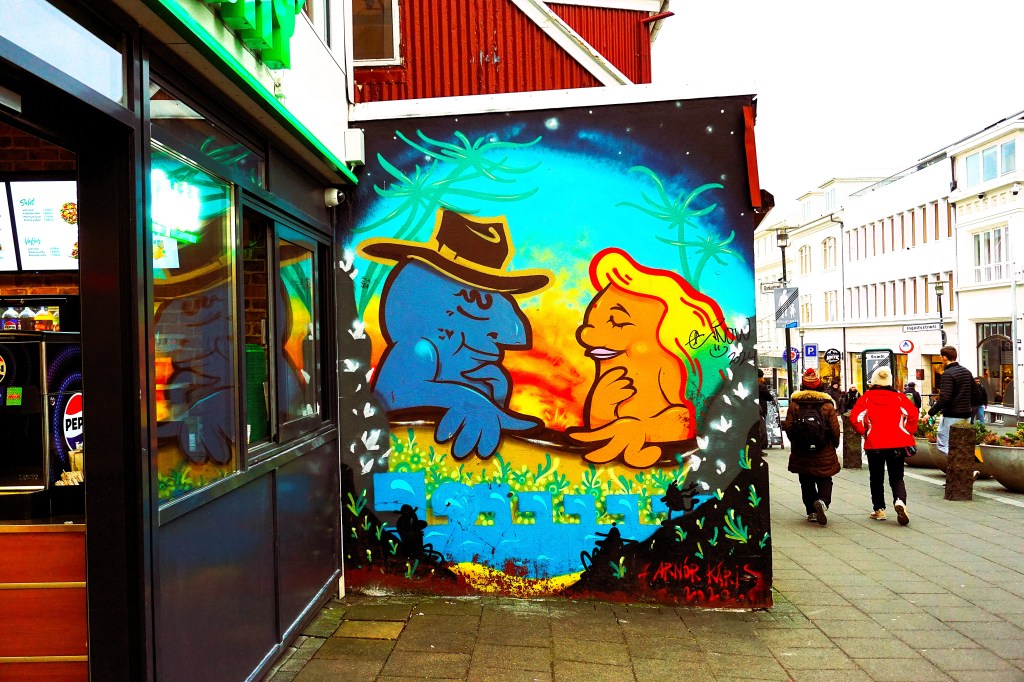
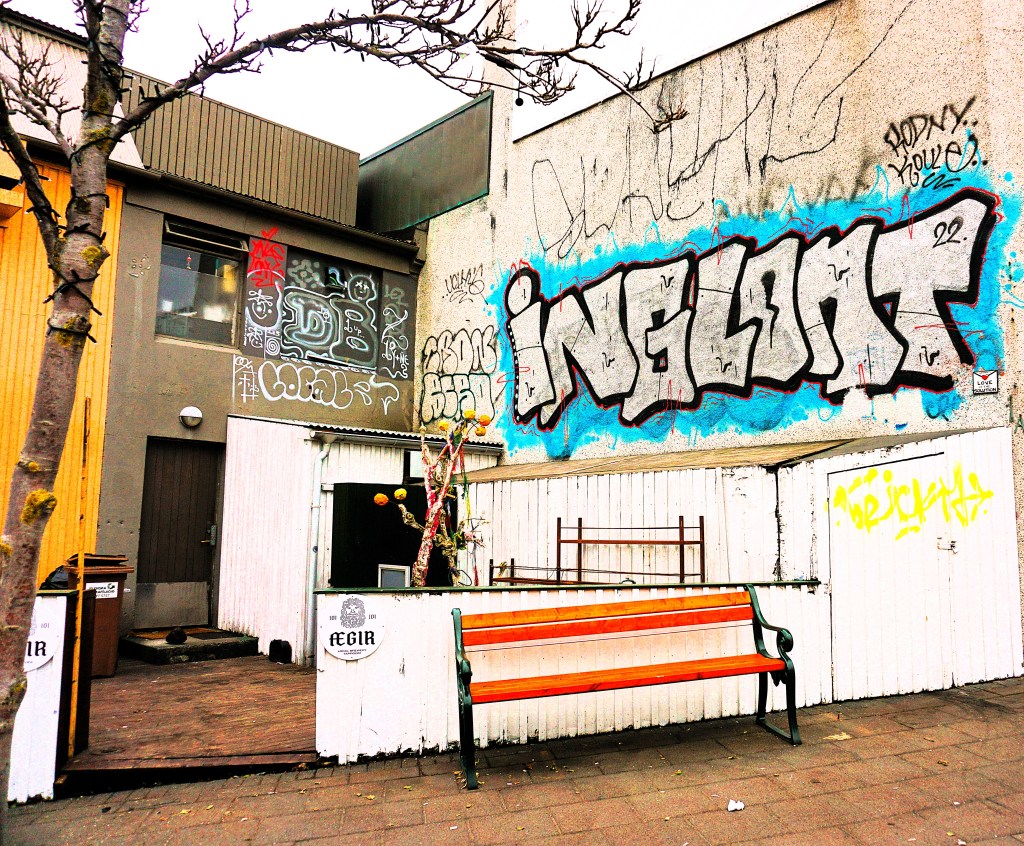
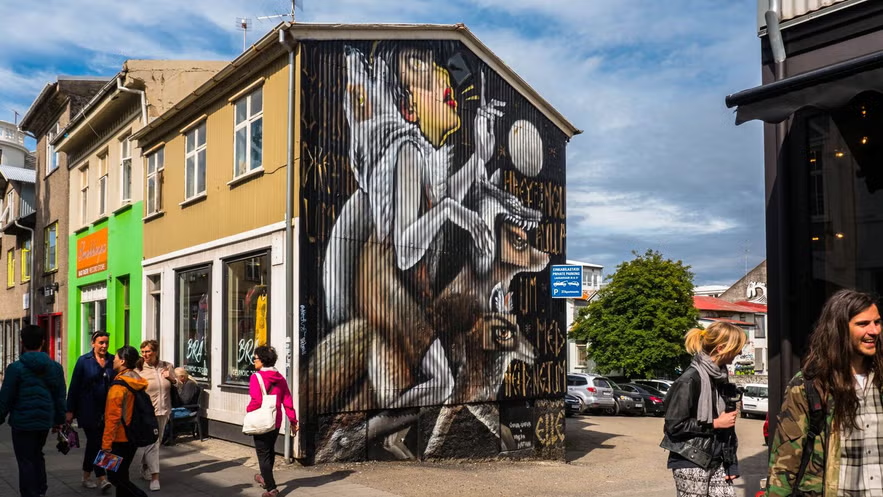
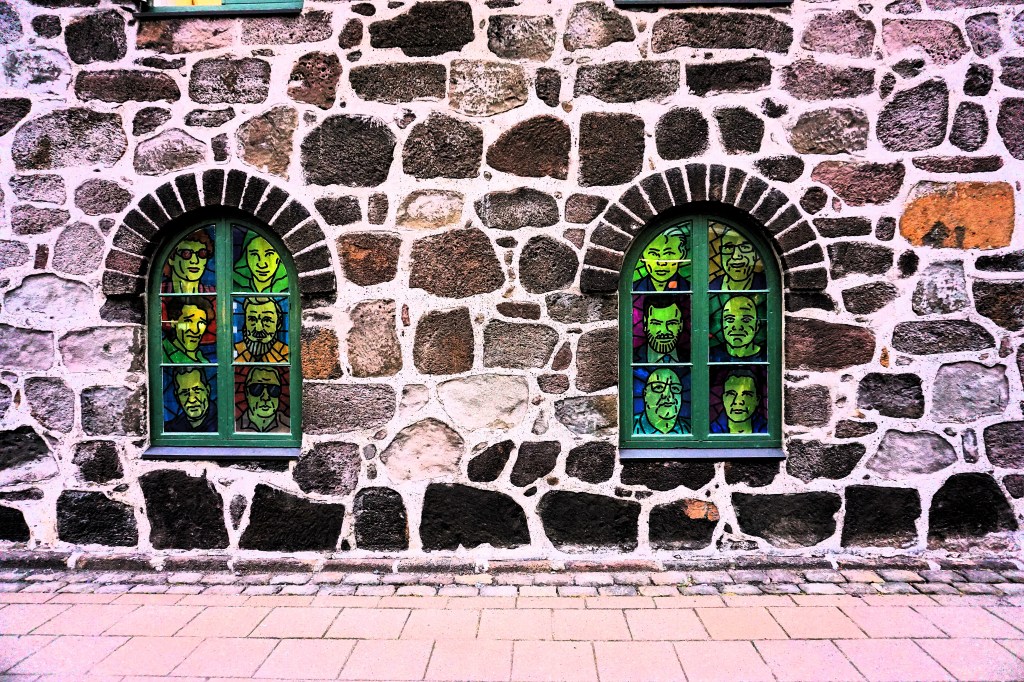
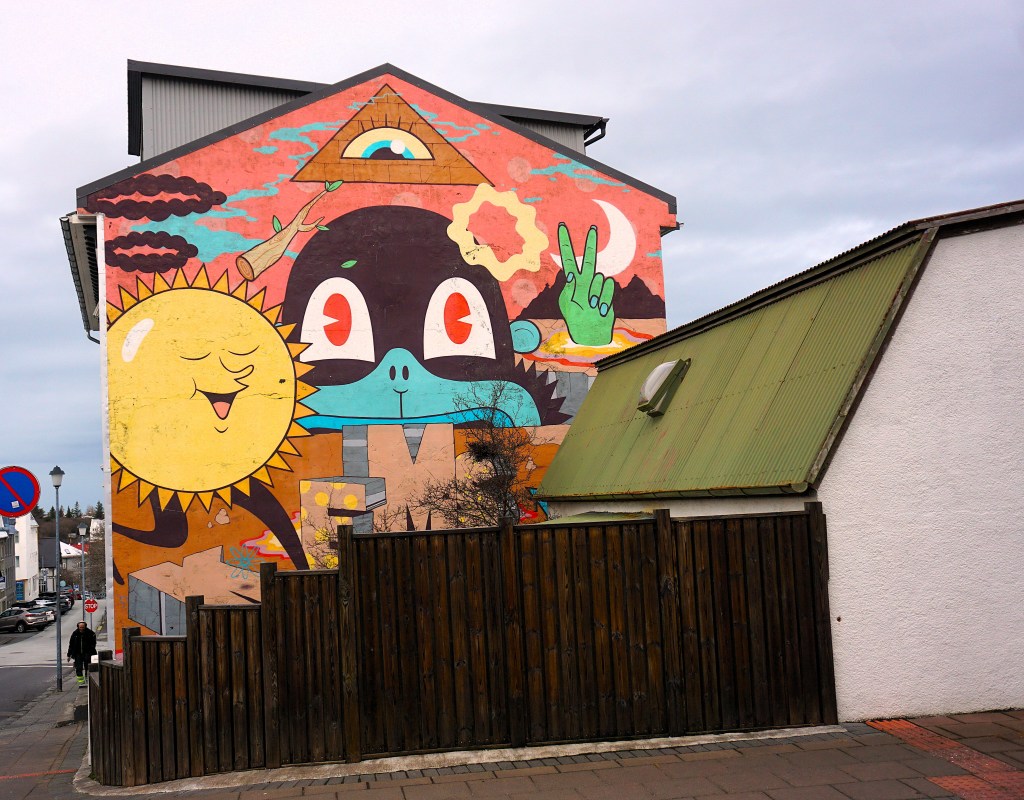
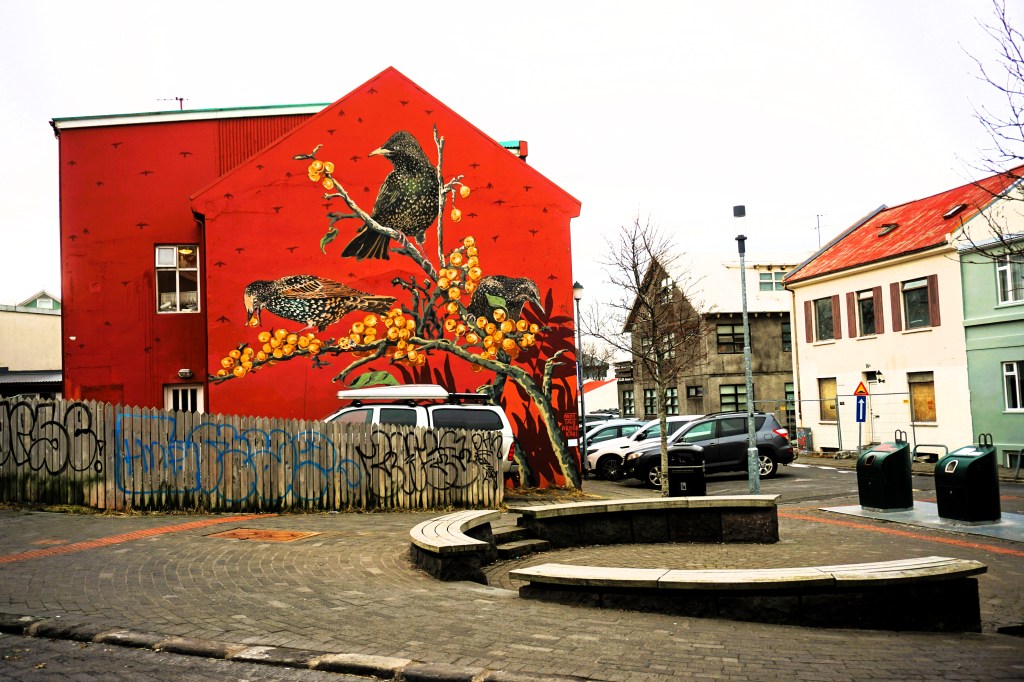
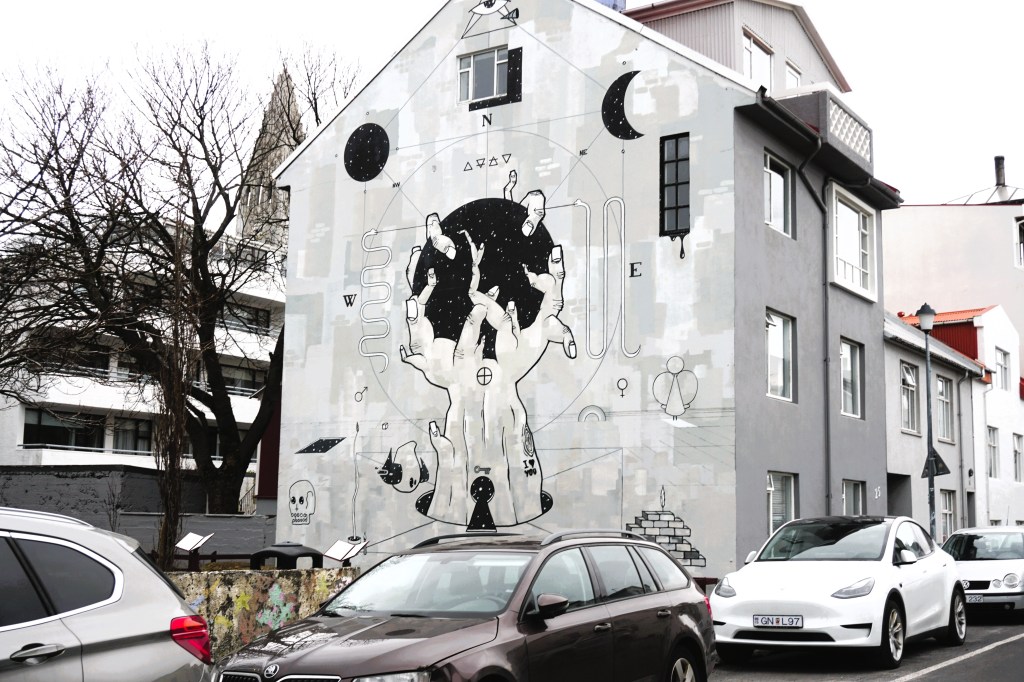
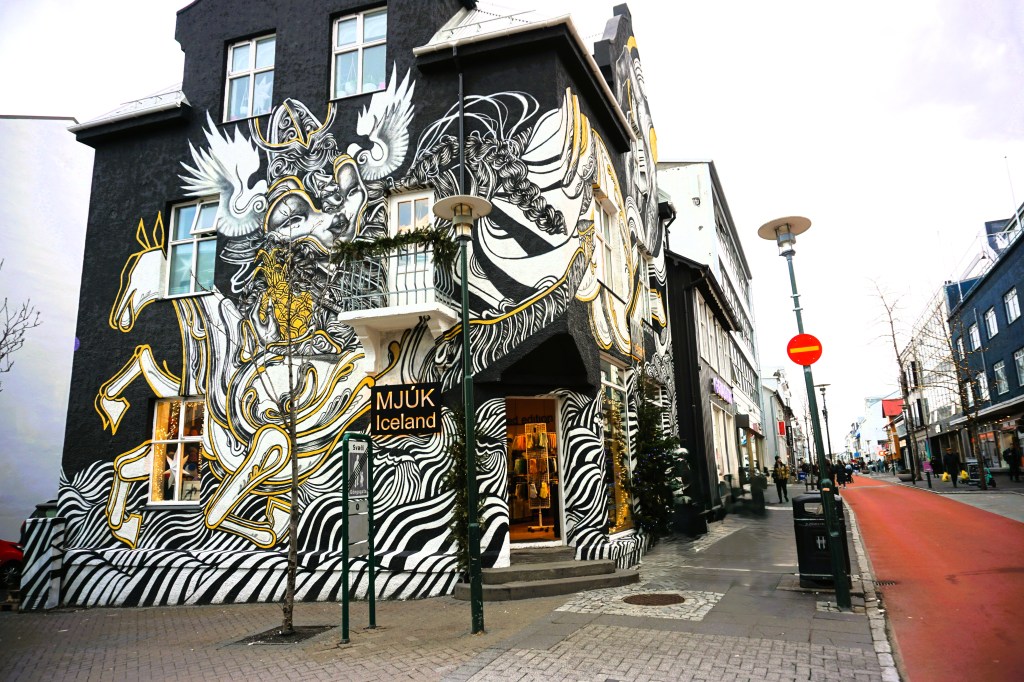
No walk about would be complete without a view of street art…

Love The Skeleton
Not Strictly Street Art…But For Beer Fans That Like To “Chew Thier Brew” This Can’t Be Beat
Outside A Bakery – ‘Natch!
Yes, Not Only Art, But Advertising A Pretty Tasty Candy Bar

Created by artist Guss W. Fussel, this bronze sculpture of a bear is the heraldic symbol of the city of Berlin. We had seen this statue somewhere else on our journeys. Oh yeah – we found the statue in San Antonio, Texas. It was a gift from West Berlin to commemorate the 1968 World’s Fair, HemisFair ’68. Guess Reykjavik was another City to be so honored. It’s a small world afterall!

Monument To The Unknown Bureaucrat

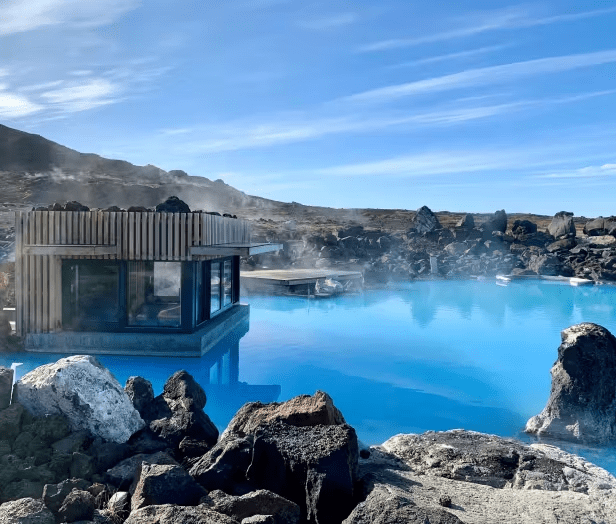
Because of our delayed flight into Iceland we missed our visit to the Blue Lagoon on the front end, and it was booked solid during our day in Reykjavik and the next day as well. We had hoped to soak in the Blue Lagoon on the way to the airport. As an alternative, Nordic Visitor booked us for a spa treatment and geothermal soak at the newly opened Sky Lagoon. In addition to the geothermal pool there were six different stations, should you choose to experience each, that made up the spa. From the geothermal pool, guests are invited to a polar plunge followed by a sit down in their very, very warm sauna. Once you get your “schvitz on,” it’s time for a leisurely stroll through a cool water rain, and now that your pores don’t know what is going on it’s time for an herbal scrub – black sand, of course. Rinse off in your own private (well, built to share!) shower, and it’s time for a healthy snack and chilled cloudberry juice. Cloudberry is said to taste like “a combination of raspberry and red currants, slightly bitter with notes of grapefruit or rich dark chocolate, and a subtle floral aroma.” Oh yeah? My palate says it tastes perfectly juicy and delicious – particularly after our journey in the spa. Back into the geothermal pool, taking a long look at the Icelandic landscape one more time before changing back into our street clothes and making our way to the airport.

Describing Iceland properly might take a lifetime. This land, rich with history, sagas, and folklore, captivates the imagination with its foreboding landscapes, smoldering volcanoes, and powerful waterfalls. The subtle rumbling of the earth beneath your feet adds to the island’s mystique, as if the ground itself whispers ancient stories.

Iceland’s black beaches, glaciers, and icebergs stand majestically against the relentless winds, bearing testimony to the resilience of Mother Nature’s creations. These natural wonders seem almost otherworldly, each one a monument to the raw, untamed beauty of this captivating island.

The citizens of Iceland, creative, bold, and proud descendants of Vikings and Danes, have found a way to thrive in this rugged environment. Their spirit of adventure and resilience echoes through the generations, and they extend an invitation to the world: “Come visit our fascinating land, stay if you dare!”

The beauty of the Northern Lights was undeniable – after all it was the reason we came to Iceland. But it was the country itself that captured us. The raw and rugged landscapes, the serenity of the wilderness, our traveling companions and tour guides, and the warmth of the Icelandic people all combined to create for us a profound sense of belonging. The Northern Lights may have been the catalyst, but the country’s embrace captivated us.

We returned home with more than just photographs of a natural wonder; we carried with us the essence of a land.

Barbara and Brian

“It’s not what you look at that matters, it’s what you see.“ – Henry David Thoreau

NORTHERN ICELAND, WESTERN ICELAND AND BACK TO REYKJAVIK

February, 2025

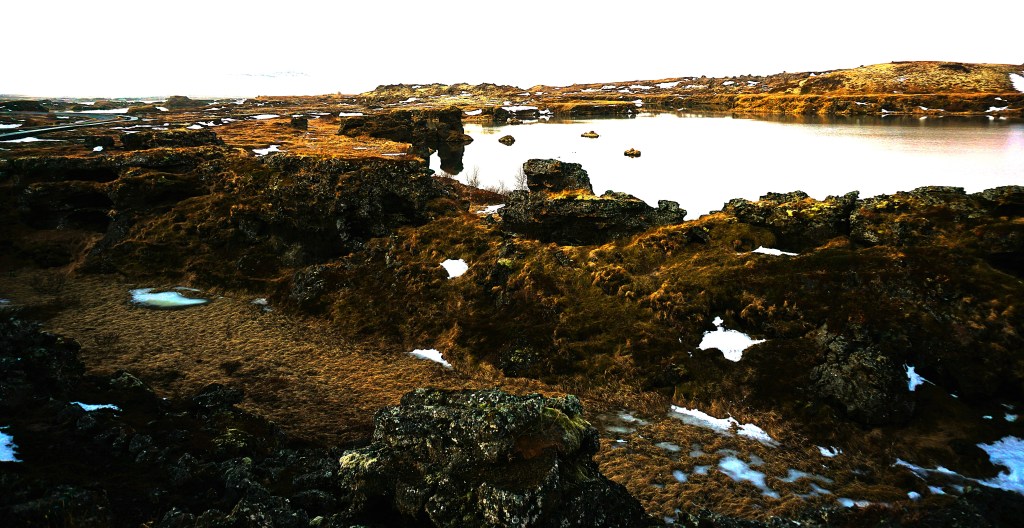
After last night’s spectacular Northern Lights display we were greeted with a pretty nice sunrise the next morning on our way to Dimmuborgir. Along the journey we were able to see wetlands that were created by a basaltic lava eruption estimated to have occurred 2,300 years ago.

All Of The Colors In God’s Palette Are On Display This Close To The Artic Circle

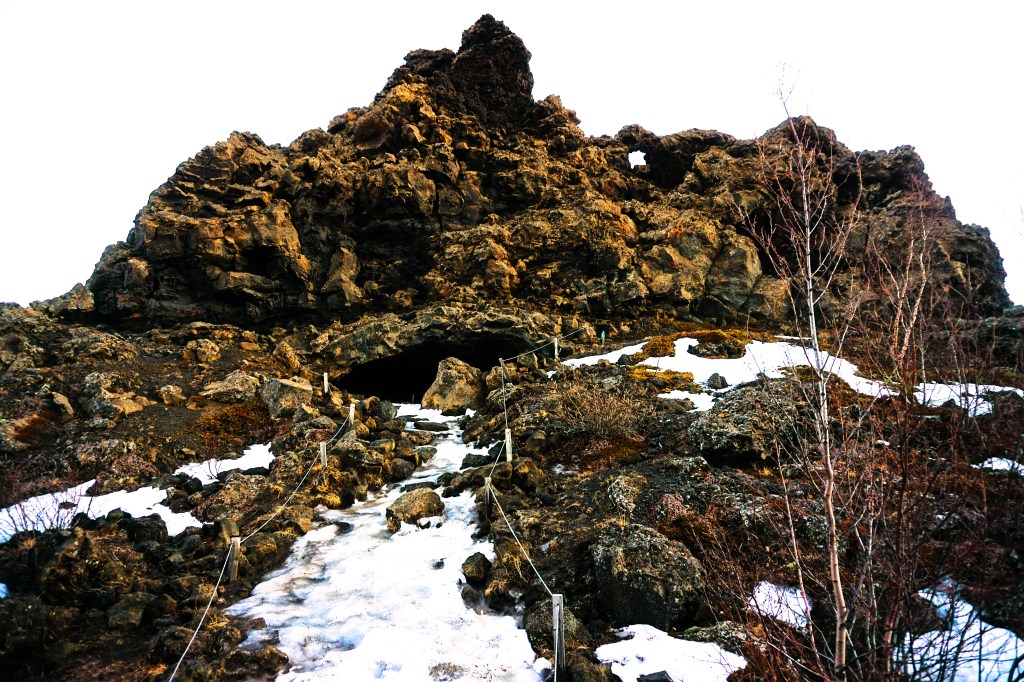
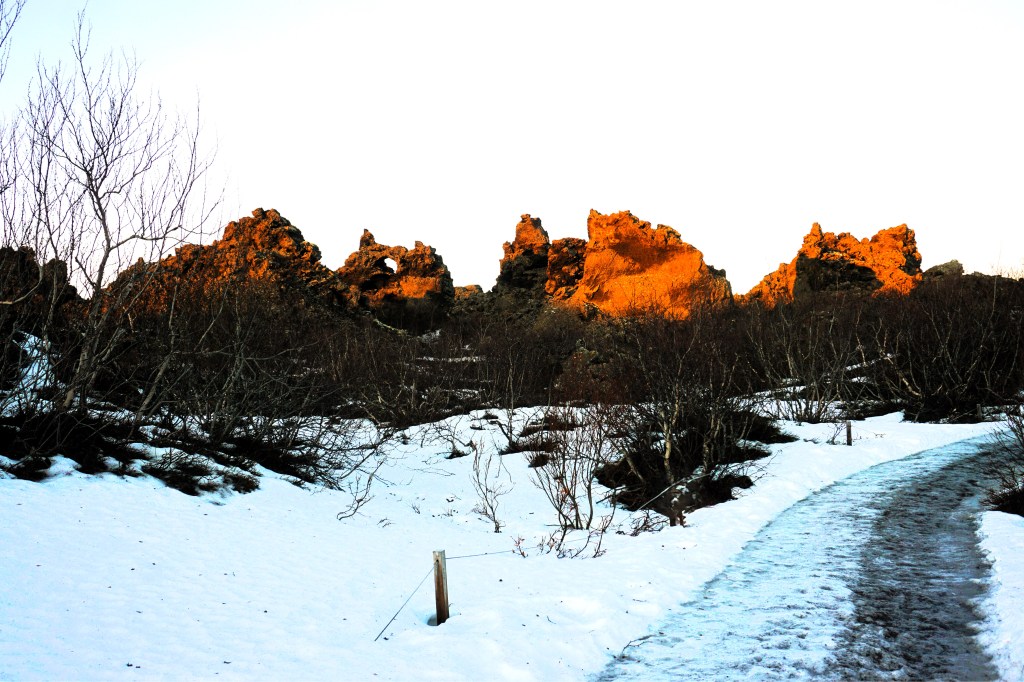
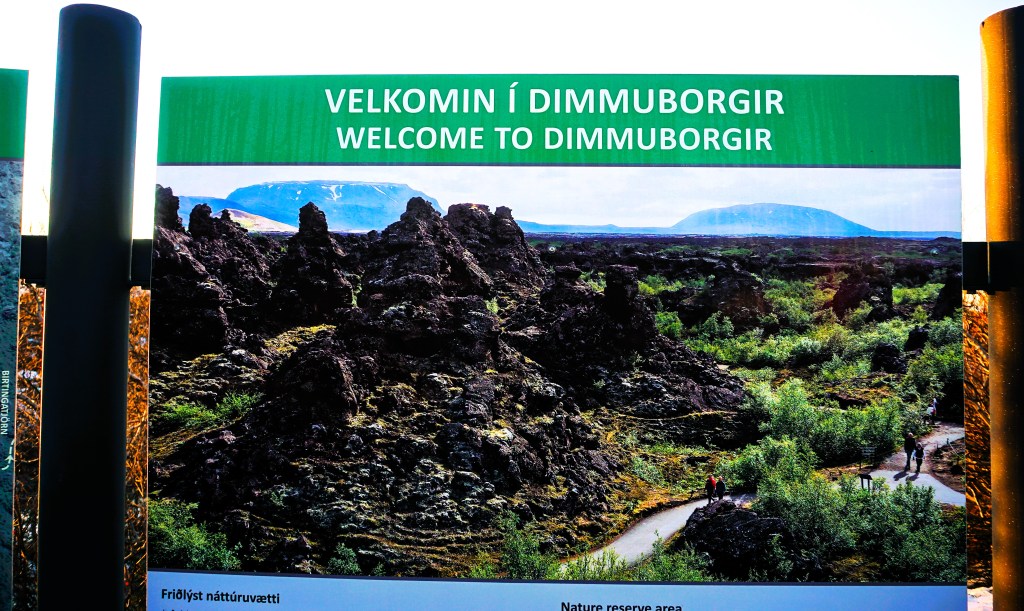
Dimmuborgir’s rock formations, arches and caves were formed when hot lava flowed over this marshy area causing the water in the ground to boil, the rising vapors pushing the lava into pillars. Dimmuborgir means “dark cities.” The area is reportedly home to the Yule Lads, and Icelandic folklore also imagines that this is an area that connects earth with hell – literally the “gates to hell.”

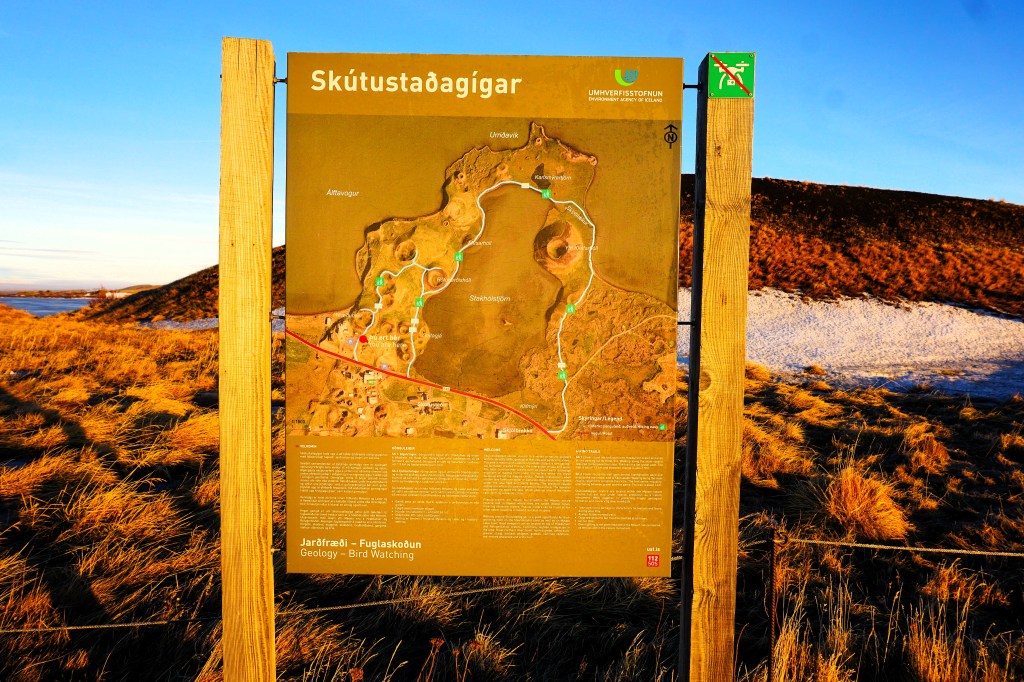
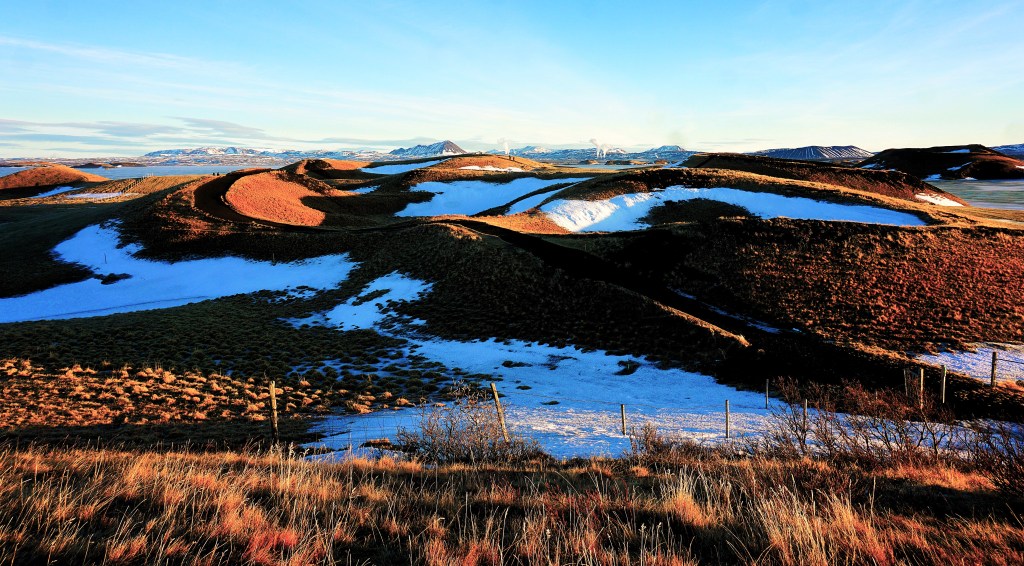
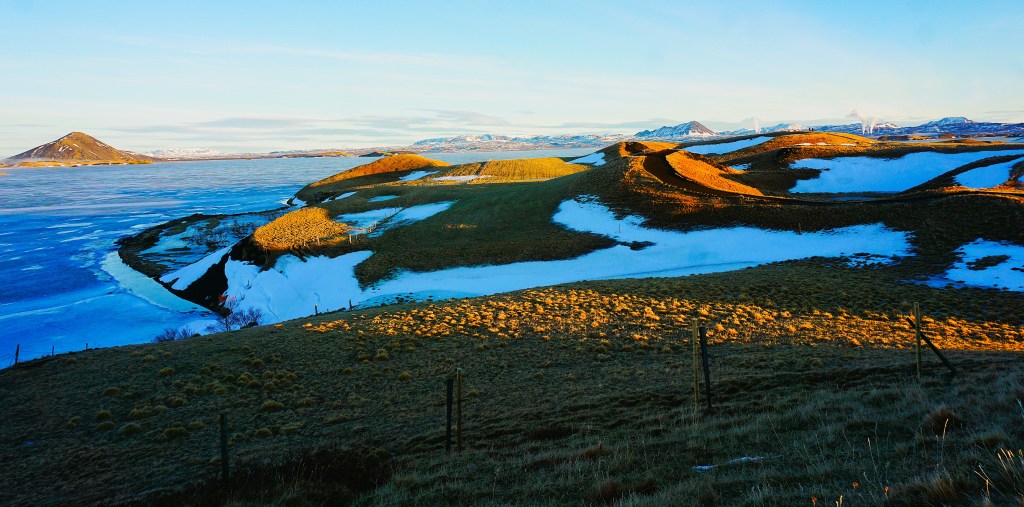
Skutustadagigar is a landscape of pseudo-craters formed by gas explosions as boiling lava flowed over cool, wet surfaces.

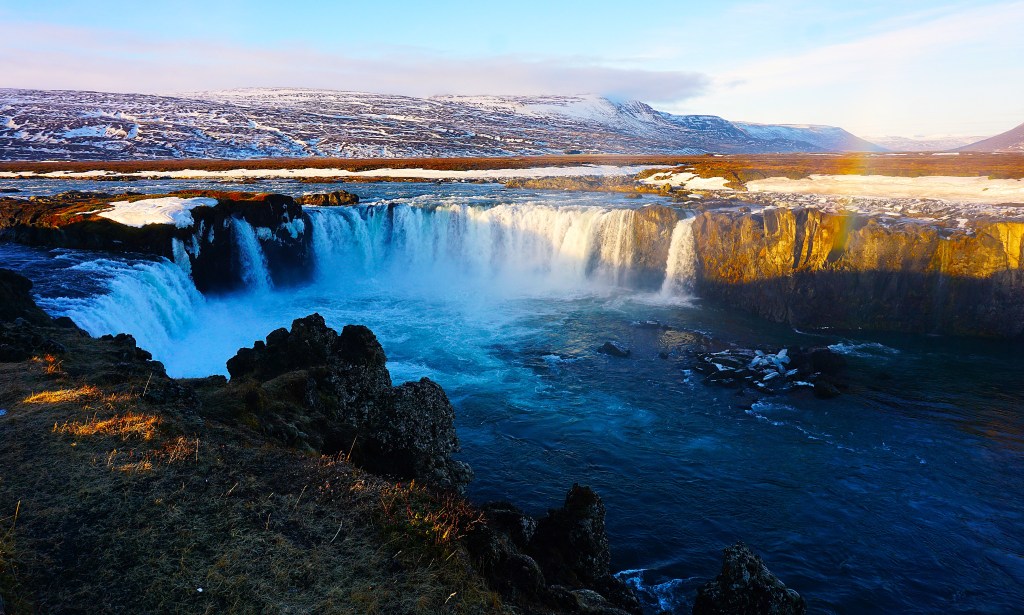
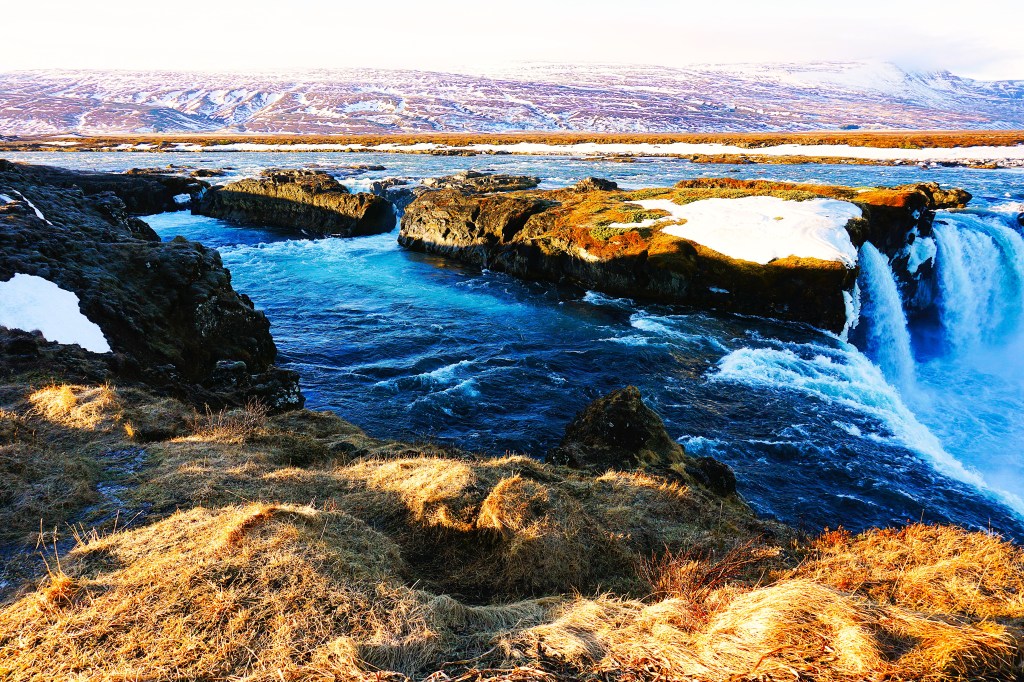
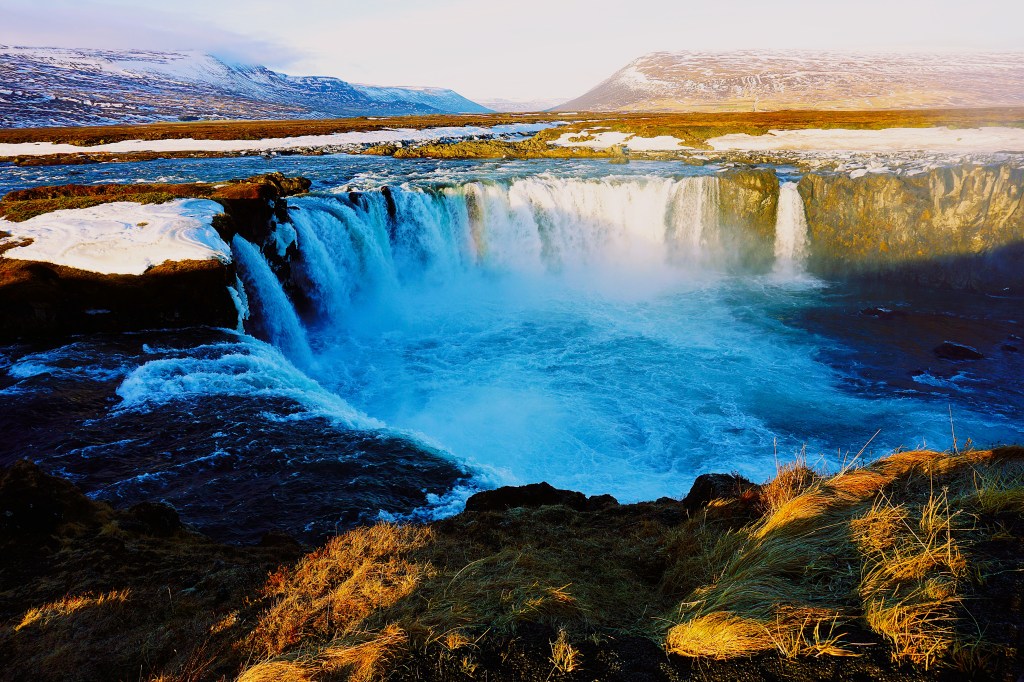
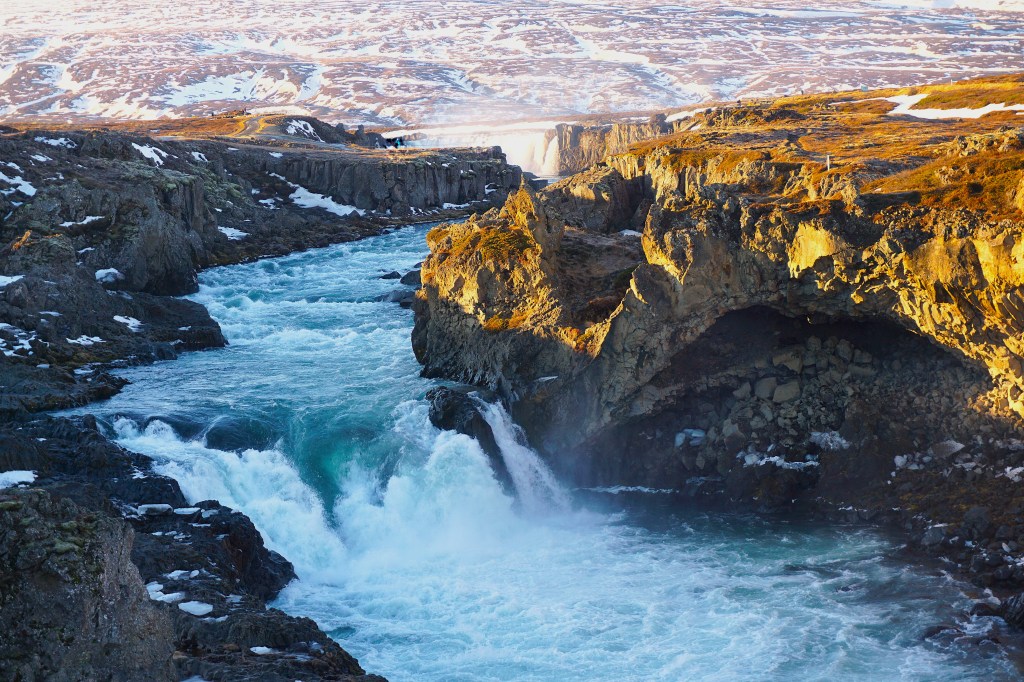
The Waterfall of the Gods or Godafoss, is not very tall, but unique as the cascade is divided into two horseshoe shaped falls. “Rumor has it” that when Iceland converted to Christianity in the year 1000CE statues of the pagan gods were thrown into the falls.

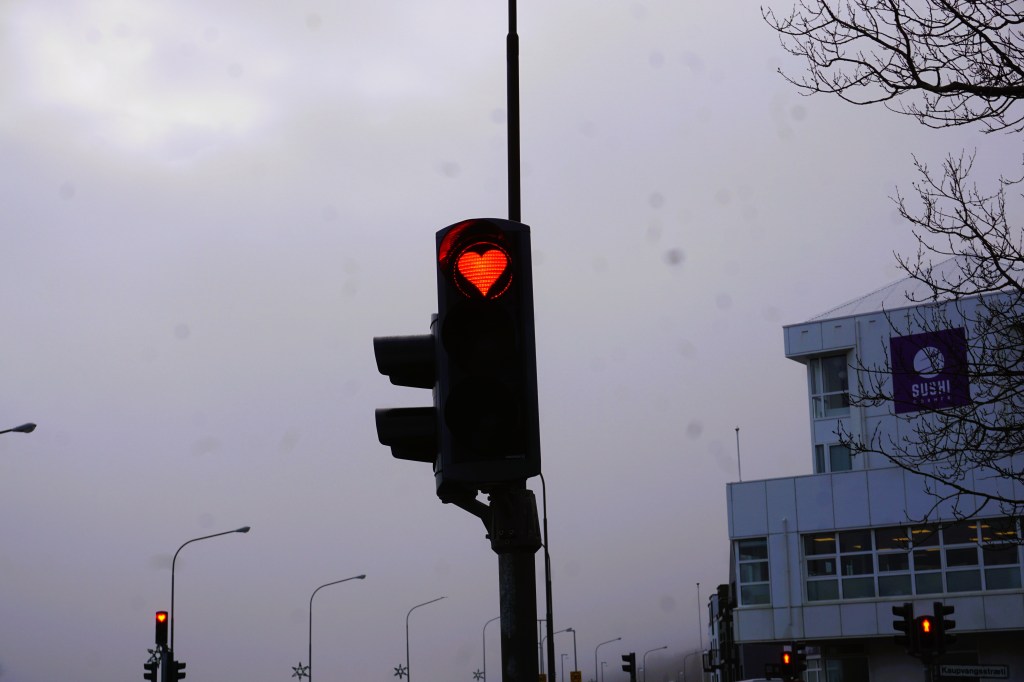
Iceland’s second largest city is Akureyri. Situated innermost on a fjord, the city is an old trading station and fishing village…and only 10 miles from the Artic Circle! A most delightful feature of Akureyri is that the red in the city’s traffic lights are in the shape of hearts. We had the chance to wander the streets of this quaint city, spend some time in the local bookstore enjoying a cappuccino (and buying a book about the Yule Lads – ‘natch!), and treating ourselves to a great lunch.

Plysa Stands Are Everywhere

Leaving Akureyri we followed the Ring Road west to our last overnight while before returning to Reykjavik. The Hofsstadir County Hotel will be remembered for serving horse on its breakfast buffet.

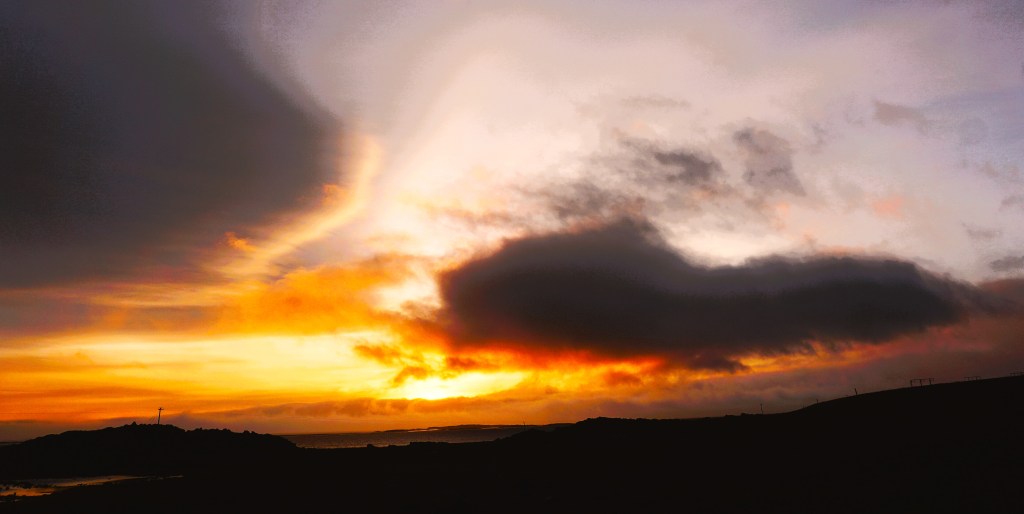
Sunset
Sunset
Sunrise

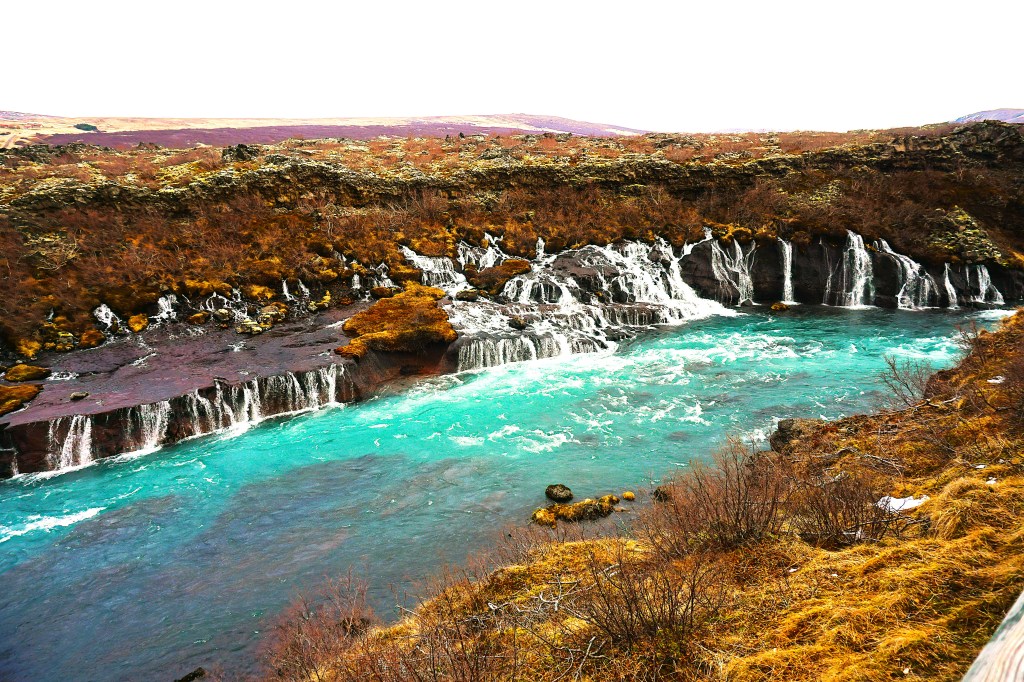
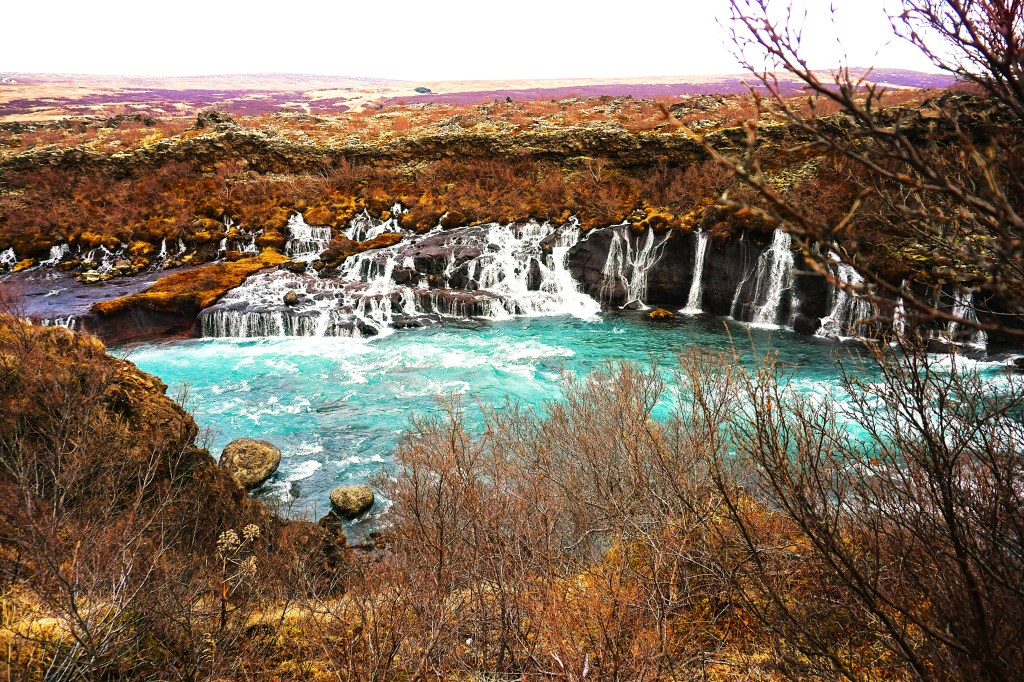
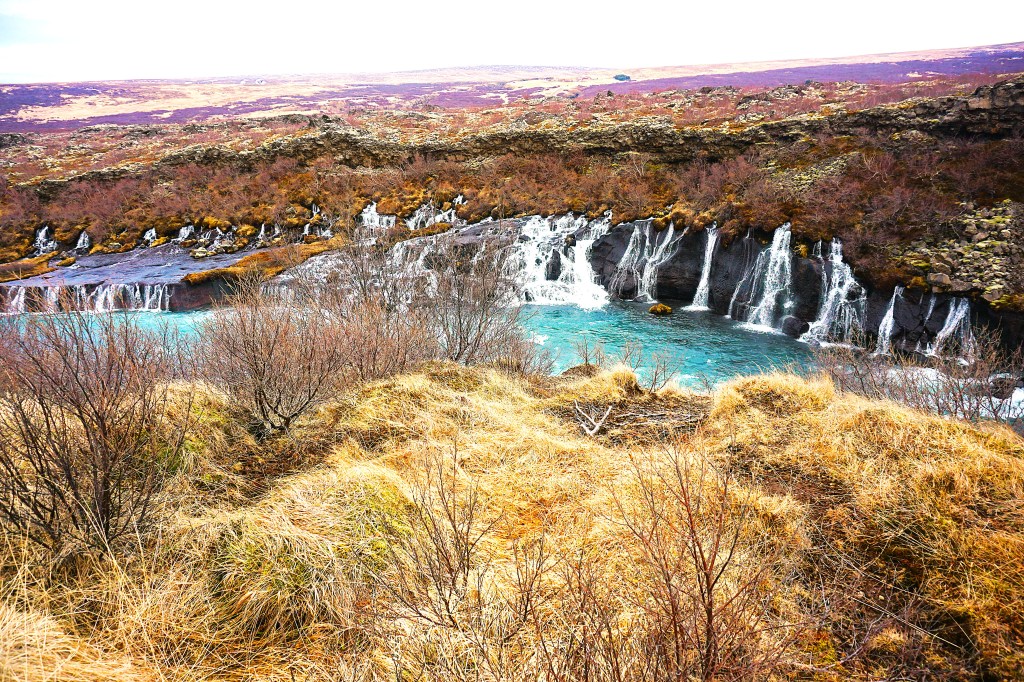
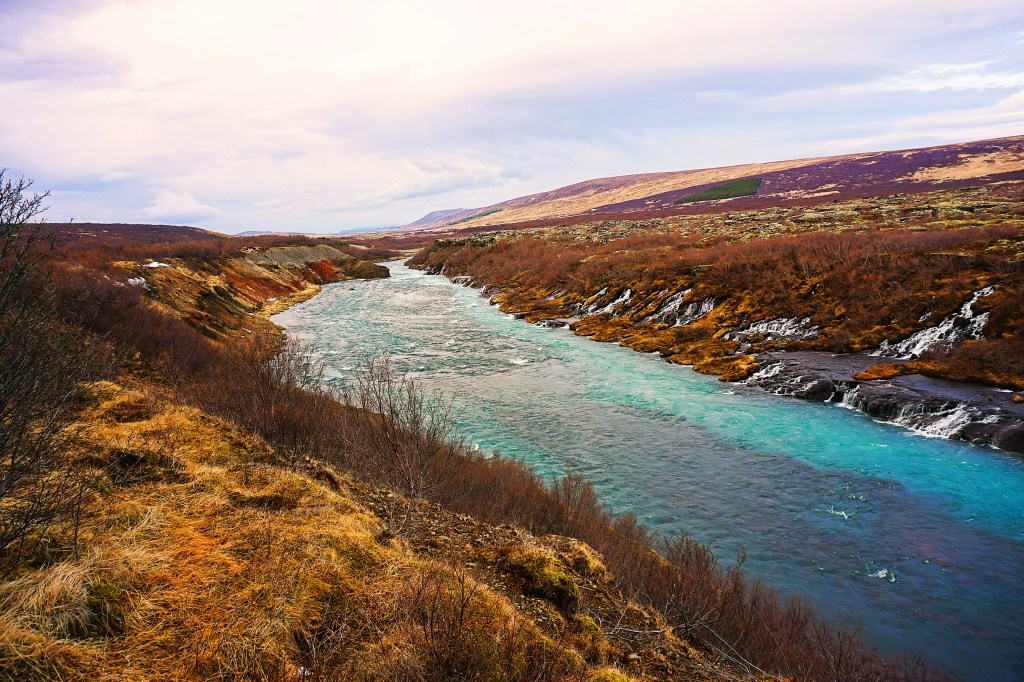
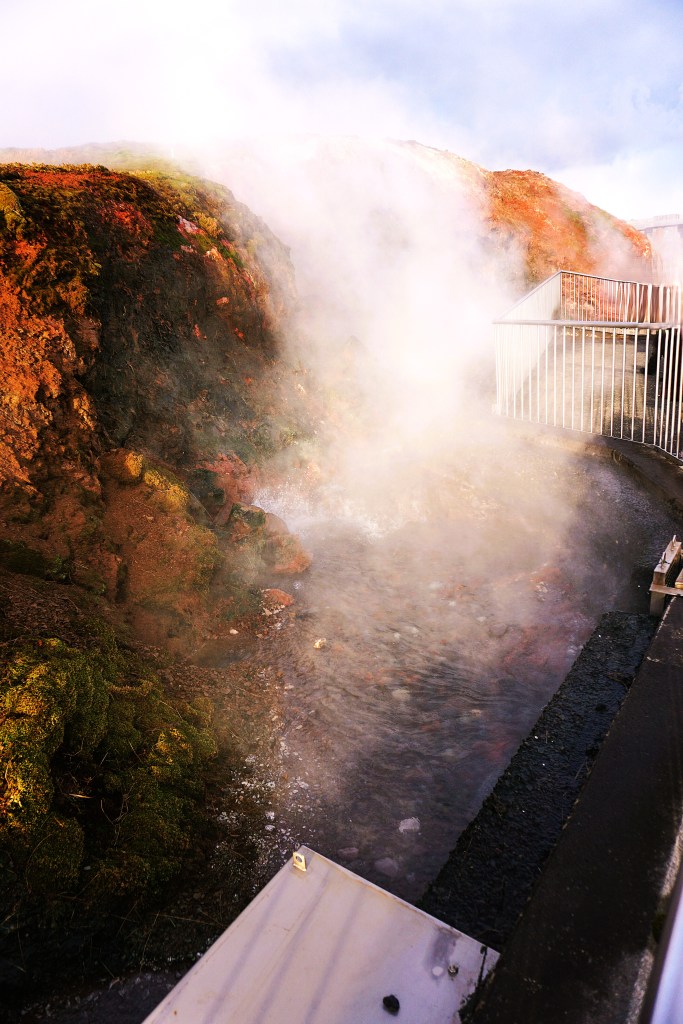
Two stops in Western Iceland before the long trek back to Reykjavik. Deildartunguhver is reportedly the most powerful hot springs in Europe. And our second stop at the twin waterfalls of Hraunfossar and Barnafoss, which were Brian’s favorite.

Hraunfossar and Barnafoss are notable falls, because the water flows through, not over lava rock formations. Hraunfossar translates to “Lava Waterfall”, and Barnafoss means “Children´s Waterfall.”

Hraunfossar is best described as a collection of countless creeks and cascades, small and big streaming out of the lava over a distance of about 10 football fields.

There’s folklore behind the Barnafoss name. Here’s the folklore: A long time ago there was a widow living on a farm nearby with her two young children. One day the widow went to a Christmas Church Service, but left her children at home unattended. When the widow came back from the evening service her children had disappeared. People went searching and found their footsteps leading to the stone arch over the river. The children were never found, and their mother had the arch destroyed promising that no one would ever cross the falls again.

Hraunfossar and Barnafoss

A few hours later and we had returned to Reykjavik bidding a fond good-bye to our tour guide Boga – thanking her for exceeding expectations every day, for sharing her insights and personal knowledge of her beloved country and cementing in our minds and hearts forever the splendor of Iceland.

Barbara and Brian

“It’s not what you look at that matters, it’s what you see.“ – Henry David Thoreau
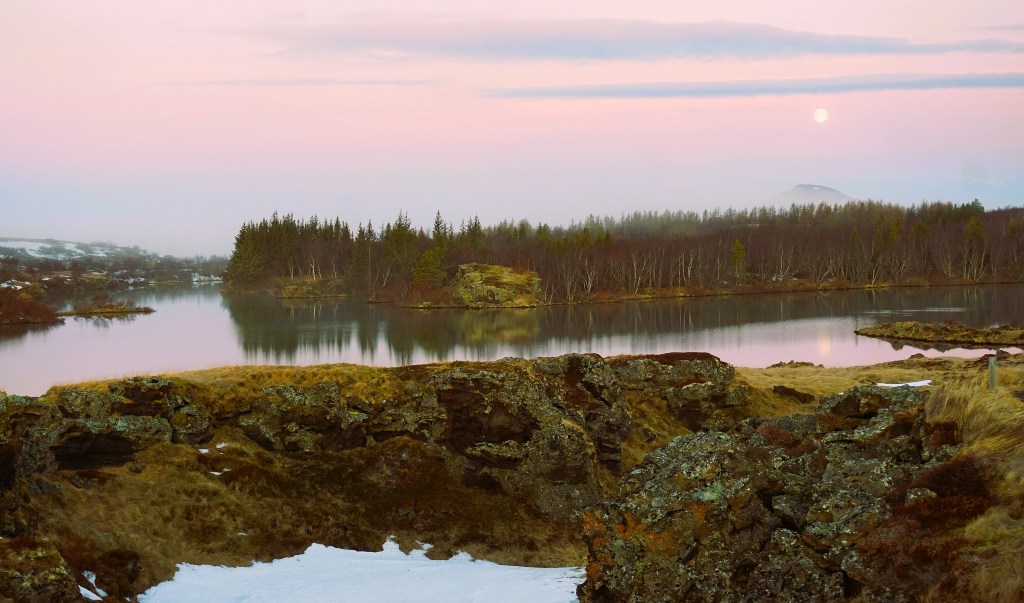
ICELAND – THE NORTHERN LIGHTS

February, 2025

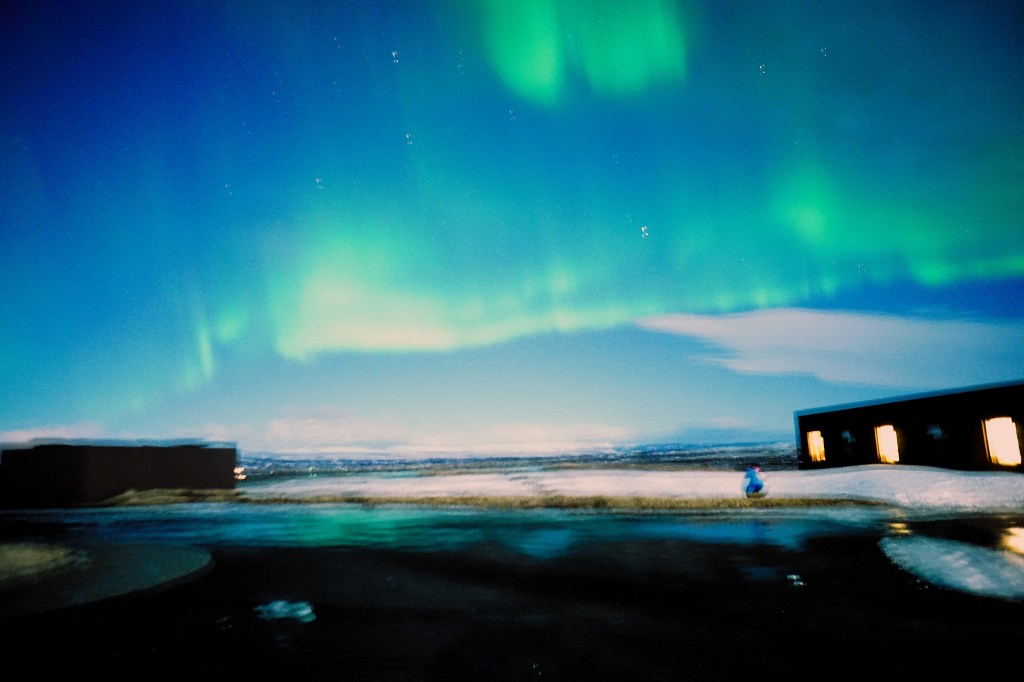
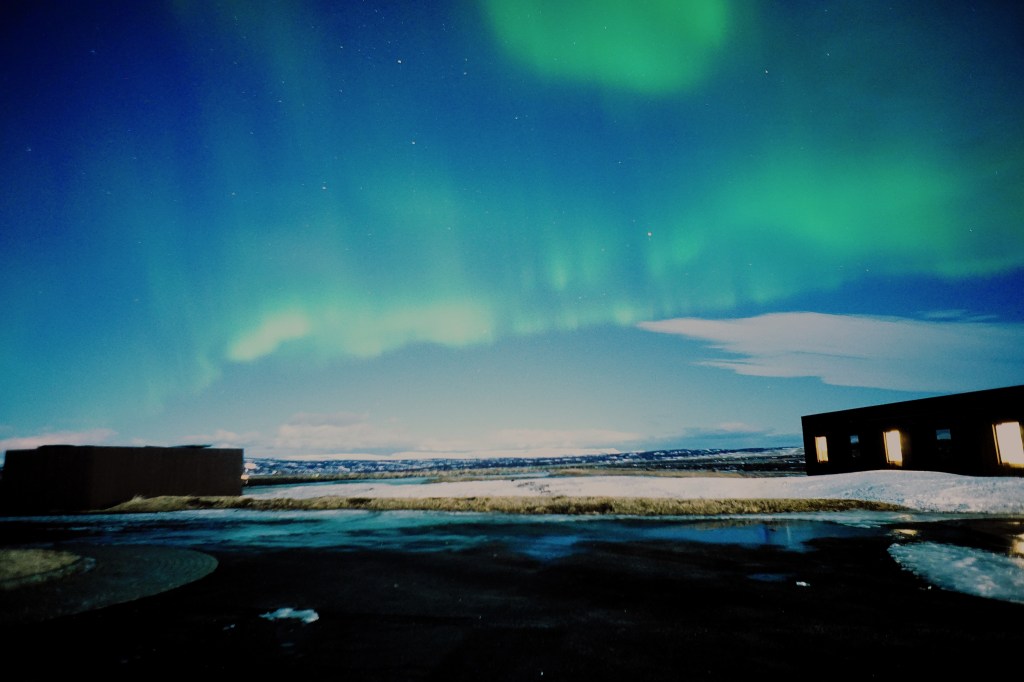
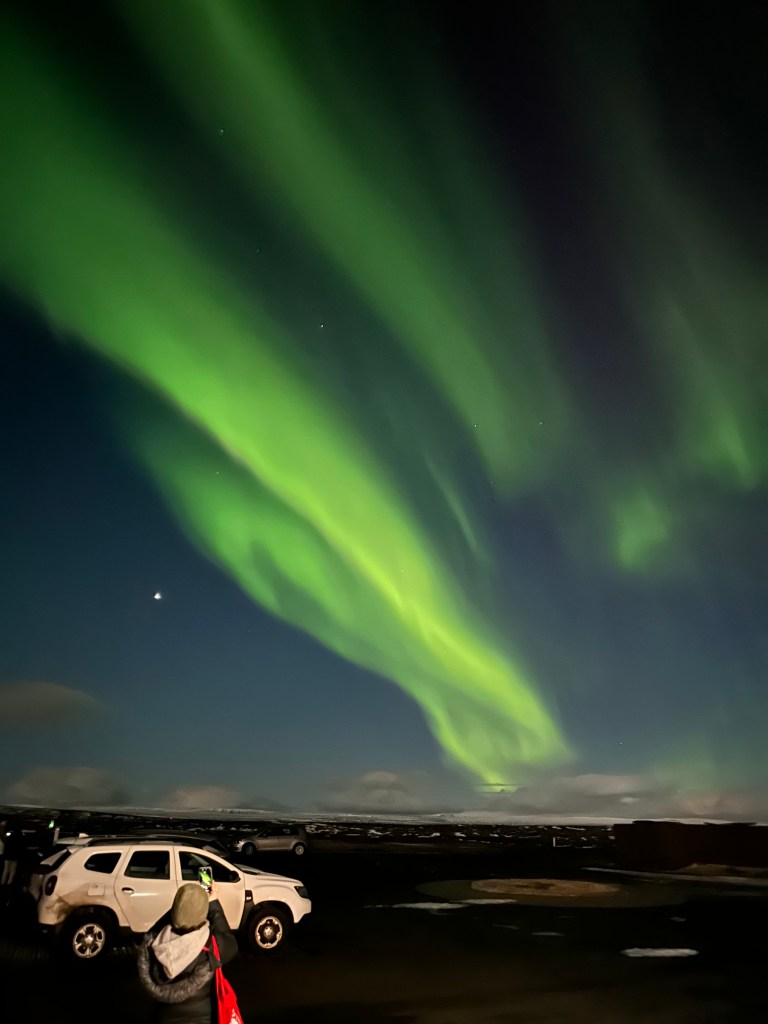
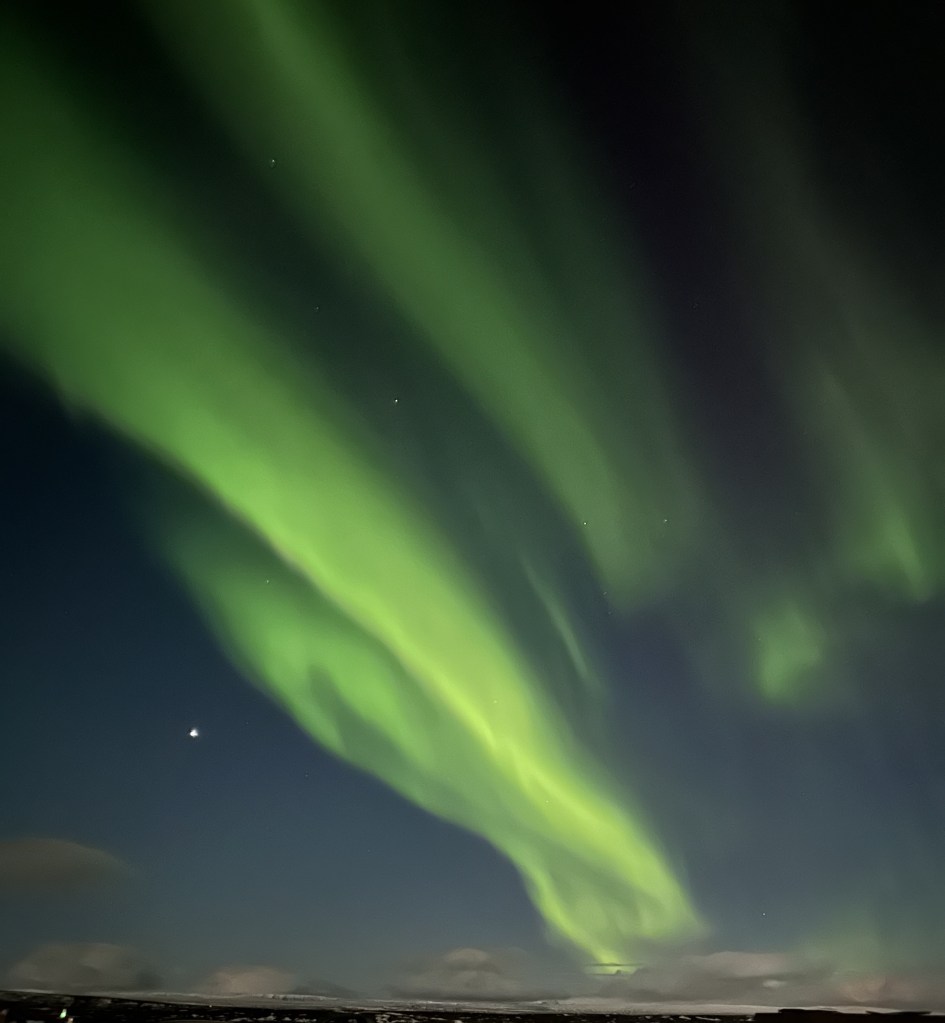
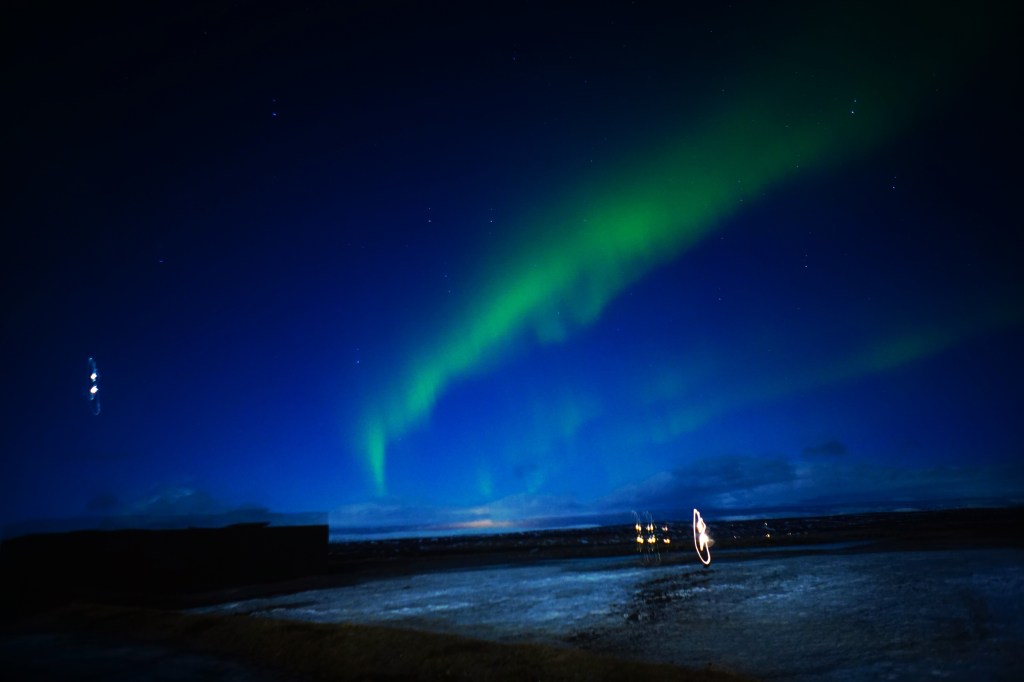
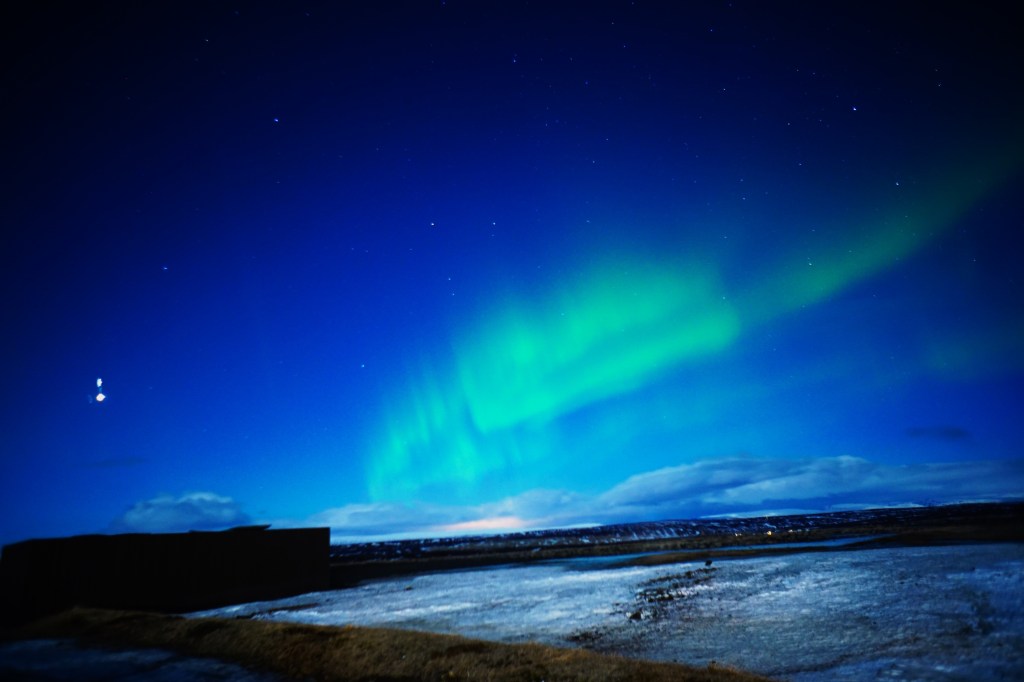
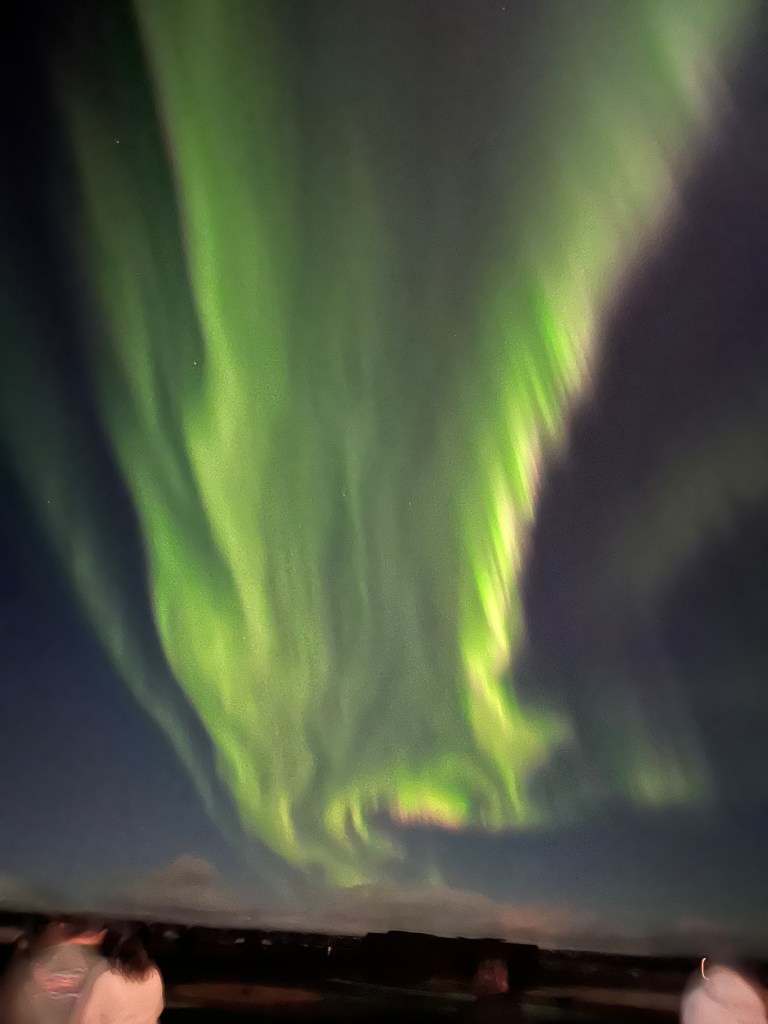
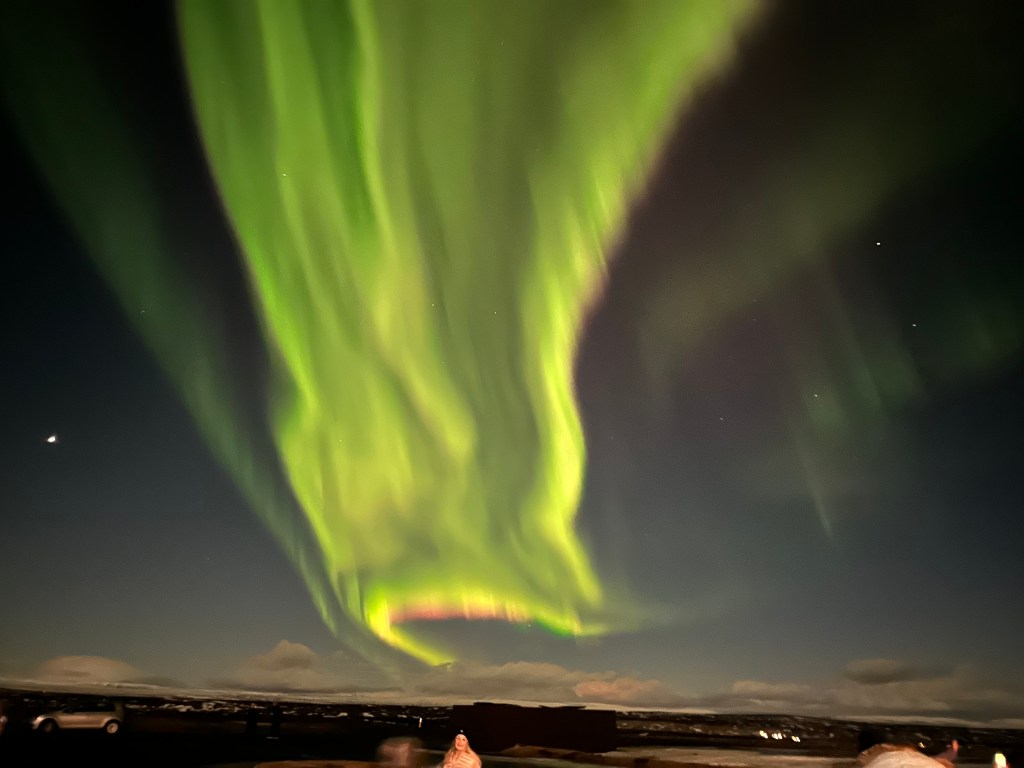
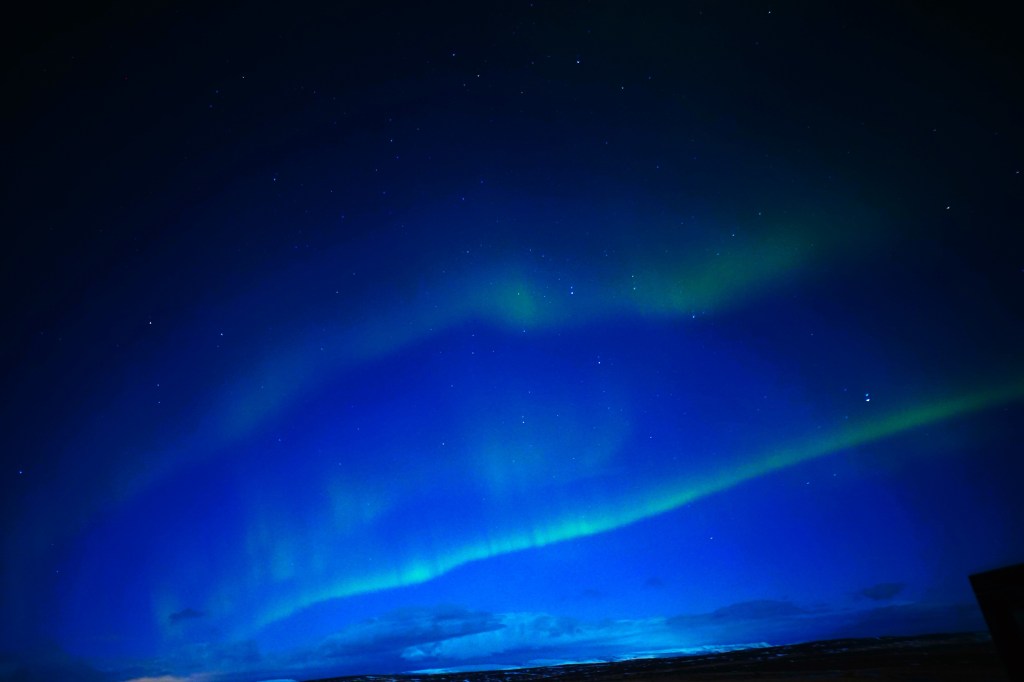
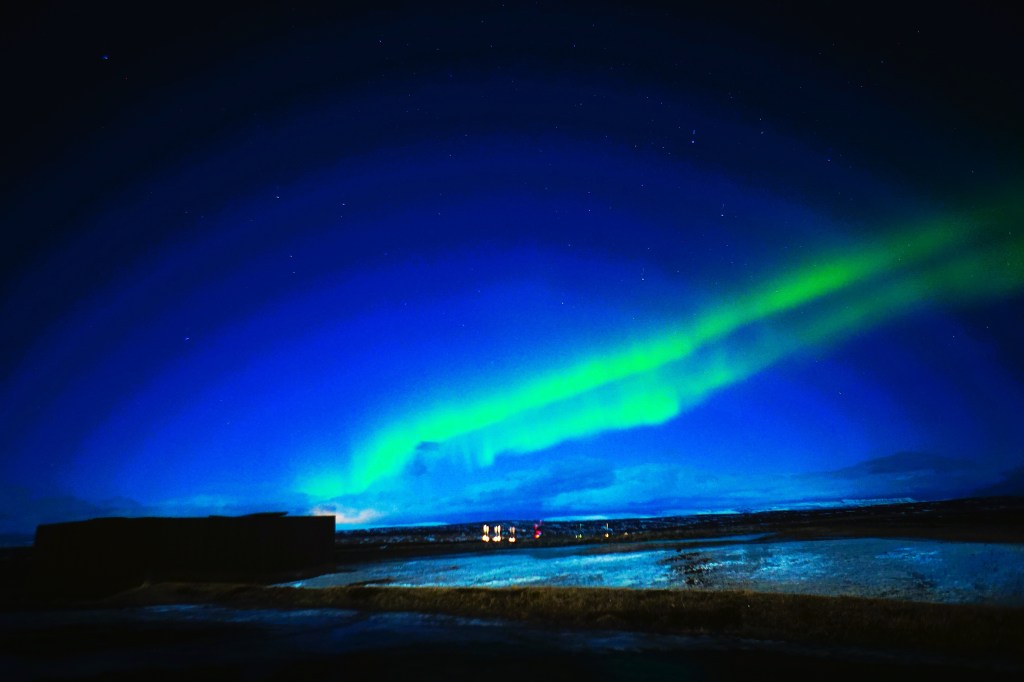
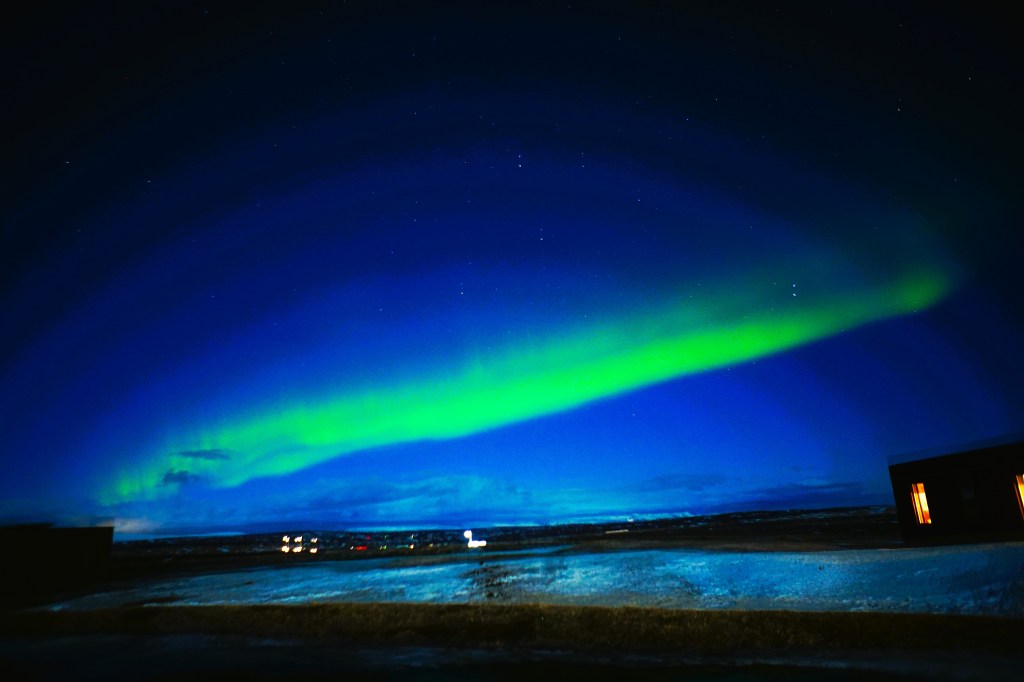
Hotel Laxa is approximately 65 miles south of the Artic Circle. It is a relatively new property, opened in 2014, and as with all of the hotels on this tour provides first class accommodations, an exceptional breakfast buffet and a delicious three-course dinner using fresh local ingredients. Our group sat down to an aperitif and had just finished the first course. As the entree was being served our tour guide, Boga, approached our table and announced that the Northern Lights were on display. Needless to say, plates were left on the table as the dining room cleared out. The most gracious waitstaff were obviously nonplused by our desertion. An hour-and-a-half later dinner resumed…

The Northern Lights, or Aurora Borealis, are one of nature’s most enthralling phenomena. This natural light display occurs when charged particles from the sun collide with gases and atoms in Earth’s atmosphere, producing vibrant colorful patterns that appear to dance across the night sky. Depending on which atom they hit and at what altitude, different colors emerge: green (oxygen atoms up to 150 miles in altitude), red (oxygen atoms above 150 miles in altitude), Blue (nitrogen, up to 60 miles in altitude), and purple/violet (nitrogen, above 60 miles in altitude). Iceland’s latitude and minimal light pollution make it one of the prime locations to experience the Northern Lights..

Enjoy…

February, 2025 was believed to offer optimal conditions for viewing the Northern Lights. And on this night, at the proper coordinates, coupled with clear skies our primary reason for coming to this Land of Fire and Ice was realized. WOW!

Barbara and Brian

“It’s not what you look at that matters, it’s what you see.“ – Henry David Thoreau
ICELAND – VISTAS, SMALL VILLAGES AND IMPROBABLE OCCURANCES

Myvatn Nature Baths

February, 2025

Learning about Iceland, its history, geography, sagas and folklore centered us for traveling the Rim Road – a 900-mile adventure circling the entire island. Our experiences these past few days of meeting horses, sampling geothermal hothouse farm produce, visiting the sites of the Golden Circle, walking along a volcanic beach pounded by the violence of the wind-driven surf, letting our fantasy run wild with Icelandic folklore, walking up to a glacier and along the bank of an iceberg lagoon and seeing nature’s ice sculptures up close left us in awe of this country. The depth of visual experiences and moments so visually striking in this vast Land of Fire and Ice has become a dynamic force…What could be next? Could this journey continue to get better every day? Literally, what’s around the corner?

We’re traveling along the eastern coast of the country – a land of fjords, tundra and continuingly amazing landscapes. We’re on the way for a quick stop in Stodvarfjordur and a chance to meet some of the people living in the small French fishing Village of Faskrudsfjordur.

A fjord is a long, narrow inlet of the sea between high cliffs formed by the submergence of a glaciated valley.

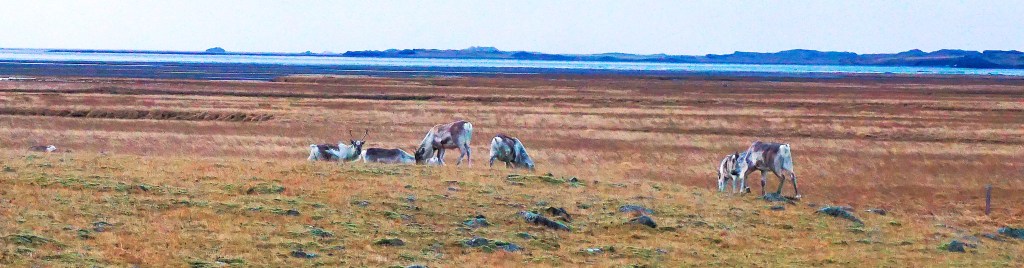
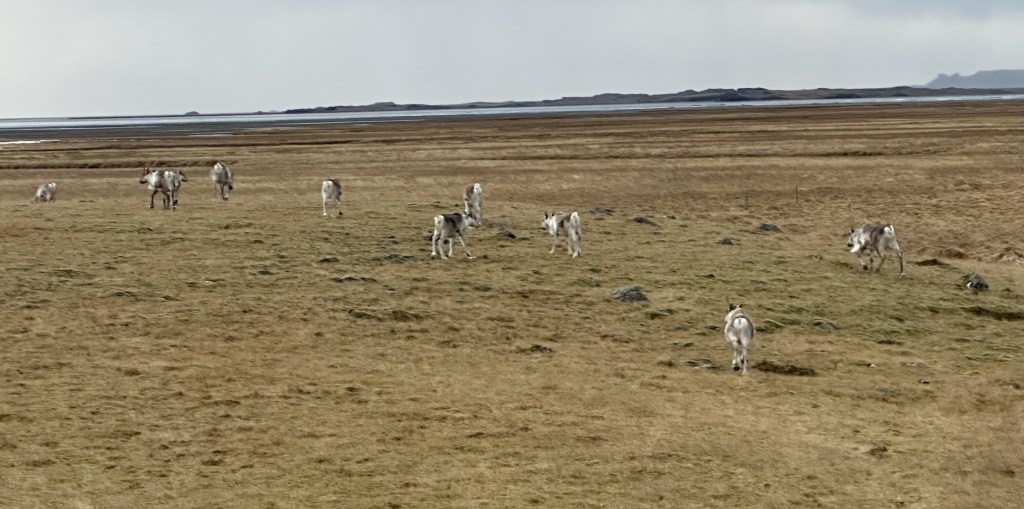
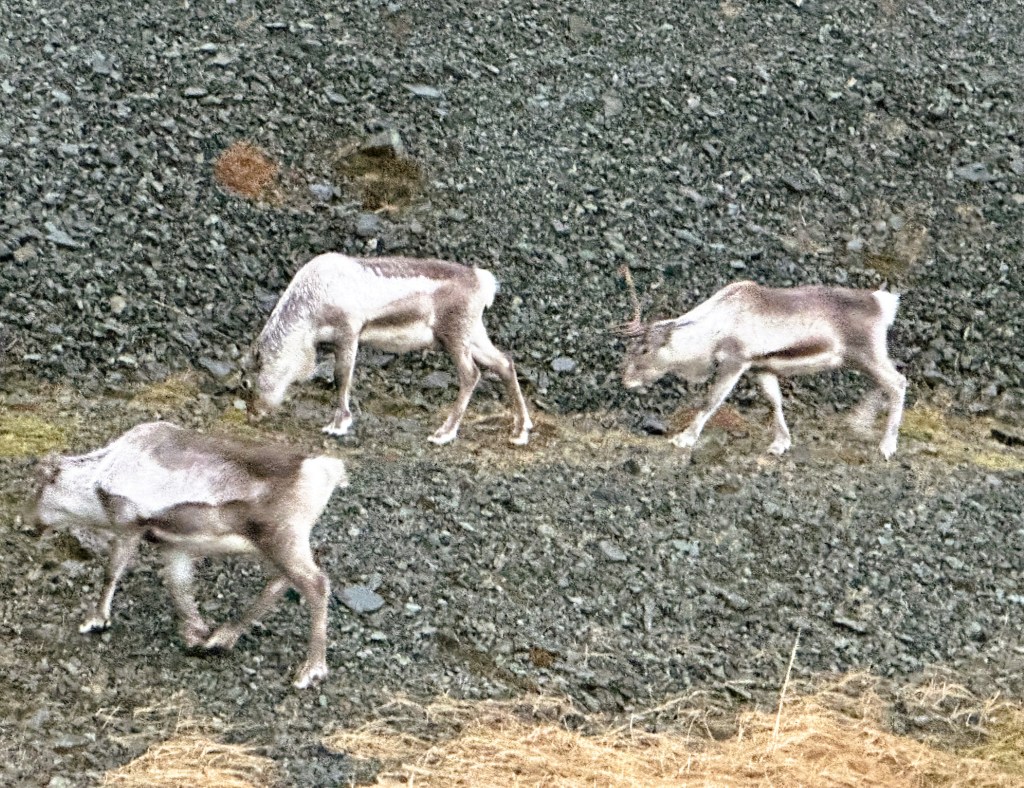
The only native land mammal inhabiting Iceland is the Artic Fox. Horses and sheep have become a permanent part of the countryside, and if you’re lucky you might see a reindeer or two along the way. Icelandic reindeer do not look like the animals we typically see in America, that are portrayed in film and animation, and not what we have come to believe reindeer should look like. Then again, why would we expect it?

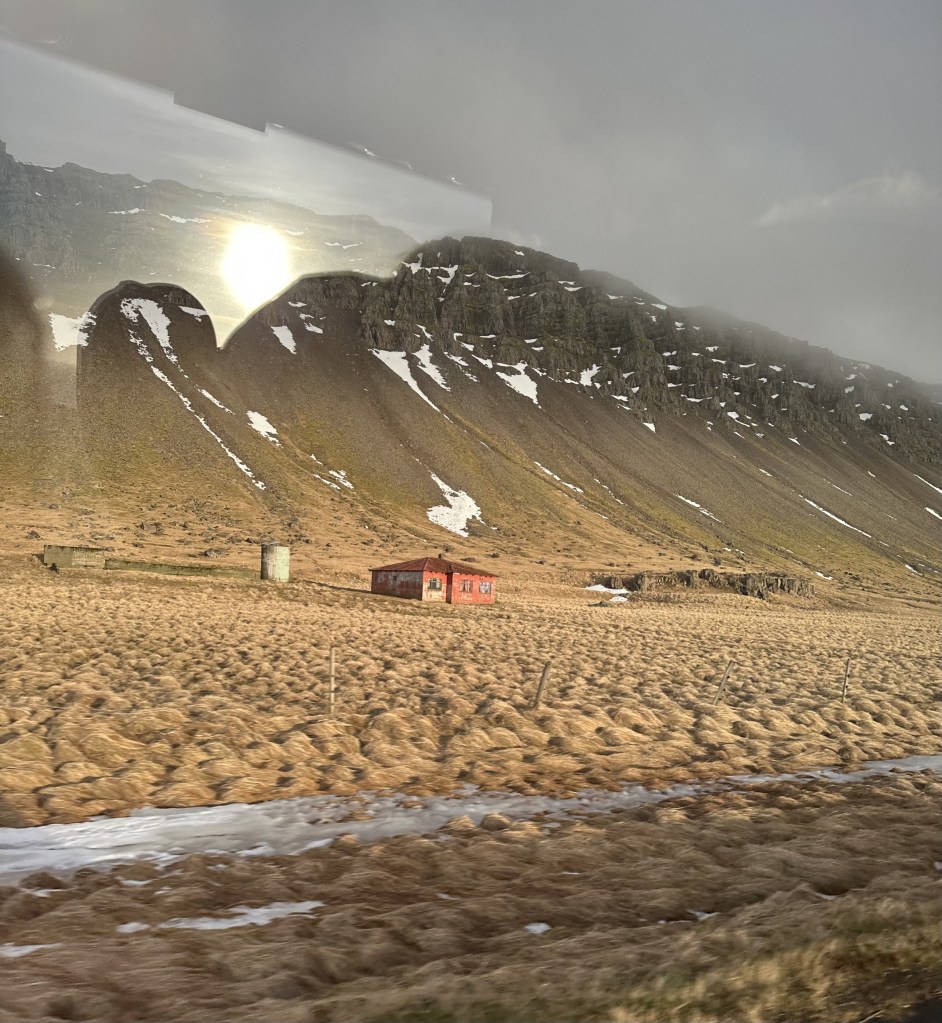
Apologies For Things Being Blurry – Pictures Taken From Our Vehicle To Not Startle The Reindeer
Crazy Beautiful – No?

Stodvarfjordur sits on the northern shore of the fjord of the same name and is home to approximately 200 inhabitants.

Picture Courtesy of B. Garrison

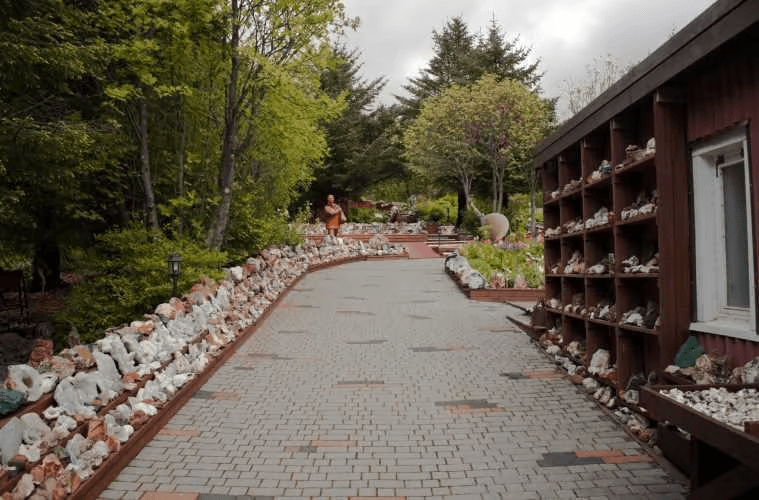
In this small village Ljósbjörg Petra María Sveinssdottir turned her lifelong love of rocks, stones and minerals into a superb collection.

Our next stop was the French fishing village Faskrudsfjordur found along the waters of the fjord of the same name. The village is on the far eastern coast of the island and has a population, as of the last census in 2011, of 662 people. Founded and settled by French fishermen in mid-1800s the village became home to the fishermen and their families, who built the city, the harbor, and a hospital(!).

Following the winter solstice and the days upon days of no or little sunlight Faskrudsfjordur celebrates the first day in which there is one hour of daylight with a pancake festival. No one remembers quite why pancakes, but the smell brings a sense of memory, comfort, and connection to the folks living in this small village.

Faskrudsfjordur Sits Across The Fjord
Cold Enough During Winter To Require Engine Block Plug-Ins

Greeted by the village’s welcoming docent we were fascinated to hear about what life is like in this isolated place. Not so different than anywhere else in the world! The city has a grocery store, restaurants, school, church, community and recreation center, hospital and medical clinic, craft workshops and local craft retail store. And would you believe, weather permitting, daily outdoor community-wide yoga/aerobics on the dock? We were privileged to tour a small northern lights museum and were overwhelmed by the beauty of the photographs proudly displayed and taken by 2 members of the community. A chance to explore the community’s craft store gave us time to consider buying locally handmade products made of wool. The gracious people of Faskrudsfjordur treated us to homemade cake and coffee. A wonderful visit.

Faskrudsfjordur: Downtown Dock
Faskrudsfjordur: From The Dock. Ever Thought Of Sea Stars As Artic Creatures?

Leaving East Iceland we headed west and somewhat north on our way to the Myvatn Nature Baths. Time to experience a relaxing soak in a geothermal lagoon! The Baths are only 65 miles south of the artic circle!

The vistas continue to be spectacular and ethereal…

Translated Jardbodin means earth’s crust, and presents a welcome entry to the Myvatn Nature Baths. Your host assures the reservation and hands you a locker key and towel. Once in the changing room and into bathing attire a required cleansing shower finishes your preparation for entering the lagoon. The warmth of the geothermal waters were especially appreciated after the brisk 10-yard walk from the changing room to the lagoon in windy (no, the wind never stops!) maybe 40-degree Fahrenheit temperatures. The wind chill hurried us along and into the waters.

Throughout the lagoon it’s kinda like the tale of goldilocks and the three bears…some spots are too cool, some too hot, and some just right.

Soaking in the lagoon, the body’s temperature was sure to rise above normal…and help with moderating that 10-yard walk back to the changing room. But to help that walk be less frigid, just about at the halfway point there was a “hot tub” – place for a warm-up before the last half distance to the changing room. Into the hot tub our party of six splashed. There was a young couple who had to move down to make room for us oldsters. I thanked the young man who responded with what I thought was an Amercian accent I recognized. I asked, and was told the couple was from Chicago… ” Nah” I replied, “where are you from? No one’s from Chicago; it’s gotta be a named neighborhood or suburb.” “Niles,” the young man stated. “Where’d you go to high school?” I asked. “Maine East, why?” was the reply. Turns out I went to Maine East High School only our graduation dates were 48 years apart! And of course, we had to travel over 3,500 miles to meet each other and compare notes on our teen years in the Chicagoland area. The last half-walk to the locker/changing room went easily and, bones properly soaked and with a relaxed demeaner we piled back into our transport for a couple of hour ride to our evening’s accommodations.

A quick note about gas stations in Iceland…they’re all convenience stores! A stop for gas turns into a bathroom break, get a snack or freshly prepared food/lunch stop, a chance to fill propane tanks or an RV dump, stock up on minor grocery items and/or souvenir shopping. N1 stops were one of the convenience stores on the Ring Road.

Traveling north and a little west from our relaxing soak at the Myvatn Nature Baths we had a scheduled stop at an N1 store. While there one of our party said to me: “Hey there’s one of you over there.” I guess I had overtalked my University of Michigan pride and wore enough gear to…well maybe be too much. “One of you” meant there were 4 more people displaying University of Michigan colors here, in Iceland, at exactly the same moment at this stop. Wandering over I greeted the group with the requisite “Go Blue” and was delighted with the salute in return. Talking for a moment we all compared the usual…where we lived, memories and dates of being on campus, connection to the University over the years, and eventually where we grew up. Everyone in the group was from Chicagoland, and one of the women in the group grew up in Park Ridge, Illinois. She was a graduate of Maine East High School, two years prior to my graduation from, you guessed it, Maine East High School! What are the odds of meeting two different groups of people anywhere in the world that within each group there was an alumnus from my high school? Redefine that definition of a small world?

We are now in Northern Iceland and had new landscapes to view on the way to our hotel.

Iceland has become a journey that is as mesmerizing as it is unforgettable. The country is an unsettling geological blend of beauty and foreboding, sculpted over centuries by volcanic activity, glacial movements, and the relentless fierce forces of wind and water. Its terrain is varied and can be surreal, and in our mind’s eye there’s a sense of walking through a dreamscape. Whatever our perception prior to arriving, the country continues to reveal its surprises day by day.

Barbara and Brian

“It’s not what you look at that matters, it’s what you see.“ – Henry David Thoreau

ICELAND – GLACIERS, ICEBERGS AND NATURE’S ICE SCULPTURES

February, 2025

At the end of each of our first two days in Iceland and with five more days ahead of us, comments were made about whether or not it could get any better. Simply, yes. Our adventure today started out overcast, the sun peeking out on occasion, and then was followed by a misty rain for most of the day. But to catch sight of the majesty of a glacier, the delicate beauty of ice sculptures washed ashore, and icebergs, the free-floating fragments of ice broken off of a glacier or ice shelf is worth enduring the elements.

The hotels chosen for us by the tour company, particularly those outside of the Reykjavik metro area were one story, with several barracks of interconnected rooms that were well appointed, comfortable, and geothermally heated. Each hotel on our tour offered a three-course dinner and full hot breakfast.

The vista we could see out our back door after settling in at last night’s lodging was captivating, particularly as the sun was setting. Sunrise revealed an even more beautiful vista gazing out in the same direction.

Sunset
Next Morning

The landscape along the way to our first stop at Skaftafell added to the enjoyment of our travel.

The Skeidara Bridge Monument is just a mile or two from our morning hike in the Skaftafell region of the vast Vatnajokull National Park to experience the grandeur of the Skeidararjokull Glacier. Once the longest span in Iceland, the Skeidara Bridge carried drivers across a wide plain of black volcanic sand marbled with creeks of run-off from the glacier.  In 1996, the volcano Vatnajökull, which sat beneath the glacier erupted, melting portions of glacier and creating massive floods. While the girder bridge was built to withstand a hefty amount of flood waters, there was no preparing for the house-sized icebergs that the floods washed down the plain. A number of these glacial shards crashed into the bridge, wiping it out and creating a gap in the ring road. All that remains of the original bridge today are two twisted girders by the side of the new road.

Skeidara Bridge Monument with a View of the Skeidararjokull glacier in the Background

Our mile long hike through Vatnajökull National Park was an exhilarating journey. As we climbed to a hilltop, we were surrounded by glaciers, lava fields, and clear streams. The scenery was breathtaking.

At the summit, the view of Skeidarajokull Glacier was stunning. The landscape’s beauty and scale made us feel small and humbled.

Picture Credit: B. Garrison

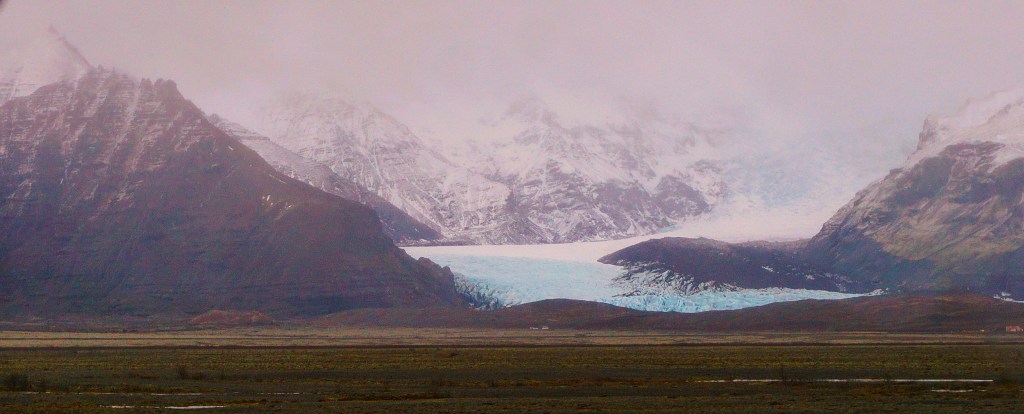
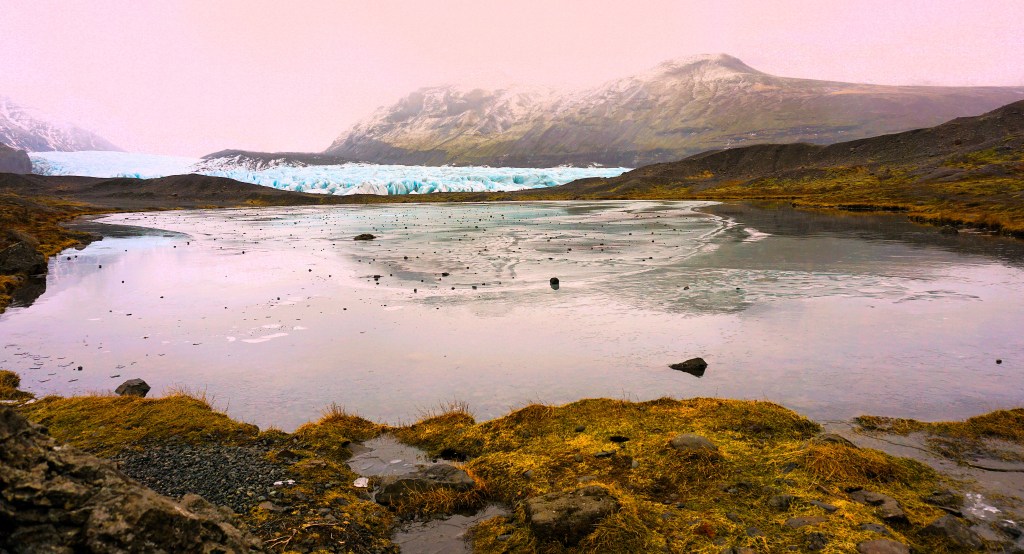
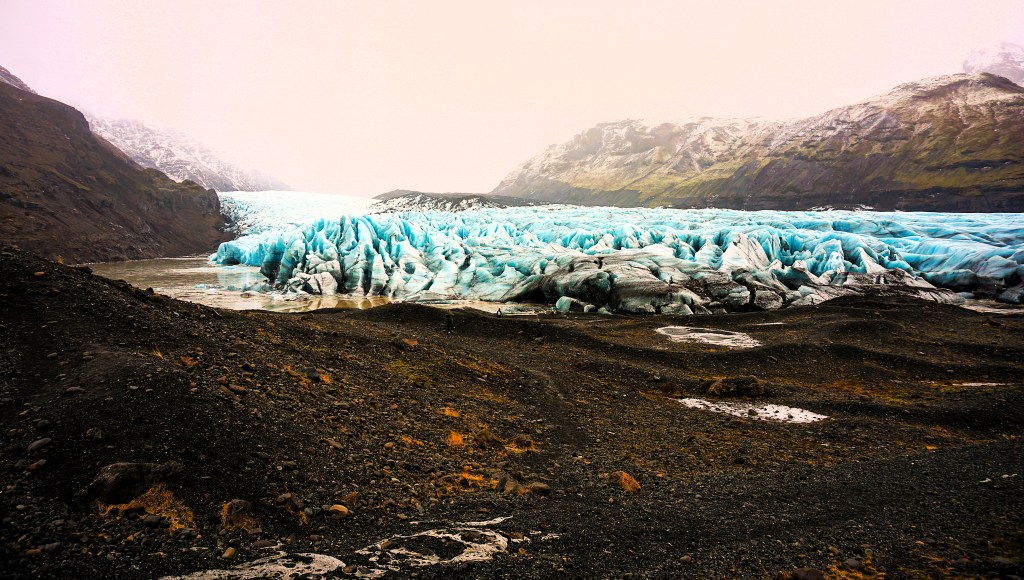
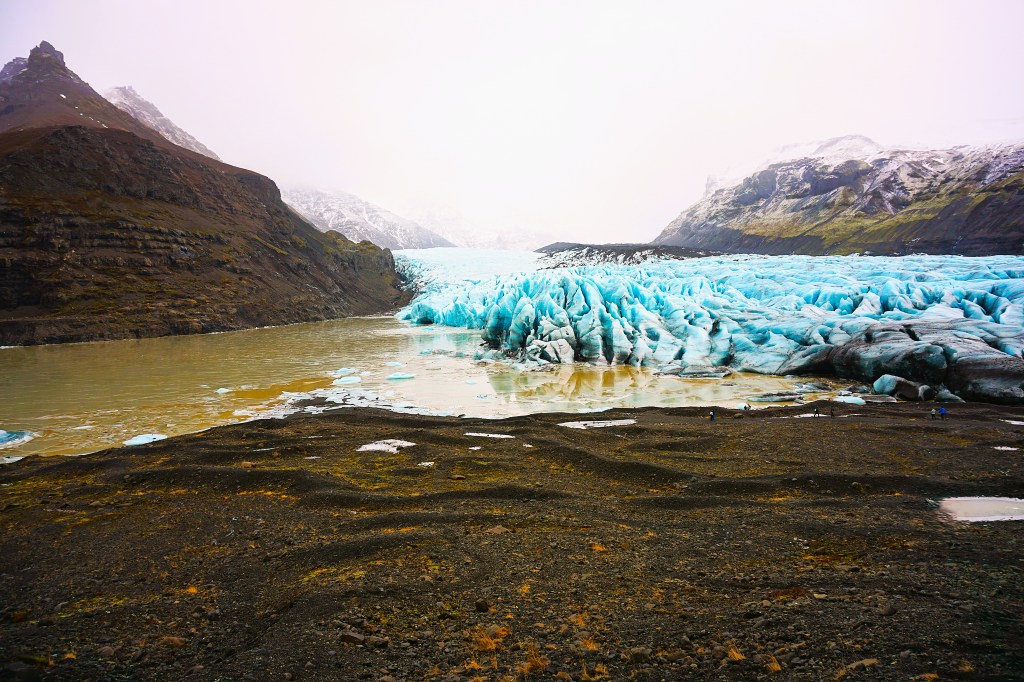
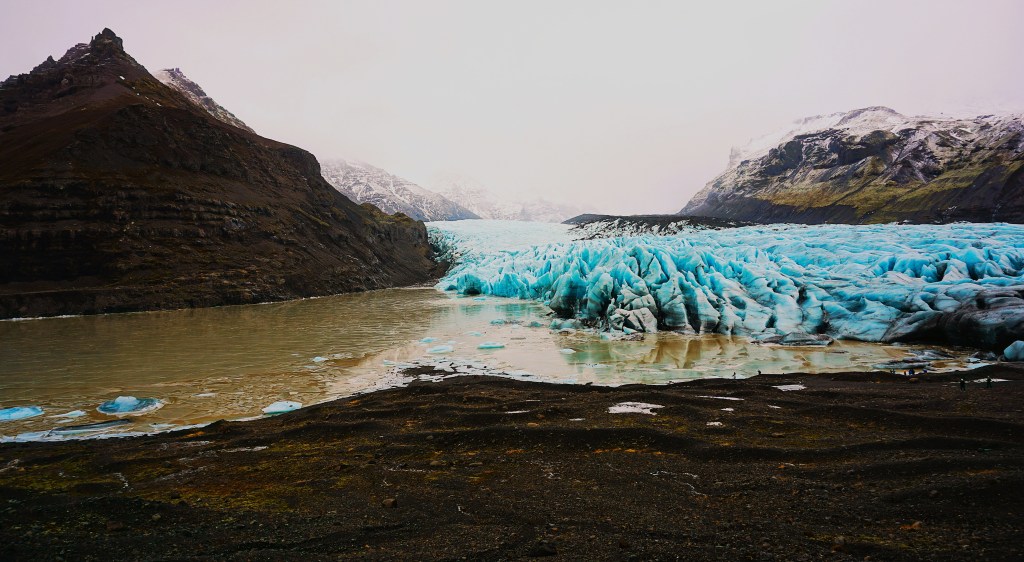
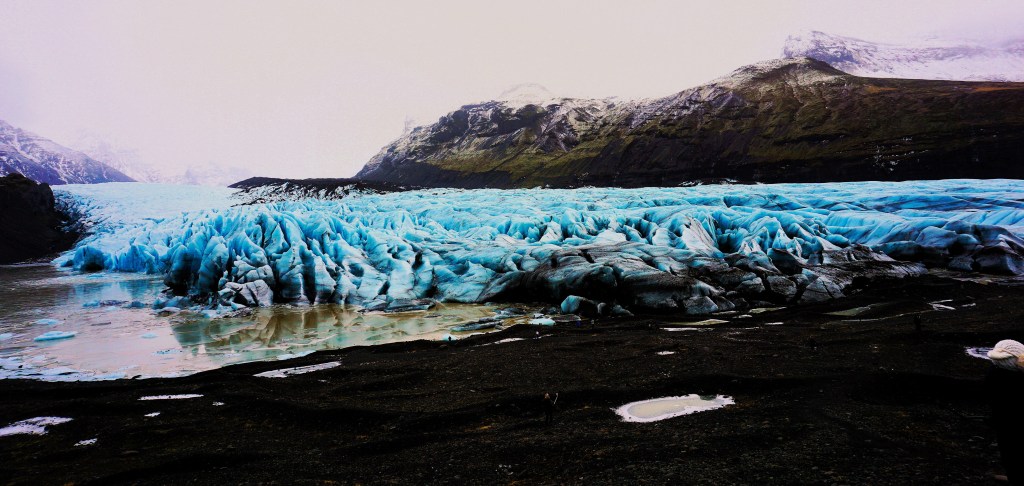
The blue of the Skeidararjokull Glacier is observable along both sides of this mountain terrain. The Skeidararjokull glacier is a part of the Vatnajokull Glacial Mass. The Vanajokull Glacial Mass is Europe’s largest by volume, encompassing almost 5,100 square miles or 15% of Iceland’s total landmass.

Skeidararjokull Glacier Bisected By A Mountain Range
For Perspective As To The Size Of The Glacier – Can You Find The People?
Another Just for Perspective: Those Are People On The Bottom Right!

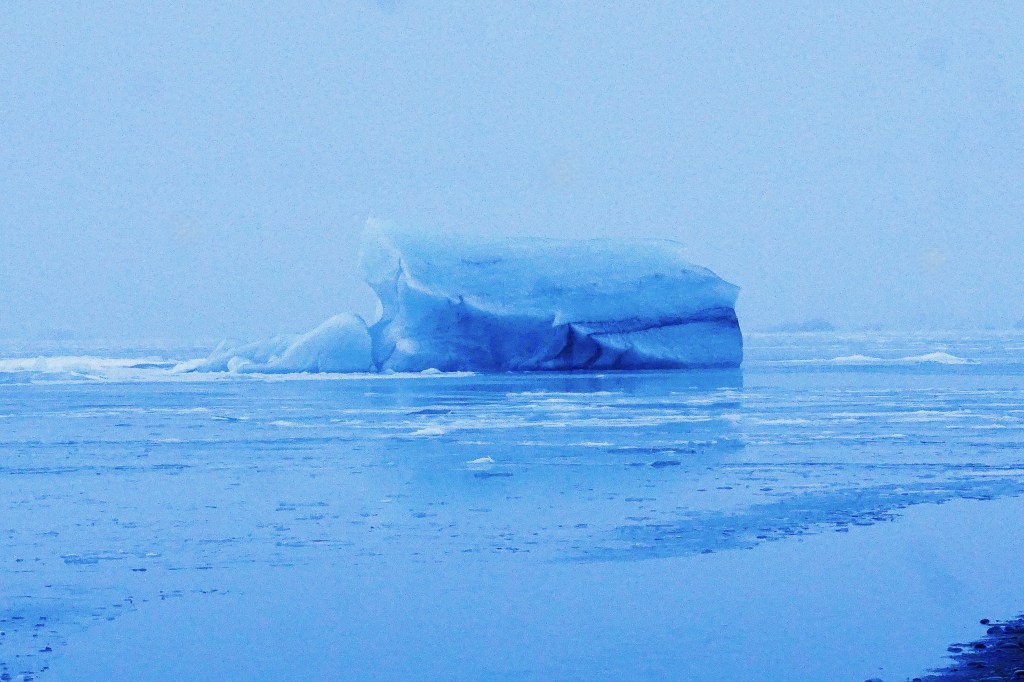
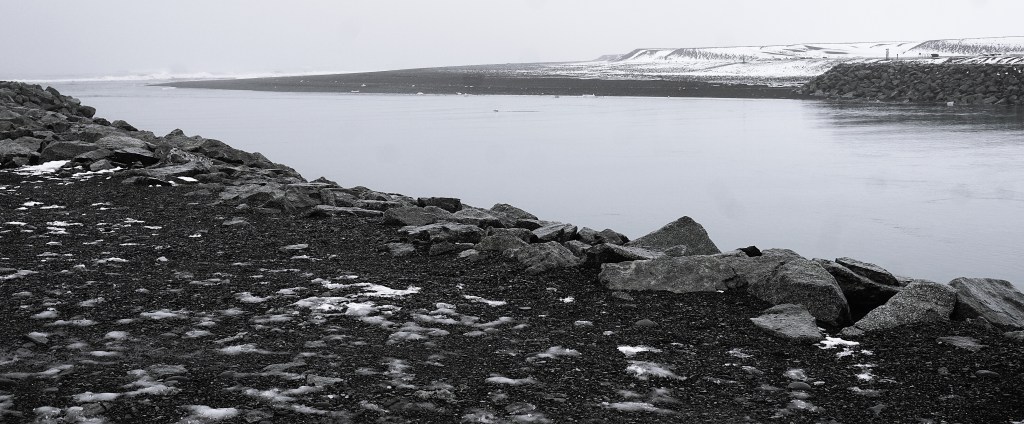
Jokulsarlon Glacier Lagoon is at the very southern edge of the Vatnajokull glacier. Large chunks of ice or icebergs regularly calve from the glacier and eventually make their way to the sea by way of the glacier lagoon. Dense ice, such as that found in a glacier absorb and reflect light differently than is observed with ice from other sources. This results in a blue, almost turquoise, color. Add a low hanging cloud cover with a misty rain we experienced this day and the entire panorama takes on that blue hue.

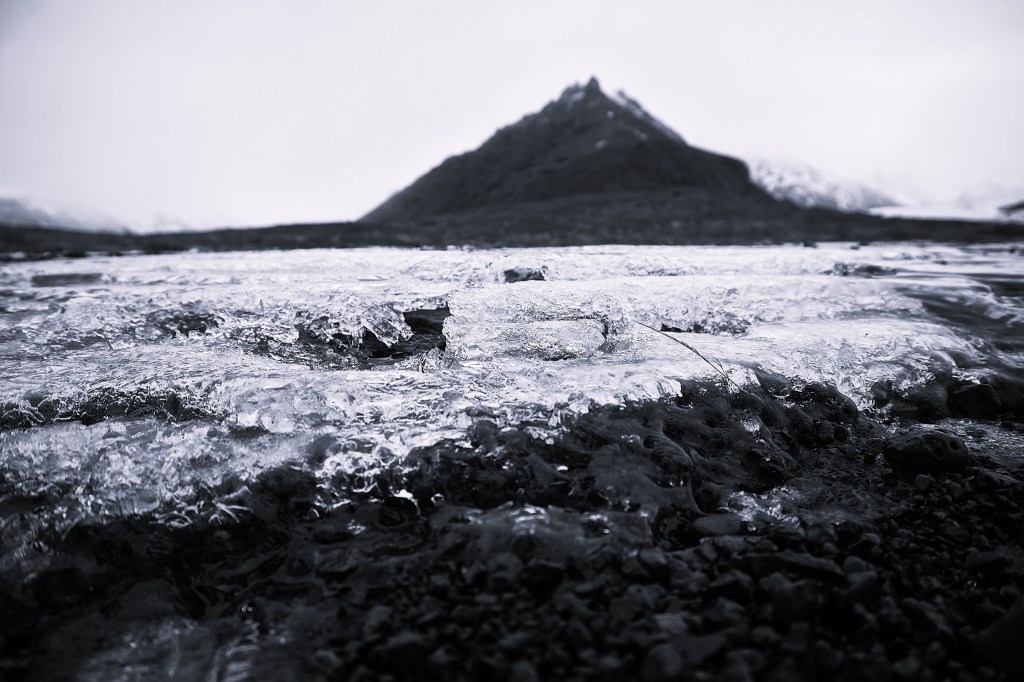
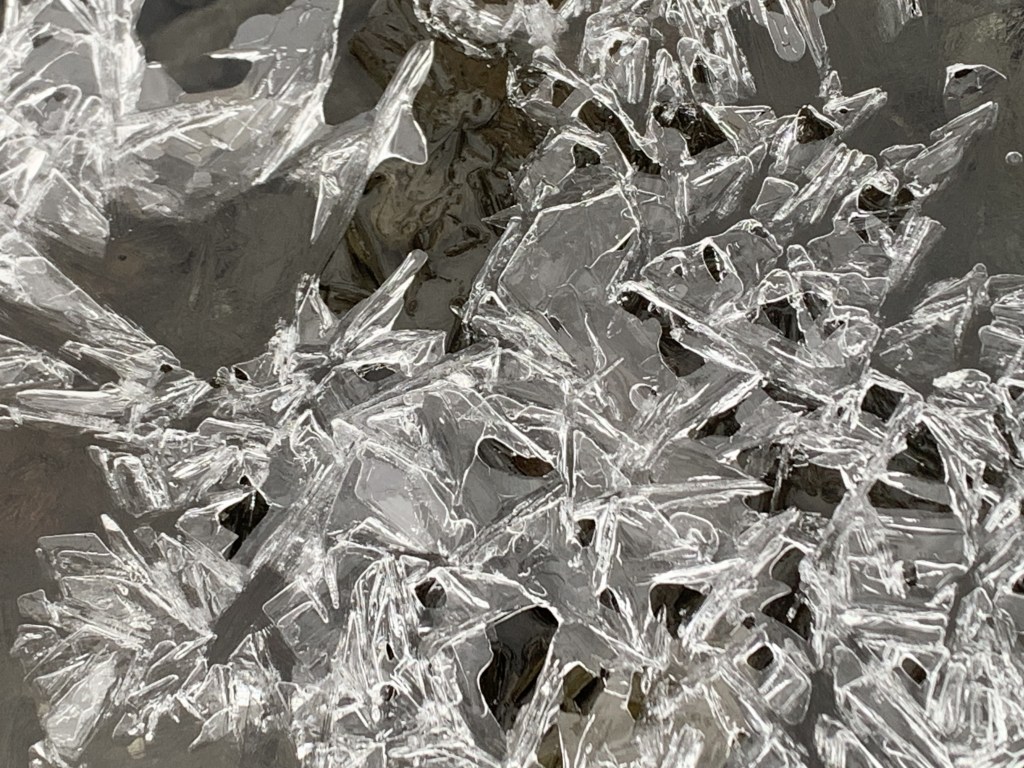
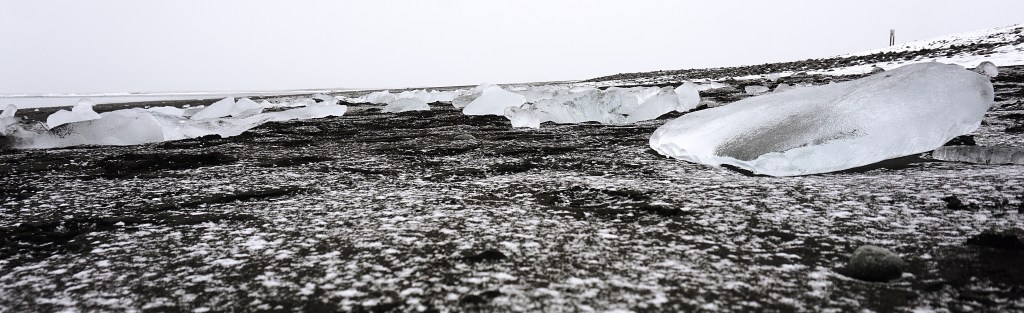
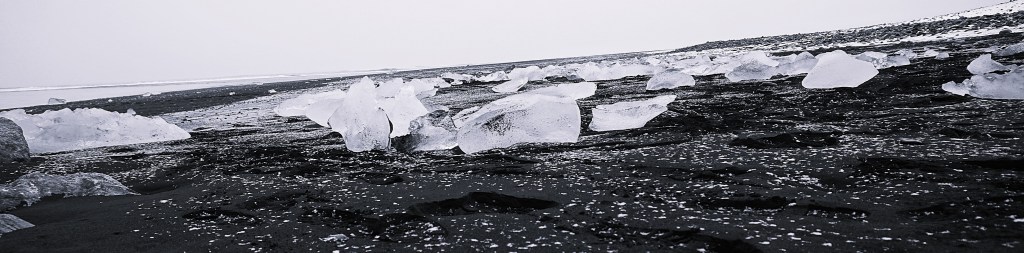
As the icebergs from glacier lagoon tumble, flip and roll along with the currents on their way to the sea interesting ice sculptures wash ashore on the adjacent black sand beach. On a clear sunny day the light plays amongst the icy sculptures with a brilliant effect – shining like a diamond. Welcome to Diamond Beach.

For us and our new friends, Iceland has become a living testament to the artistry of Mother Nature – a breathtaking illustration of the raw, unspoiled power of nature that creates landscapes unlike any other on Earth.

Barbara and Brian

“It’s not what you look at that matters, it’s what you see.“ – Henry David Thoreau
ICELAND – WATERFALLS, BLACK BEACHES AND FOLKLORE

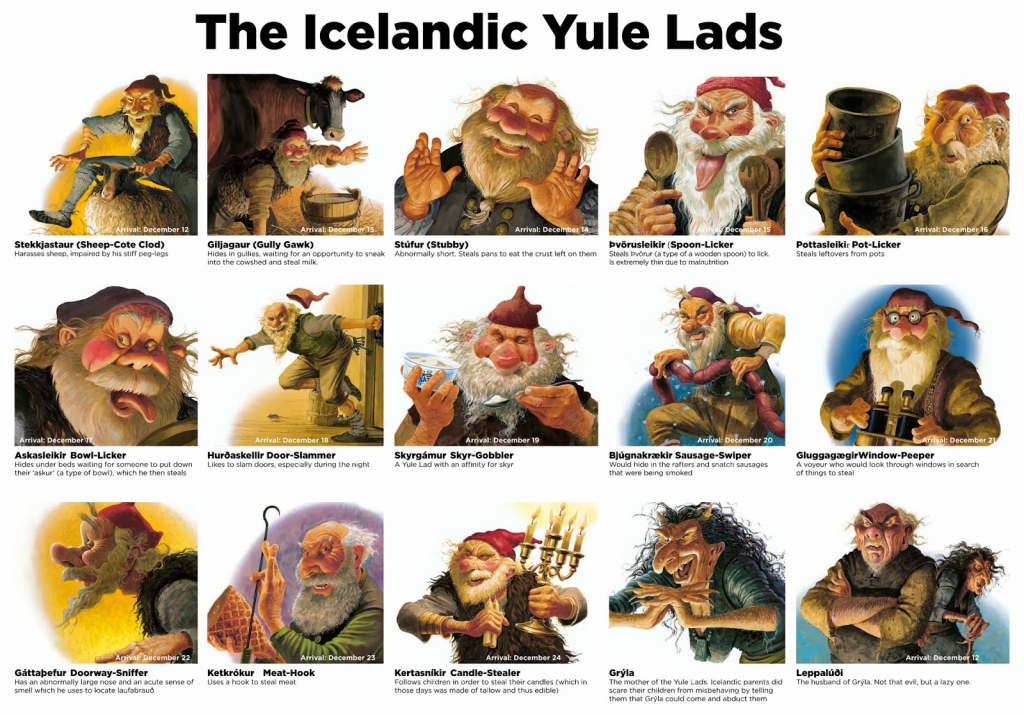
The Yule Lads

February, 2025

Our second day in Iceland and after a great breakfast buffet at last night’s accommodation we were off on today’s adventure. Our first stop afforded the opportunity for an interactive learning experience about Iceland’s volcanic activity, frequent earthquakes, and evolution. Not exactly as if we were outdoors watching mother nature’s fury, but the videos, explosive sounds, and accompanying tremors beneath our feet gave us a sense of the enormous power of the earth’s intensity. What could be a more appropriate name for this exhibition than LAVA?

All right – let’s get this out of the way. The Icelandic language is difficult at best, not just because the arrangement of letters make tongue twisters, but also because of the diacritic marks that go along with some letters at some time. For example there’s a volcano whose name includes 16 letters and 3 diacritic marks, the first letter of which is an E – so difficult to pronounce even the Icelanders call it E15. We’re proud we actually learned an Icelandic word…foss. It means waterfall.

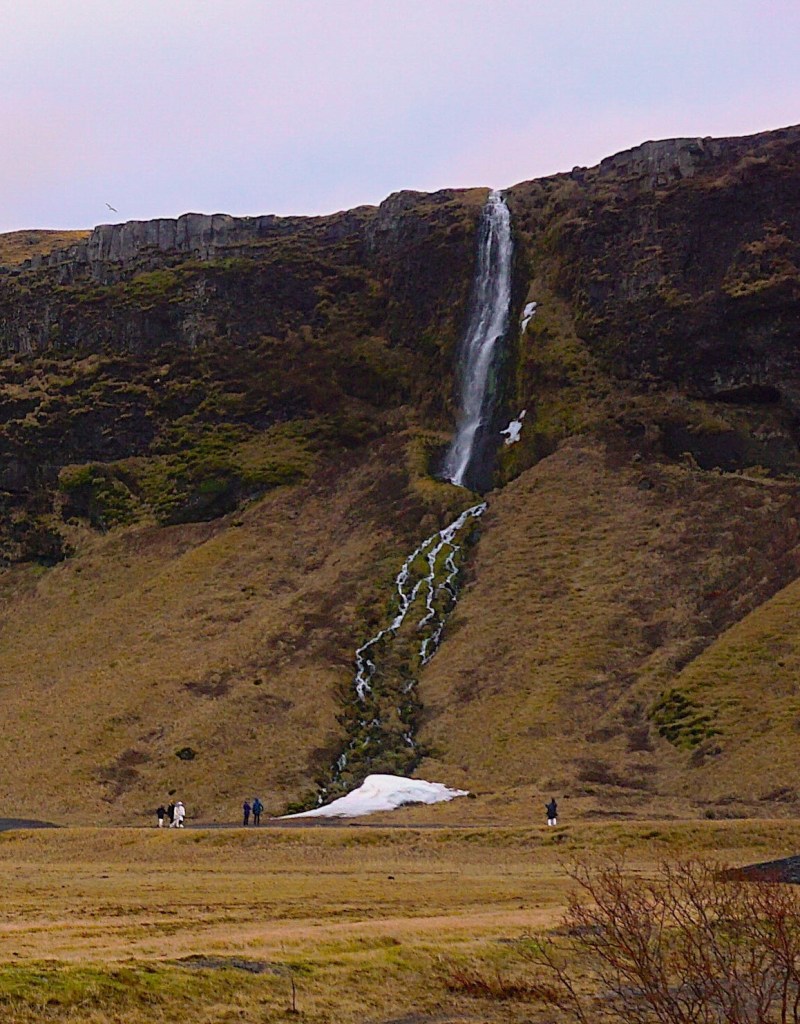
Gljufrabuifoss, our first waterfall for today, is a about 40 meters tall, and is difficult to reach as the pathway is undeveloped and also involves crossing a shallow stream without a bridge.

Gljufrabulfoss
Gljufrabulfoss

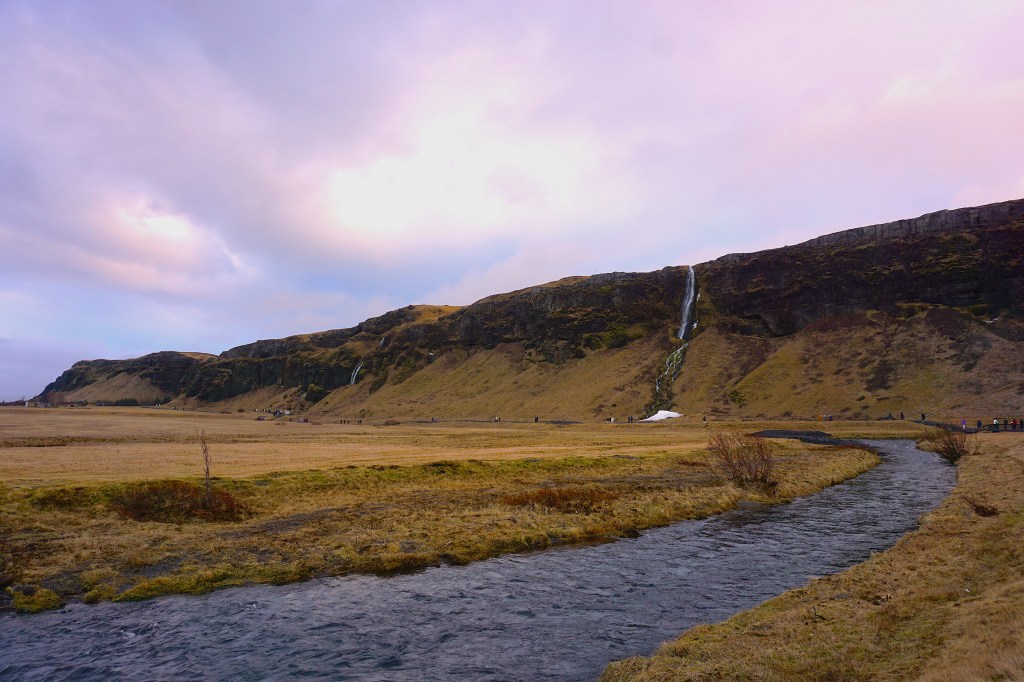
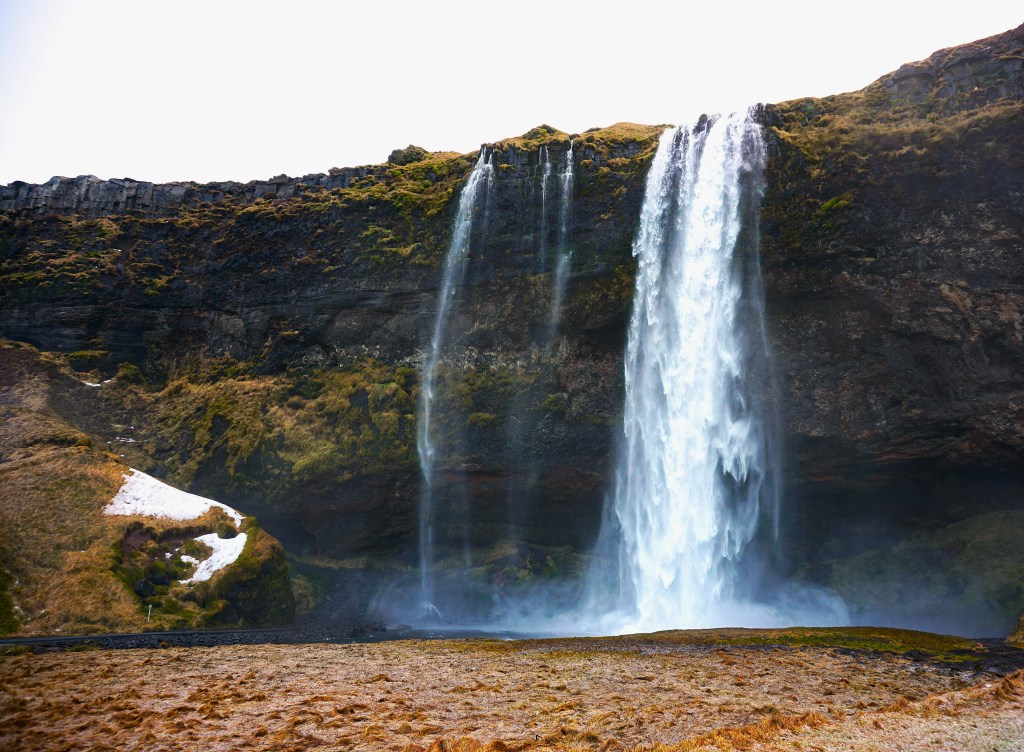
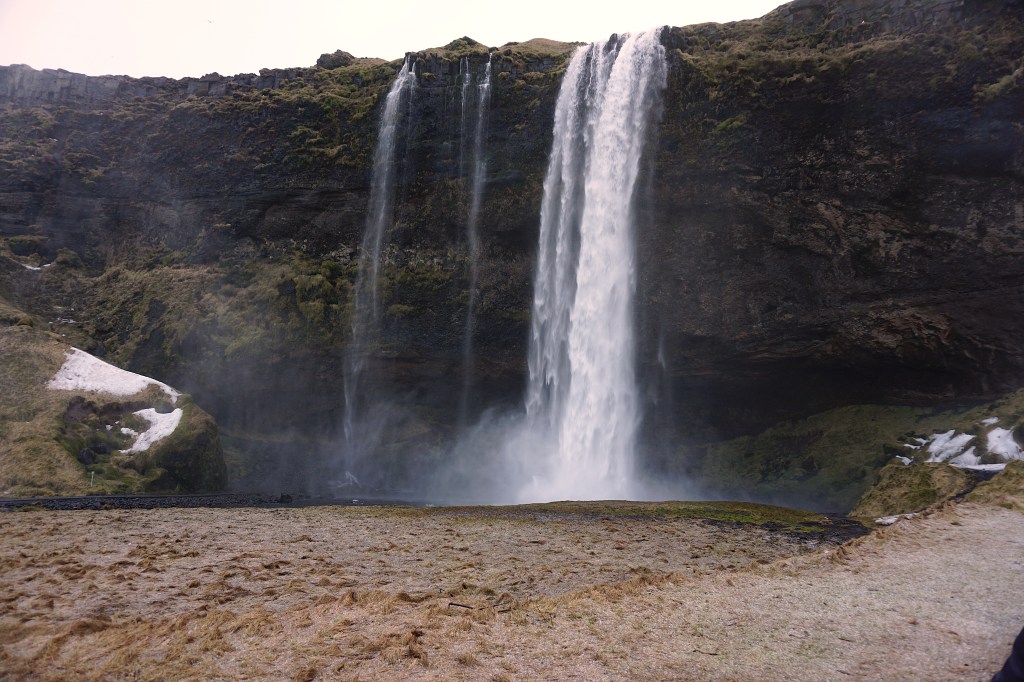
Seljalandsfoss is considered one of the world’s 10 most beautiful waterfalls, as the Seljalandsa river plummets 20 meters over the cliff face. It is unique amongst Iceland’s waterfalls as the shape of the cliff over which it falls allows visitors to walk at the base of the falls and behind the chute. Access to the walkway is weather dependent, and unfortunately winter is not a good time for the experience. Beautiful, nonetheless.

Seljalandsfoss
Base of Seljalandsfoss

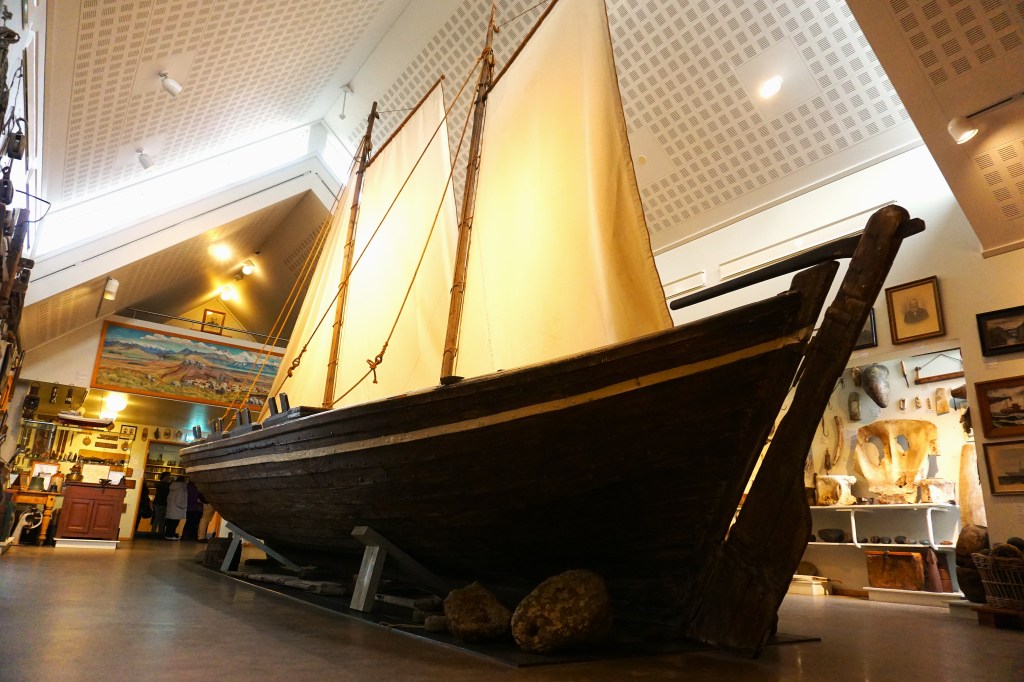
The Skogar Folk Museum is loaded with historical artifacts, like the eight-oared fishing boat Petursey donated to the museum in1952…

…or preserved turf dwellings built around 1840 that were moved intact to this site…

The Windows May Be Modern, But Imagine This As Your Home. Wonder What The Inside Of A Turf Home Smells Like?

…but as soon as folklore, trolls and Iceland’s Yule traditions became the focus of our museum tour nothing else mattered. Folklore is integral to the Iceland culture. Trolls are not small creatures to Icelanders. They live in the hills or may be part of the invisible people walking alongside citizens in everyday life or may have been caught out in the seas at sunrise and turned into sea stacks. They may be malevolent or mischievous or bearers of good fortune.

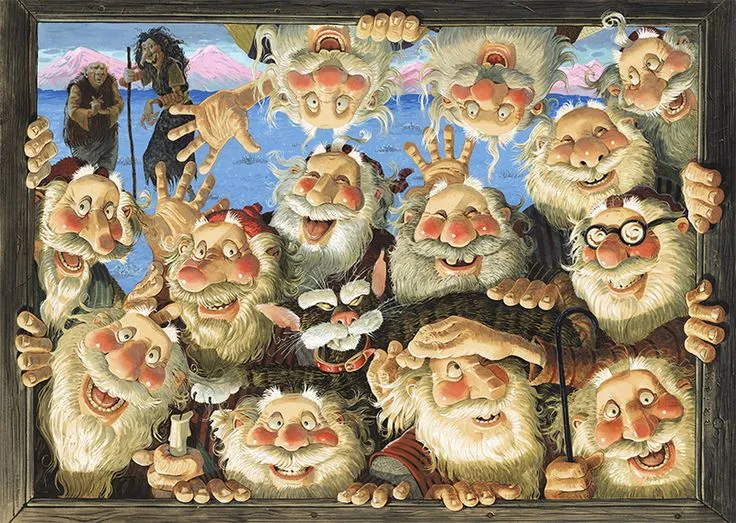
Iceland does not celebrate the Yule with traditional Christmas activities. Their traditions involve our favorite trolls – the Yule Lads. According to lore there are 13 Yule Lads born of Gryla, a woman who married 3 times, and gave birth to 88 children. Gryla ate her first two husbands following their death and reportedly ate 75 of her 88 children. The 13 Yule Lads are mischievous rascals making households a bit more interesting during the Yule season. Each spends a staggered 13 days over the Country’s 26 days roaming about the villages, cities and homes of Icelanders before heading back home to the hills. The Yule Lads include: Stubby, Sheep-Cote Clod (pegged-legged, harassing sheep and drinking their milk); Gully Hawk (hides out in ditches or gullies and waits for an opportune moment to run into the cow shed and lick the foam off the milk in the milking buckets); Spoon-Licker, Pot-Licker, Bowl-Licker, Door Slammer, Skyr-Gobbler (yogurt), Sausage-Swiper, Window-Peeper, Door-Sniffer, Candle-Stealer, and Meat-Hook (steals meat).

Not sure how Stubby makes life more difficult but just imagine a visit from any of the others while trying to survive the Icelandic winter. Bad enough? Nah. There’s also specific attention focused on children during the Yule season. Icelandic children leave a single shoe “out” overnight and tradition has it that the Yule Lads will either leave a treat in the shoe of “good” children or a rotten potato in the shoe of “bad” children. Since this is Yule the folklore regarding the identification of good and bad children leads to up whether or not a child receives clothing as their Yule gift. No new clothing and the child will be visited by Jólakötturinn, or the child-eating Yule Cat. Jólakötturinn is a black cat the size of a house that roams the Icelandic countryside, attacking and eating children who fail to wear at least one new piece of clothing. Is the moral of the story that old “be good for goodness sake” or something more malevolent? Isn’t folklore interesting?

Gryla
Jólakötturinn

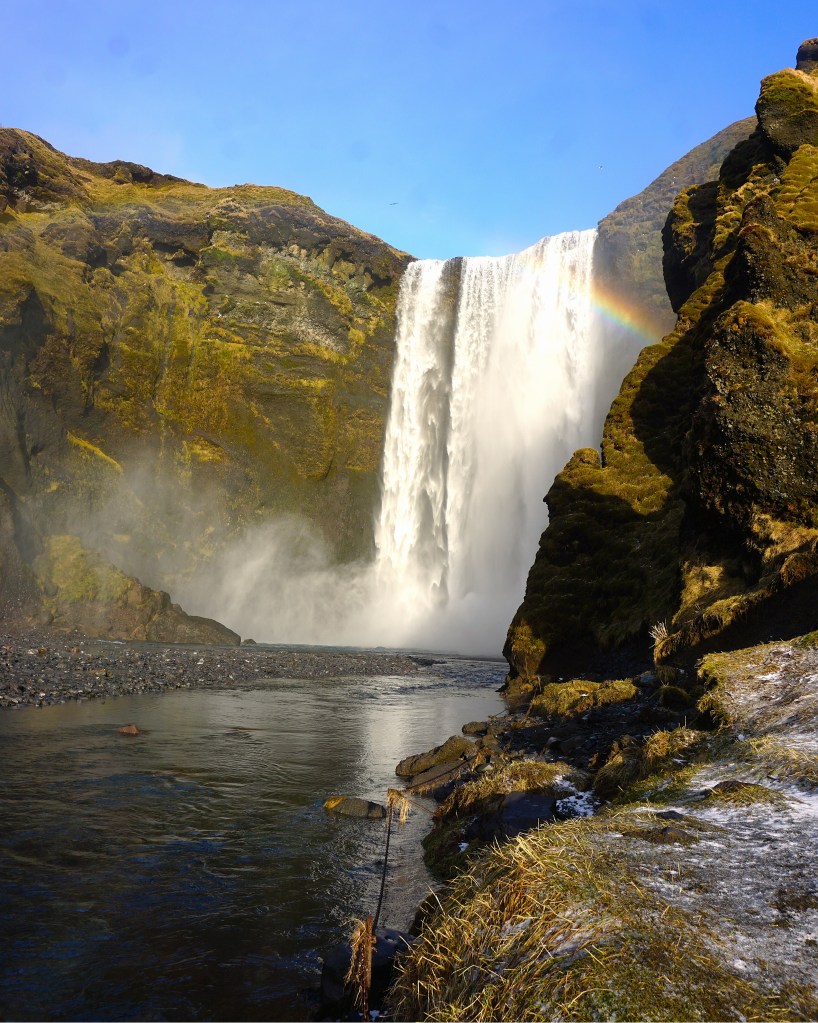
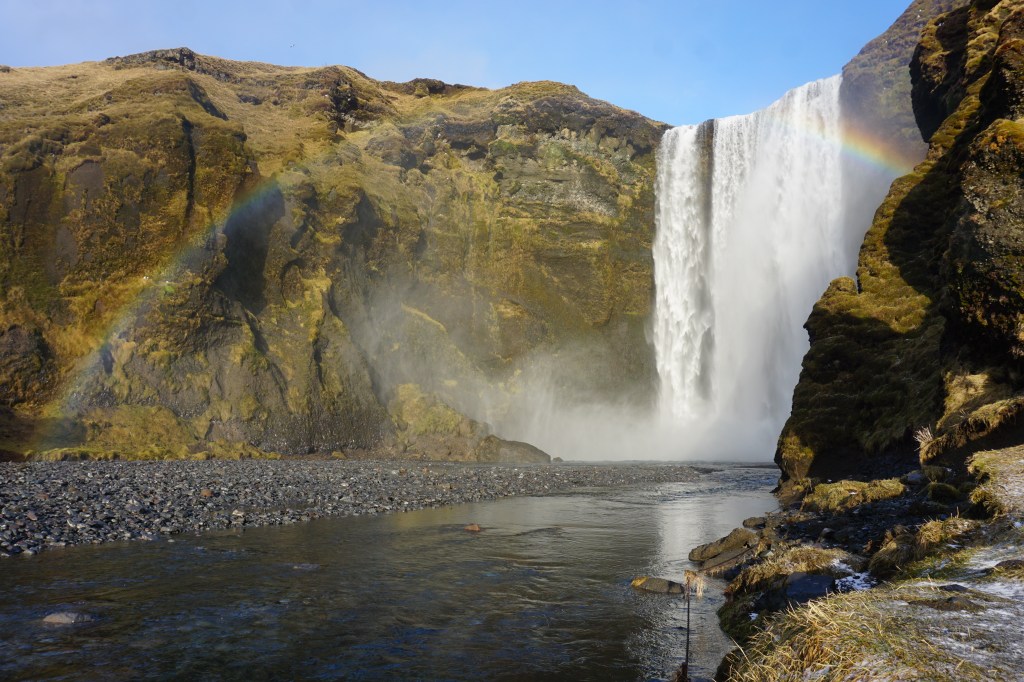
A short walking distance from The Skogar Folk Museum is Skogafoss, another waterfall that has been called one of the world’s 10 most beautiful. Skogafoss is 60 meters high, and according to folklore, the first Viking settlers in the area hid a treasure in the cave behind the cascade. The treasure has never been found, and since the land has been inhabited since the late 9th and early 10th Century CE, that treasure is well hidden.

Myrdalsjokull Glacier
Skogafoss
Can You See Both Parts Of The Rainbow?

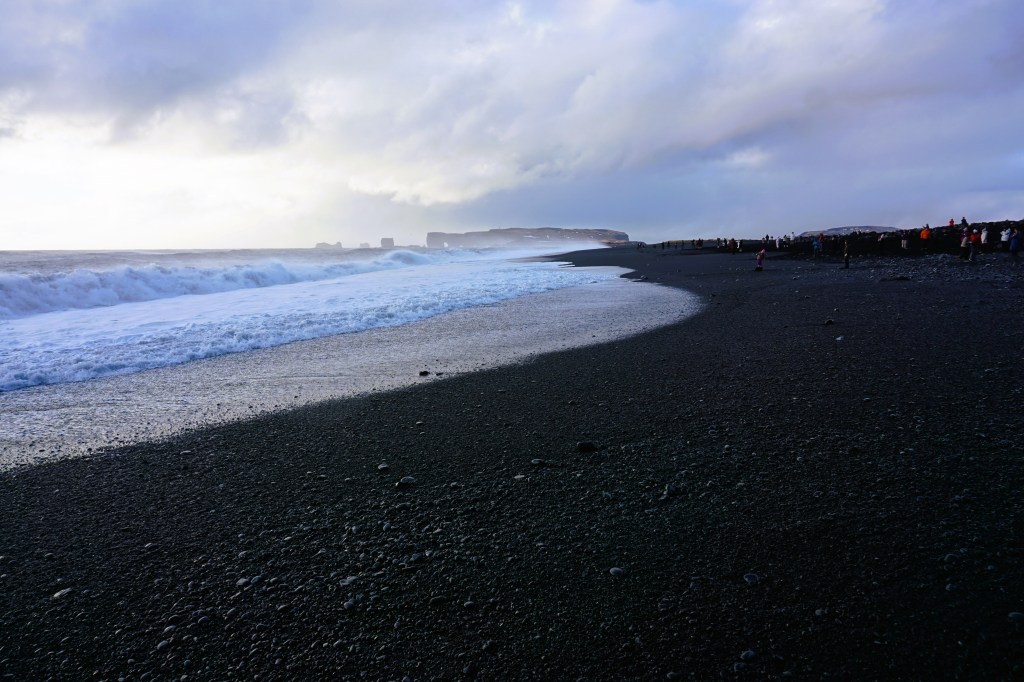
Walk on a beach in Iceland and you’re walking on black sand that was once lava. The hot lava flowed across the land, towards and into the sea. When it hit the cold water the lava cooled and formed solidified chunks of basalt that slowly began eroding and breaking down into small pieces of volcanic rock. Over the centuries, these small pieces became even smaller, until they’d been weathered into tiny pebbles of sediment that make up the black sand we recognize today.

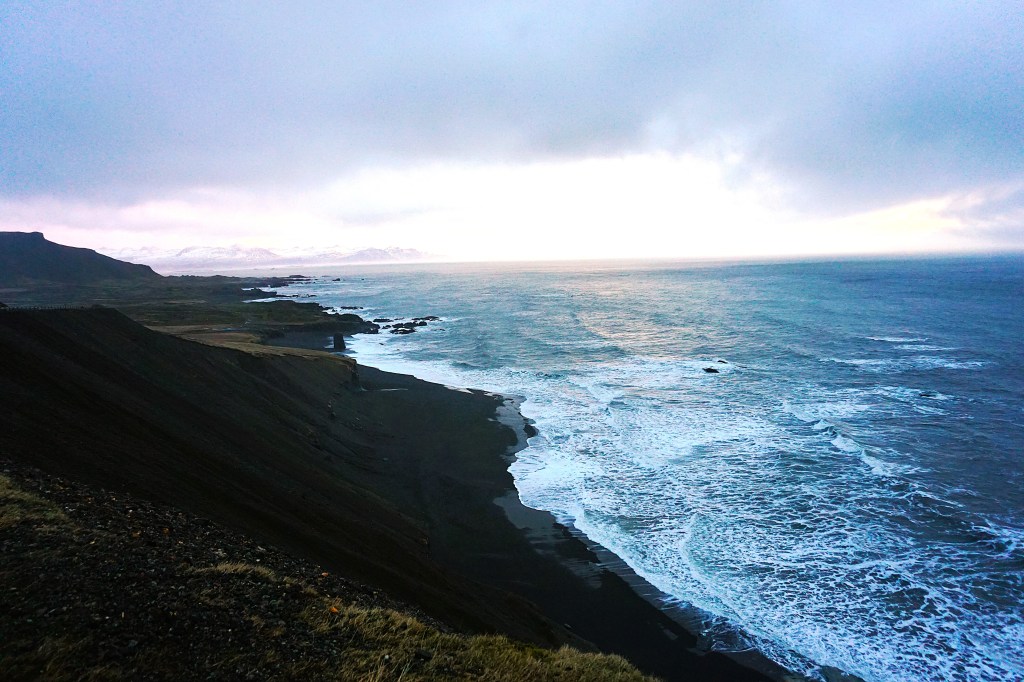
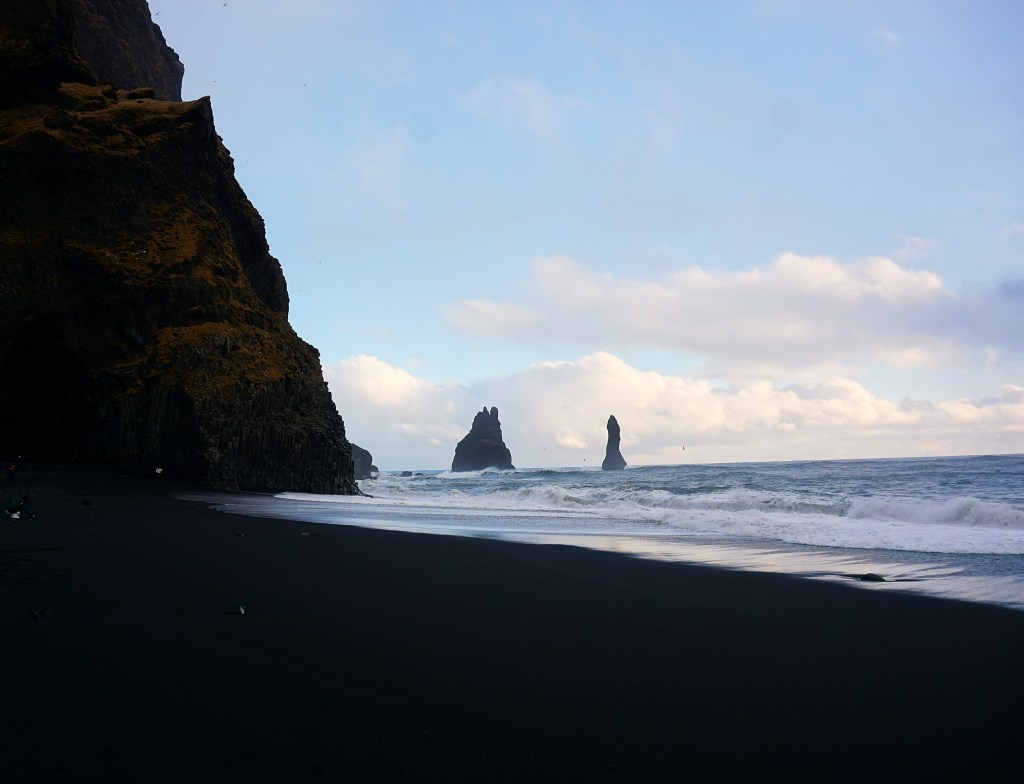
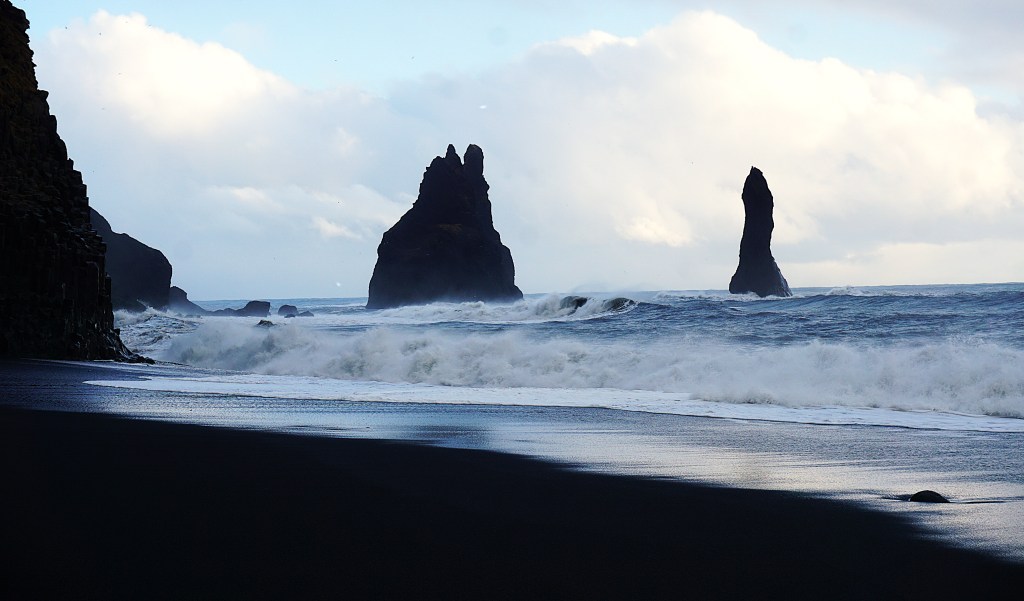
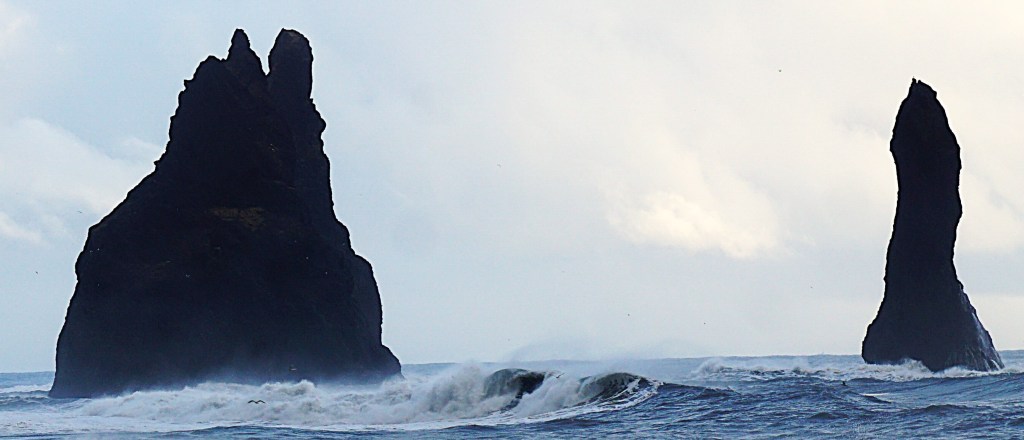
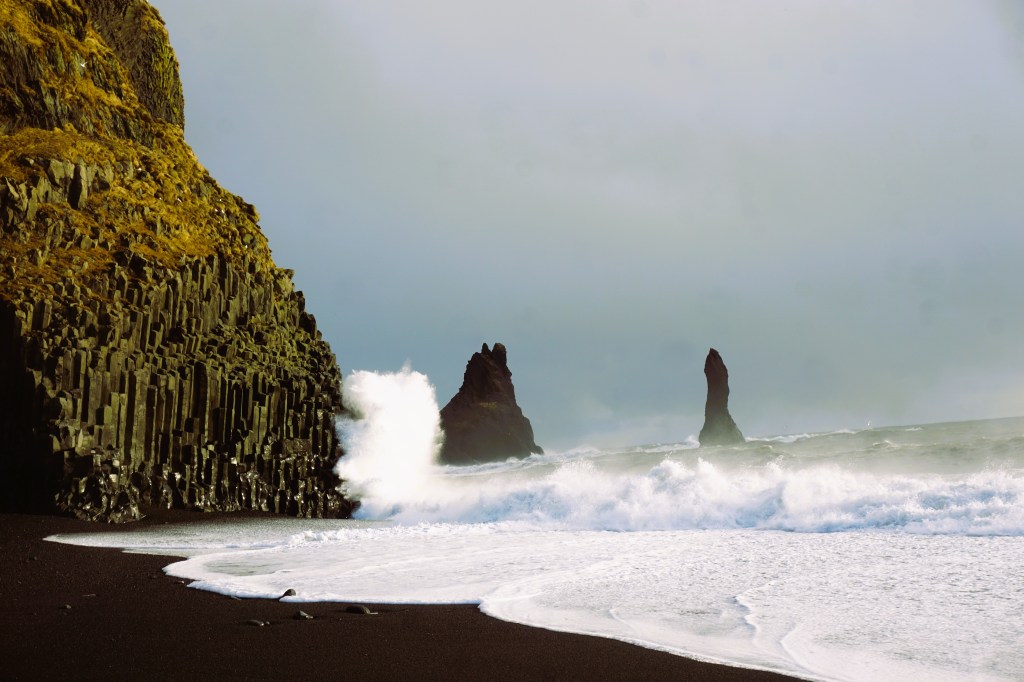
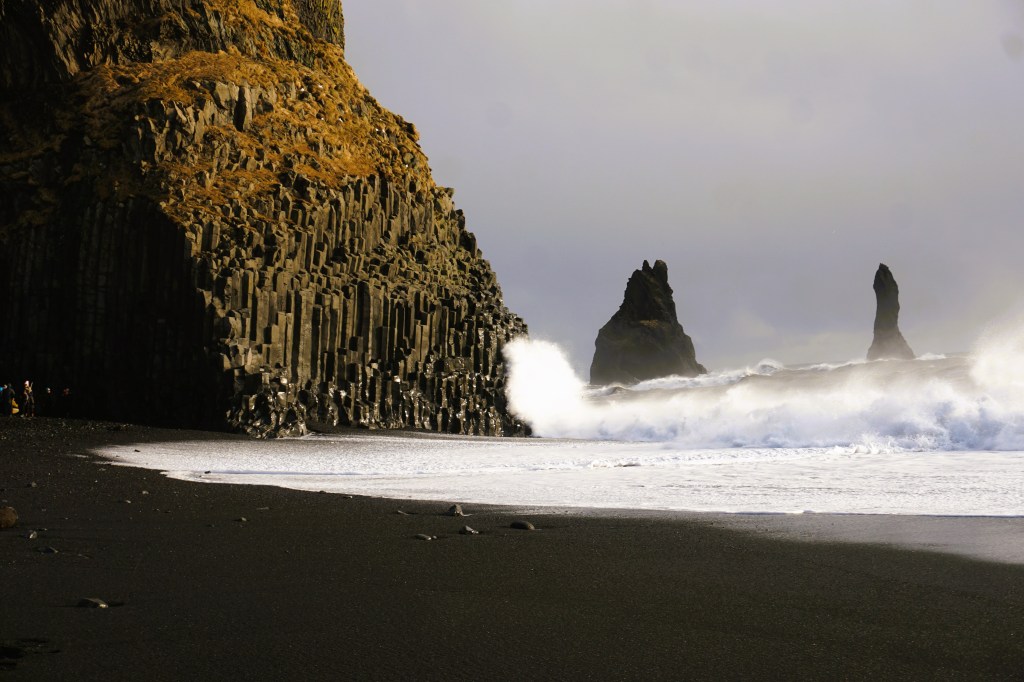
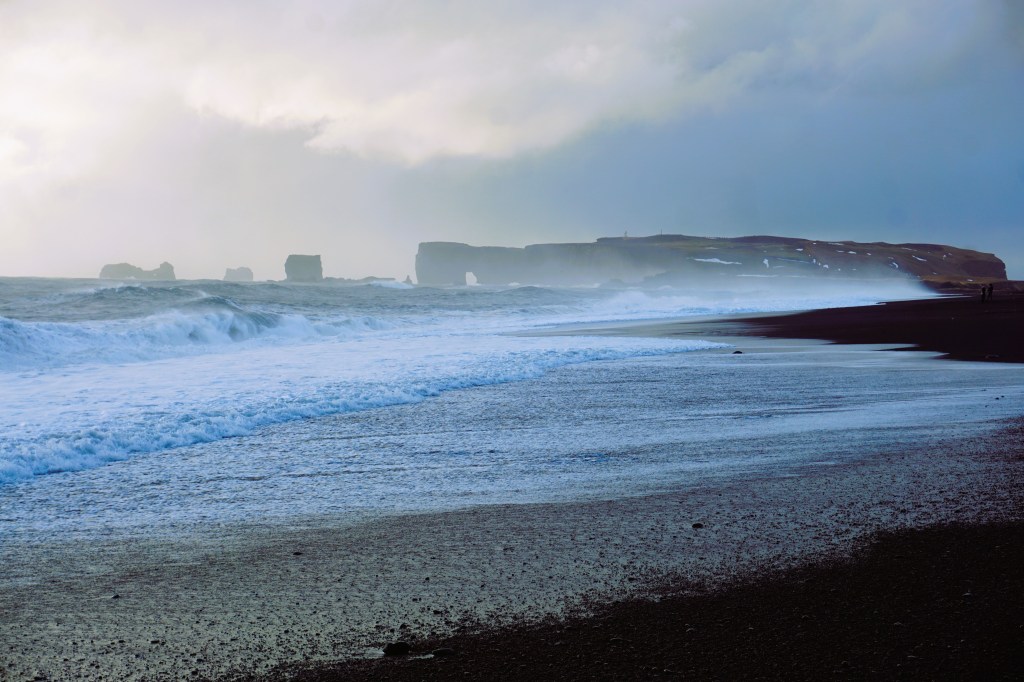
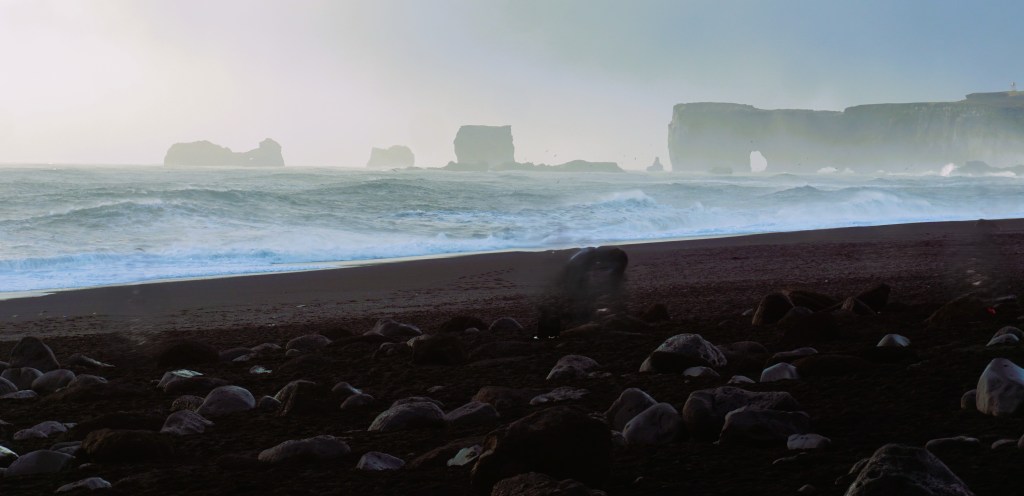
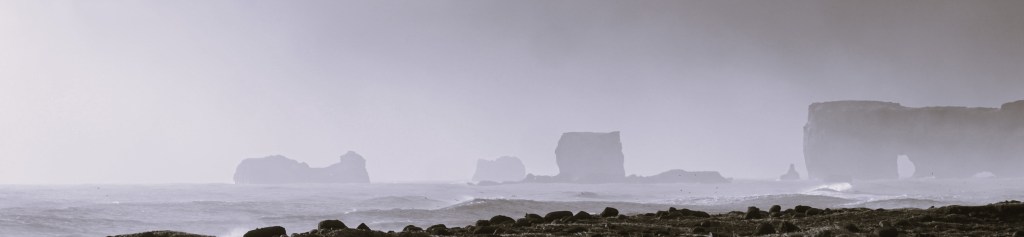
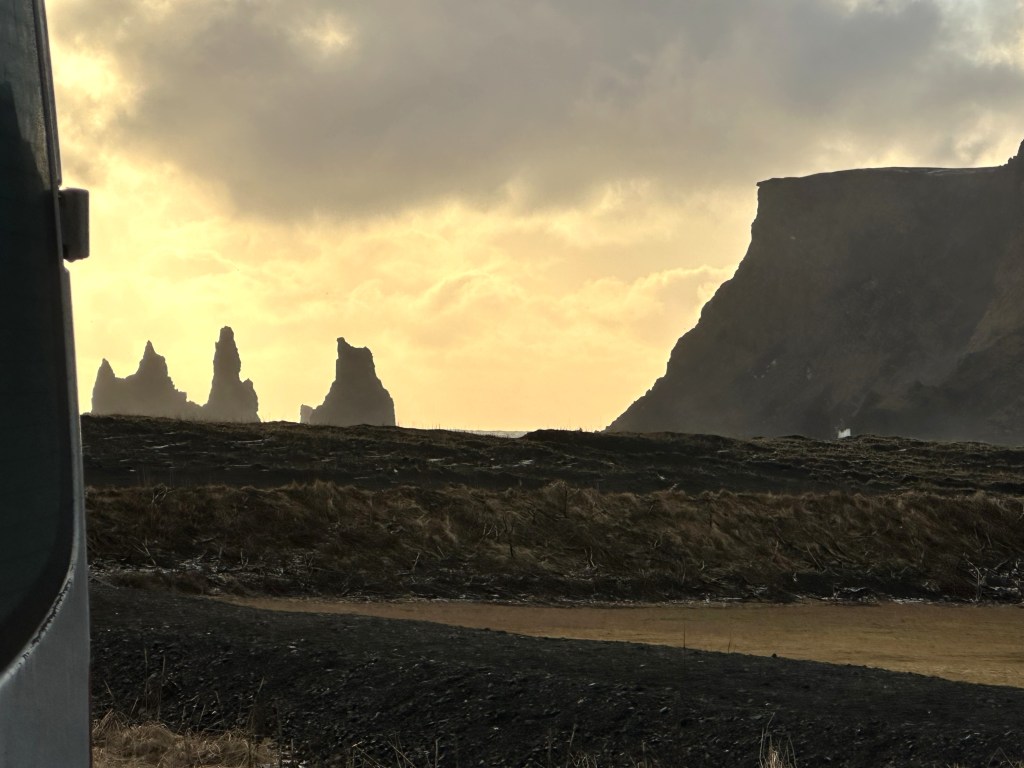
Reynisfjara is said to be the most famous beach in all of Iceland. Black sand, monster waves and unrelenting and powerful winds, the basalt Reynisdranger Sea Stacks that according to folklore are petrified trolls, the Halsanefshellir Sea Cave and Gardar Cliff, and the Dyrholaey Cliff jutting out into the Atlantic Ocean make for spectacular views. It is quite a challenge to walk the shore or even keep your feet as it’s been known that rouge waves have taken their toll.

Reynisfjara with the Dyrholaey Cliff in the Disctance
Edge of the Gardar Cliff and Reynisdranger Sea Stacks

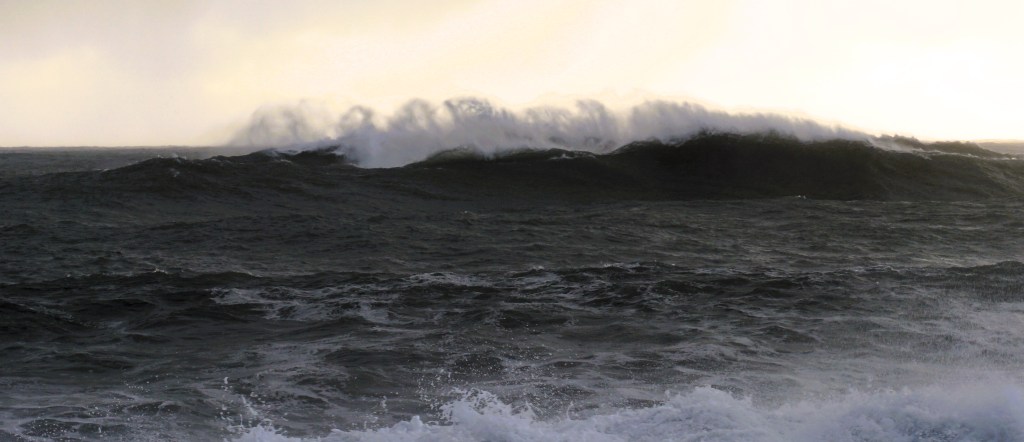
The unrelenting winds push the waves to shore. As the waves crest they are adorned with an astonishing, misty top created by Mother Nature’s fury. It’s a mesmerizing spectacle, where power and elegance coexist.

Edge of the Gardar Cliff and Reynisdranger Sea Stacks
Reynisdranger Sea Stacks
Edge of the Gardar Cliff Edge and Reynisdranger Sea Stacks
Dyrholaey Cliff

From the far side of Gardar Cliff is Vikurfjara and another view of the trolls caught out at sunrise!

A full day left us a bit weary, but at dinner with our traveling companions we talked excitedly about the sites we had experienced today. Taking from that discussion we all had come to believe that Iceland is more than a destination. It is a living, breathing experience that engages all of your senses and leaves an indelible mark. It invites travelers not merely to observe its breathtaking landscapes but to immerse themselves fully in adventures undertaken.

Wonder what tomorrow will bring? All we know is that it’ll build on the story of our time in the Land of Fire and Ice.

Barbara and Brian

“It’s not what you look at that matters, it’s what you see.“ – Henry David Thoreau
ICELAND – BEGINNING

February, 2025

For those of you who follow the aimless wanderings of this love affair started so long ago, Mesa Arizona should be the place you’d expect to find us during the winter months. But a strange thing happened following our 2023-2024 fun in the sun spending oh so much quality time with our VDO friends…we thought to ourselves that there just might be a better way to enjoy our golden years while we were still the crazy pickleball junkies, softball playing, hiking crazed, bike riding enthusiasts, in great health who just happen to want to see the world. We would never discount the importance of our friends, and the friends we have made in Arizona are perhaps nearer and dearer to us than anyone but our own family.

So on the way home from Arizona in 2024 we began making a bucket list of where we wanted to go and what we wanted to see before we settled down (AGAIN!) to a less active lifestyle. You’d never guess that Iceland topped the list – right?

The questions asked when considering an adventure include what and where do friends recommend, what do you want to see, when do you want to travel, how long do you want to be gone, and how much is in your budget? We quickly found out that all of our friends that had gone to Iceland loved it but couldn’t remember the tour company they used. We decided that the Ring Road tour including the golden triangle was a must (more on this later), that we wanted to “soak our bones” in geothermal pools and spend a day or so in the country’s capital city, Reykjavik. Ten days seemed an OK length of time, and, well, did the cost really matter? Airfare was not included in the tour package, and from our home in Southeast Michigan there are no less than 6 airports offering international air travel within a reasonable distance. Long story short, we flew out of Toronto on Icelandic Air direct into Reykjavik at a savings of approximately $800 per ticket compared to airports and carriers in the States. We booked an Icelandic adventure for early February, 2025 with Nordic Visitor, a company we can now highly recommend.

February in Iceland? Well, the winter months of 2024-2025 were reported to be the best months in a long, long time to come to see the Aurora Borealis, and guess what was #1 on our travel bucket list?

Yup…Iceland, 2025

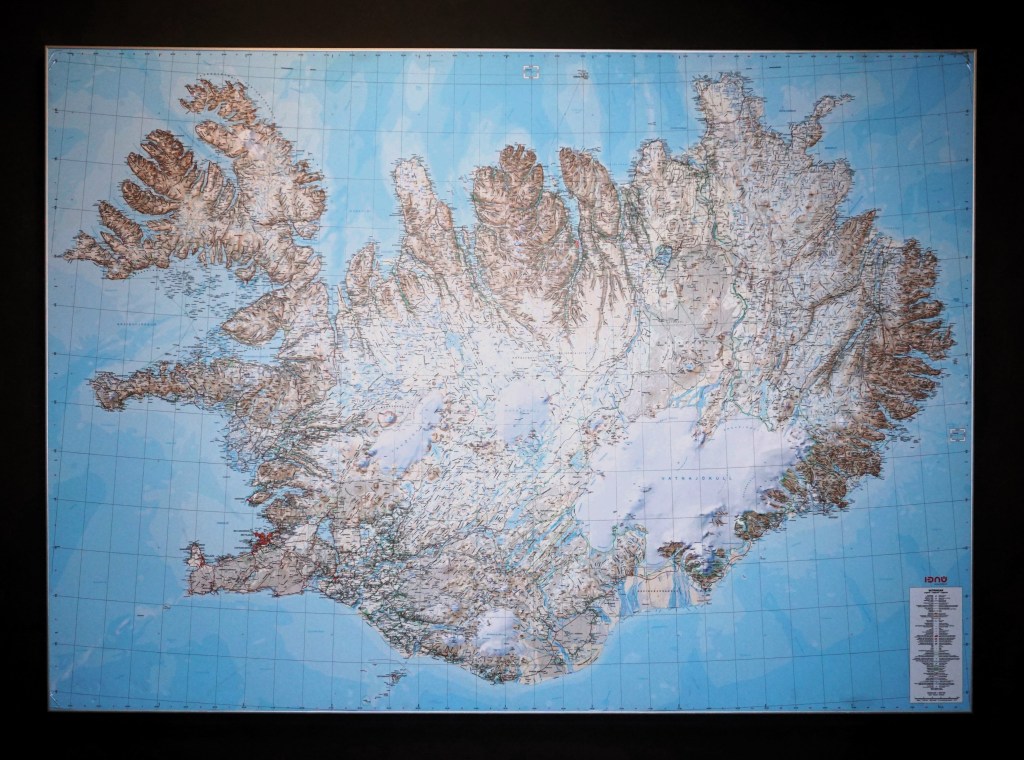
The country is 305 miles across at its widest point and is approximately 40,000 square miles in total area – about the same size as Kentucky or Virginia. At its most northern point Iceland is less than10 miles from the Artic Circle, and the island is approximately 205 miles from the artic at its southernmost point.

The Artic Circle is found at latitude 66.3359 N and longitude 0.0000 E, and Iceland’s coordinates are latitude 64.9313 N and longitude 19.0212 E – just next door! Being so far north the island’s daylight and darkness cycles are strongly affected all year long with almost 24 hours of darkness a few days before and then a few days after the winter solstice. Would there be enough daylight in February to enjoy our tour? Thank goodness for google. We found that, on average, there would be around 8 hours of daylight during the time we’d booked to be in the country. What we experienced though is that although sunrise was near 9:45am, the sun wasn’t what we think of as the sun until closer to 10:30 (kinda like it needing that second cup of coffee in the morning). Sunset was around 5:30pm, and it got very, very dark very, very fast. For a photographer the angle of the sun to the earth at this latitude produced some amazing color. Even on a cloudy bleak day the black of the volcanic beach sand and the iceberg lagoon turning totally to a blue hue were discovered through the eye of the camera. But you’ll get a chance to see all of that…read on!

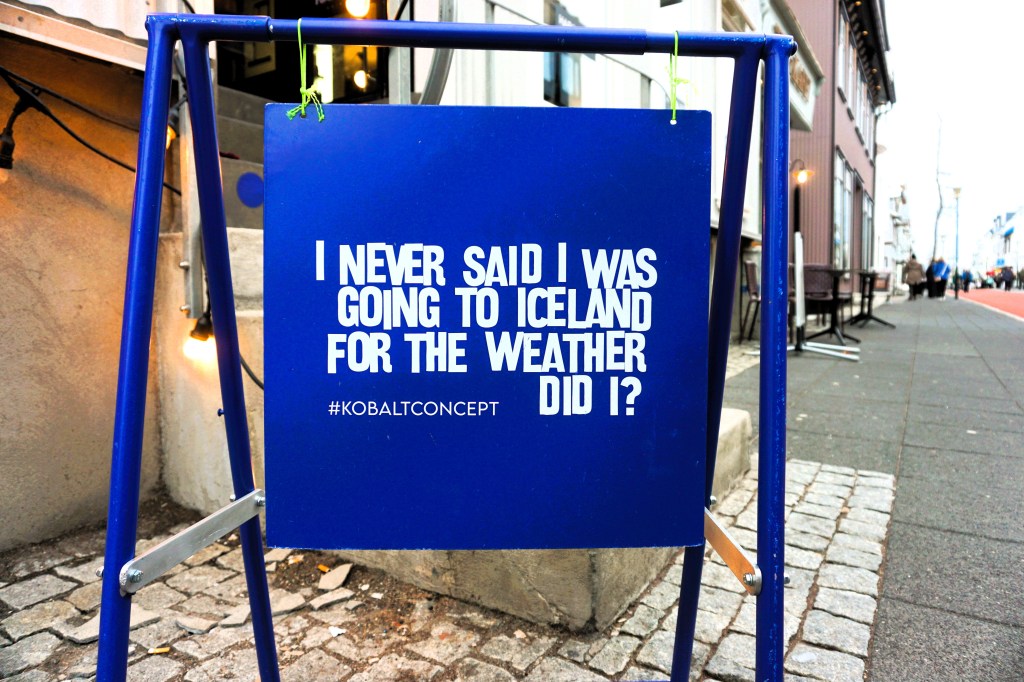
And as for the weather…check it out. The average daily high temperature in Iceland in the beginning to middle of February is 39 degrees Fahrenheit with overnight lows around 30 degrees. Now compare that to where we live in Michigan with the average February high temperature of 34 degrees Fahrenheit and overnight lows around 17 degrees. Warmer in Iceland and so close to the Artic? The gulf stream runs right along the island’s eastern shore and provides a moderating effect. Don’t think this makes the island totally habitable though. Inland, referred to by Icelanders as the Highlands, is more akin to the usual perception of being in the Artic…snow and ice covered, glacial, rapidly running rivers and streams fed by glacial run-off, and 32 (yes 32!) calderas, volcano systems or active volcanos.

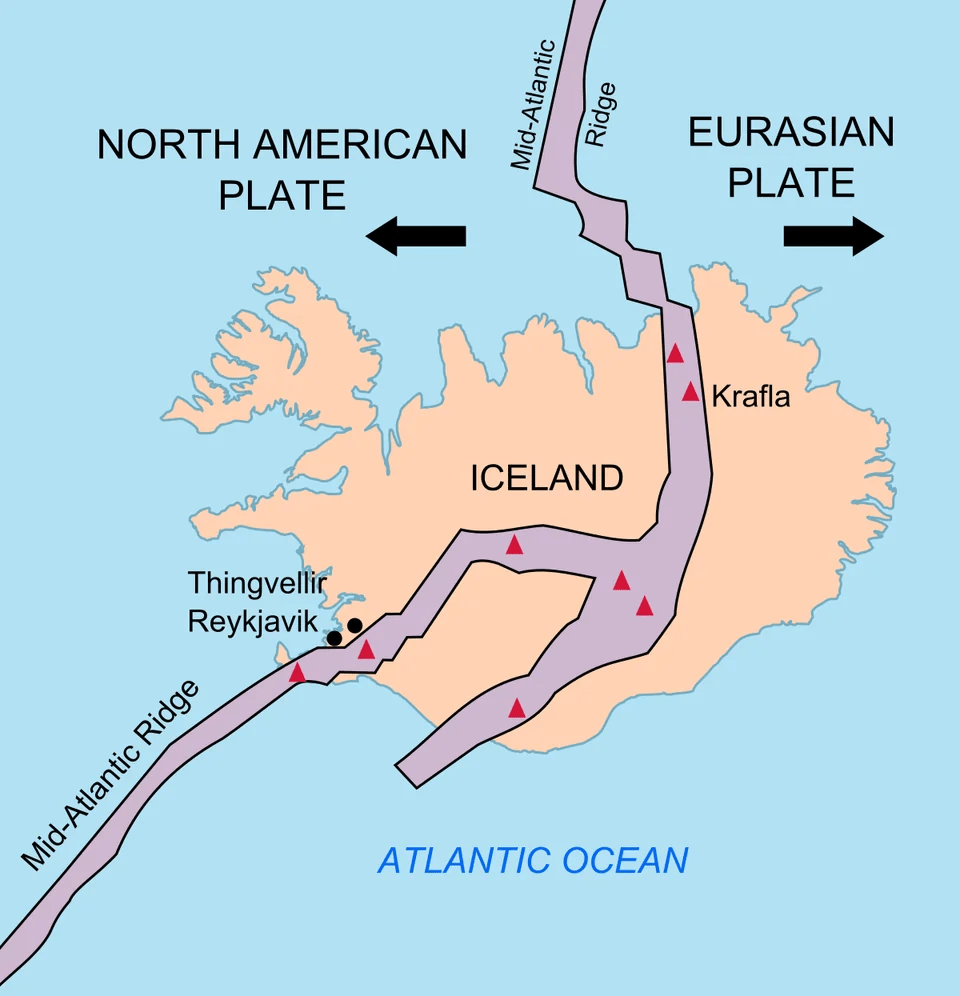
Iceland broke from the Eurasian landmass being “brought” to the North Atlantic on the back of two tectonic plates which settled into what was to become the Mid-Atlantic Ridge. The North American and Eurasian tectonic plates bisect the island. Now this is curious as tectonic plates are not fixed in place and in this case, each is moving in an opposite direction at a rate of about 1 centimeter per year. Iceland’s landmass is literally growing at that same rate of 1 centimeter per year as the tectonic plates continue on their journeys. The movement of the plates is anything but smooth and there is constant jostling for position. Movement of tectonic plates results in earthquakes, and Iceland experiences approximately 20 mostly minor earthquakes per day – yes, per day.

The other interesting fact about pressured movement of the tectonic plates is that it opens up chasms and chimneys into the earth’s layer of magma, and “hotspots,” caldera and open fissures on the earth’s crust result. The probability of major volcanic activity in Iceland is high, as is the probability of new fissures.

The country is a geologist, seismologist and volcanologist’s dream! Or is that perhaps nightmare?

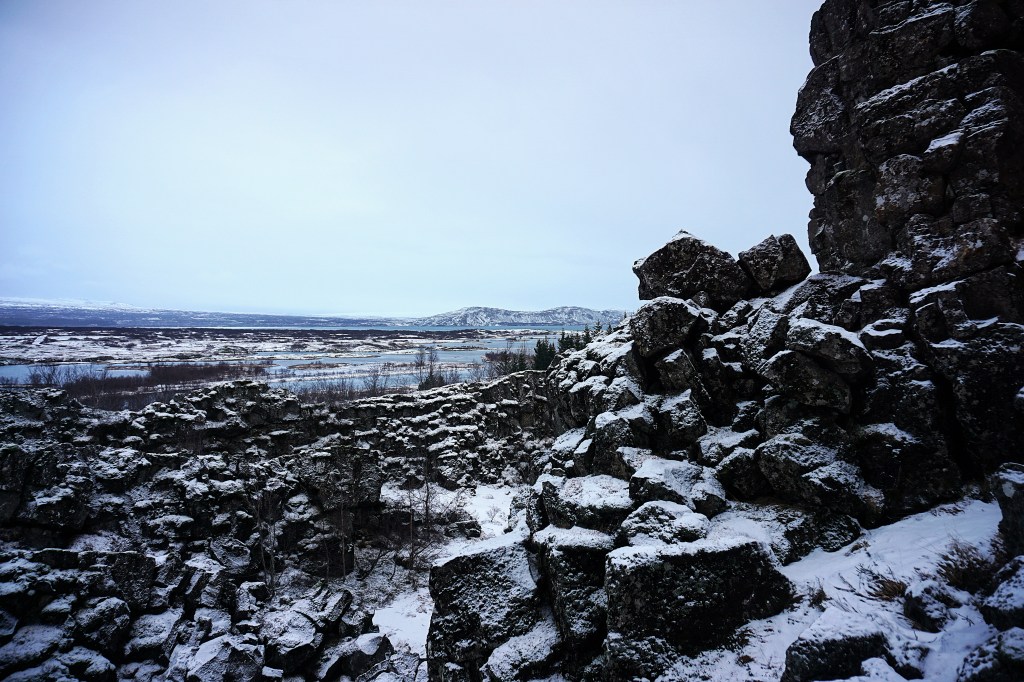
Earth’s Fissure at Pingvellir

Did we mention that the one constant about Icelandic weather, regardless of time of the year, is that the wind never stops? Occasionally weather patterns will occur which include a heavy rainfall, ice or blizzard conditions combined with gale force winds. Gale force winds are those between 39 and 54 miles per hour, which if sustained become particularly dangerous for air travel. In those circumstances a red flag warning is issued, which means citizens should stay indoors, and air travel is suspended – -the airport closed. Yup – on the day we were to catch our flight there was a red flag warning. We had scheduled a day for the geothermal joys of the Blue Lagoon and roaming about the capital city of Reykjavik before our tour the next day, and that had to be cancelled. We would have a chance to explore Reykjavik after our island tour. We were also scheduled for a geothermal spa adventure the day after our time in Reykjavik and on the way to the airport for our flight home.

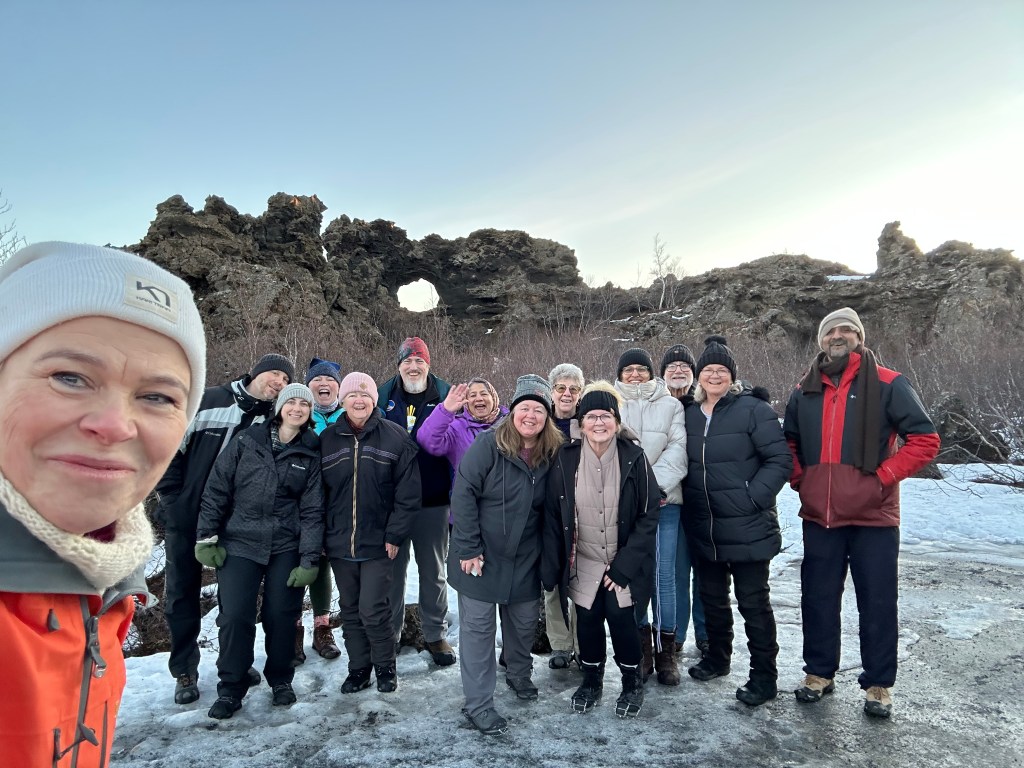
We were rebooked for a flight the next evening, boarded on time and five-and-a-half hours later Barbara and I landed at Keflavík International Airport – about an hour west of Reykjavik. Easily through customs we found our driver and made it to the meeting point for our tour with 20 minutes to spare, immediately found our group waiting in the lobby of the hotel and managed to grab a bit of breakfast before heading out. There were 14 of us ready to visit this land of fire and ice; a Kenyan couple, his sister and mother, four sisters from all over the US traveling together to celebrate one of the sister’s 70th birthday, two couples from different locations in California, and of course us. It turned out to be a wonderful group of new friends with whom to share this adventure. Our tour guide introduced herself as Boga. We loaded up and off we went.

Boga and The Explorers

We booked the Northern Lights Circle Tour, traveling the entire circumference of Iceland (Ring Road – get it?). The first day on the road took us past many scenic landscapes prior to reaching the Golden Circle.

First views of the Icelandic countryside during stops on the way to the Golden Circle. It was still early on an overcast day…

Strandarkirkja is nicknamed the “miracle church” due to a rumor that mystical happenings occurred at the location. Visitors from all over the world visit the church while in country and many more send donations in the belief that it will bring them good luck.

Strandarkirkja

The Golden Circle contains some of the best-known sites in Iceland; UNESCO World Heritage Site Pingvellir National Park, Geysir Geothermal Hot Springs, and Gullfoss Waterfall.

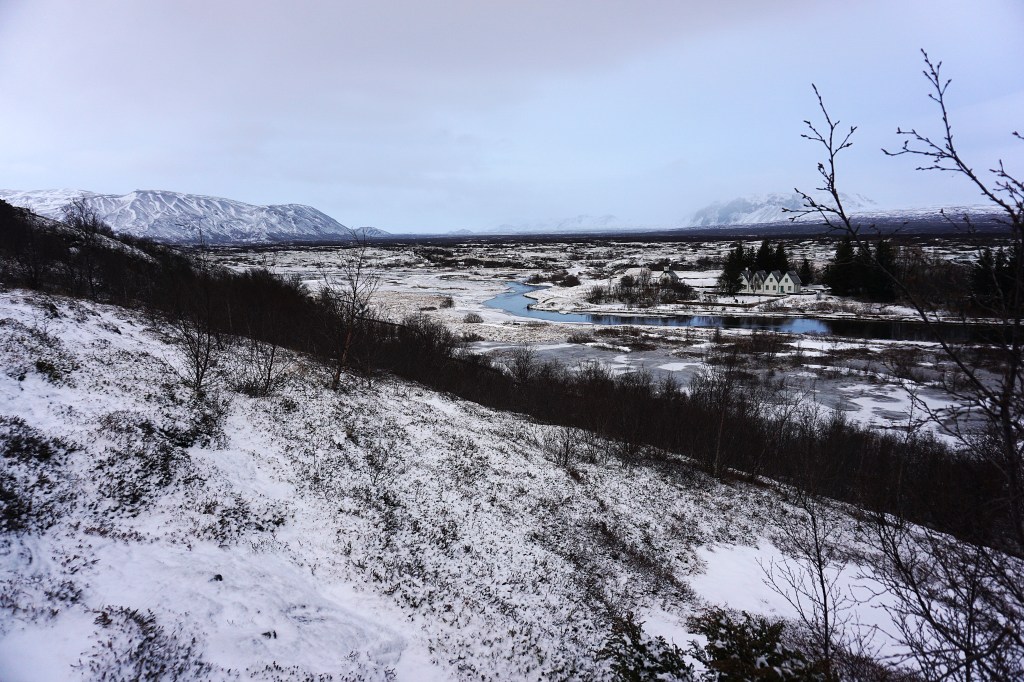
Pingvellir National Park

There are two significant reasons for this to be an important stop in Iceland. The Icelandic Parliament, Althingi, was established here in 930AD, and then on 17 June 1944 Icelanders celebrated their independence from Denmark at this site. The second reason is that it is at this site that the continental rift that splits Iceland between the North American and Eurasian continents occurs.

Icelandic Flag
Earth’s Fissure Between Tectonic Plates

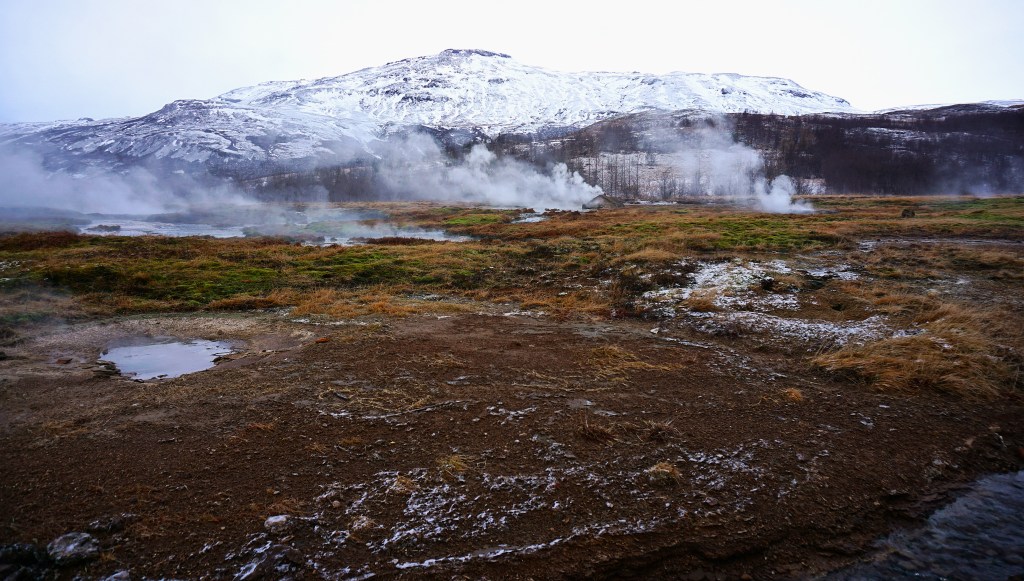
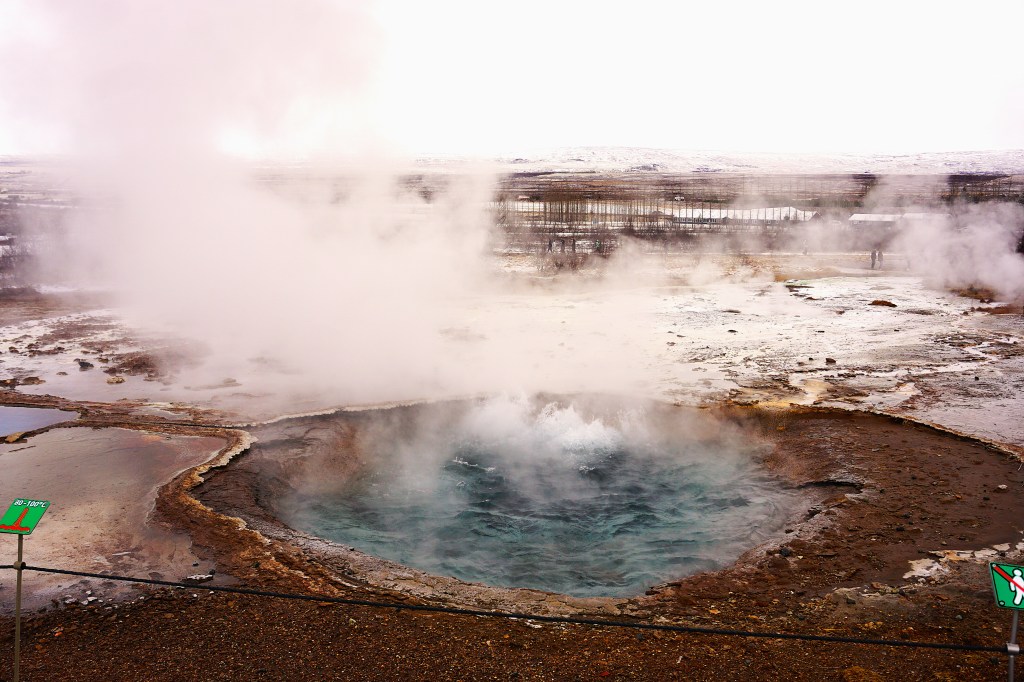
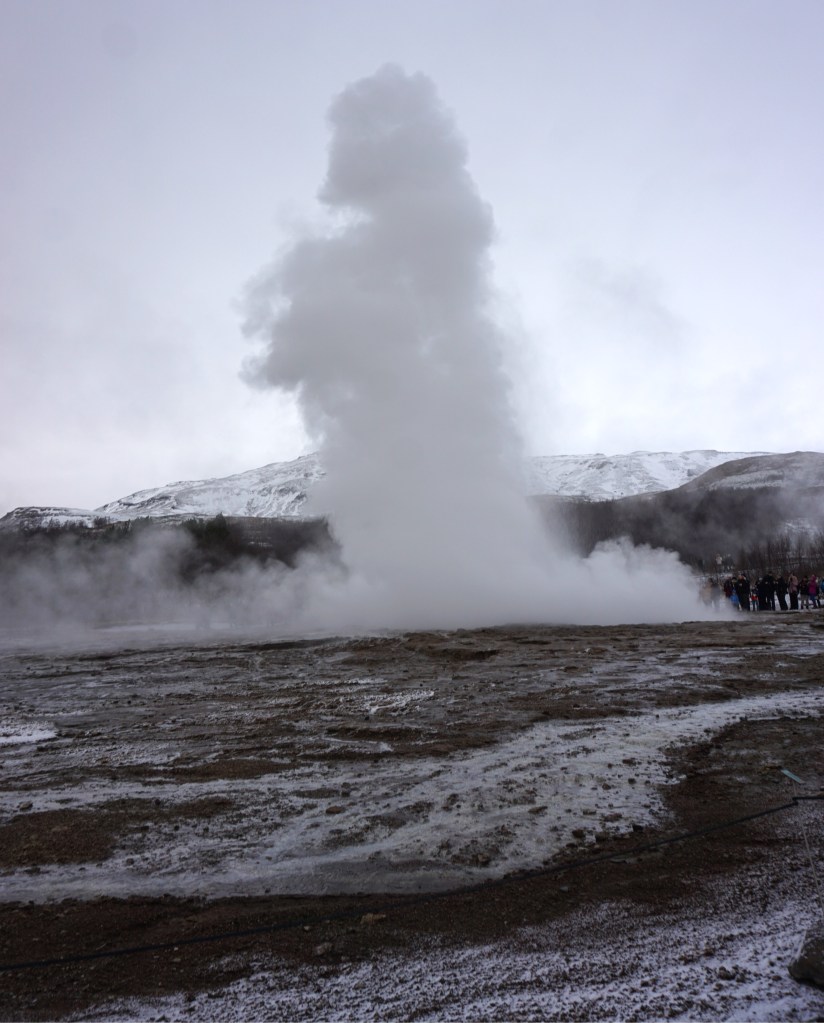
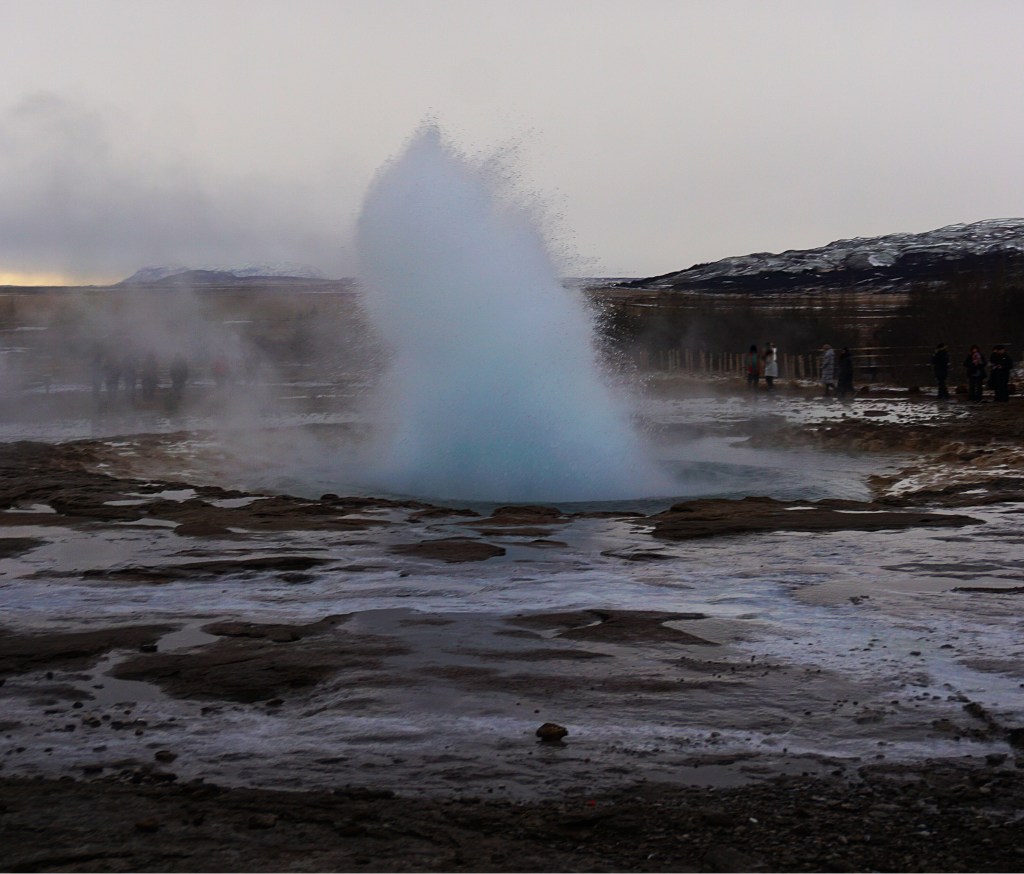
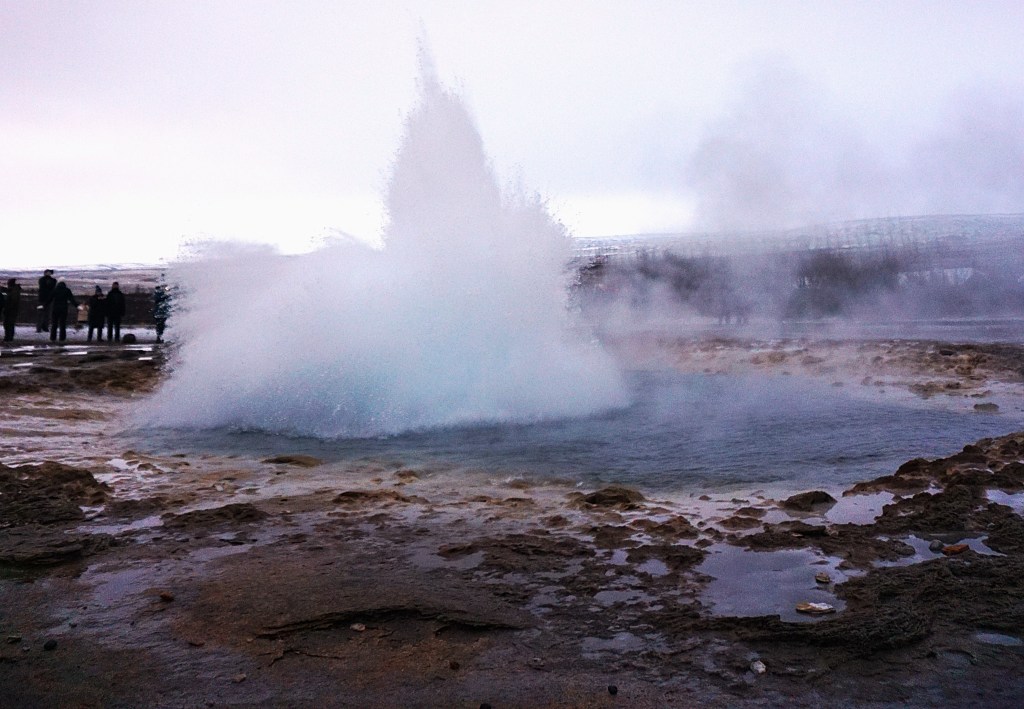
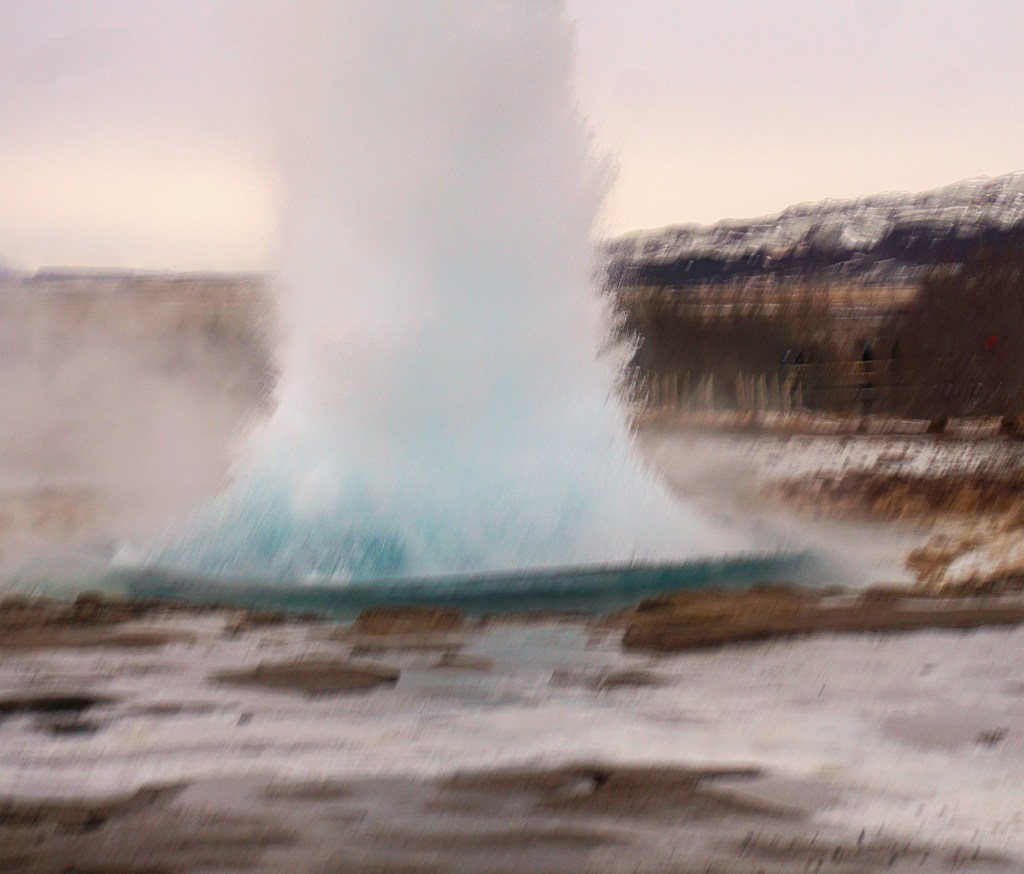
Geysir may be called a geothermal hot springs area, but it is really a caldera similar to Yellowstone National Park in the US. The volcano at this location has been dormant for “many” years; however, Mount Hekla is just in the distance and last erupted in 2000. The geyser Strokkur erupts every 10 minutes.

Strokkur Geyser

There are 269 glaciers in Iceland covering 4,400 square miles and covering approximately 10% of the landmass. The “run off” from the glaciers feeds the island’s rivers and as the waters flow towards the ocean, the waters pass over the hard rock layers in the riverbeds, eroding the softer rock beneath and creating steep drops. Iceland is home to tremendously beautiful and powerful waterfalls.

Just a quick “by the way…” All of the electricity the island needs is generated by turbines placed in the path of glacial rivers!

Gullfoss is a two-tiered waterfall that drops 32 meters into a narrow canyon.

Surprised that glacial “run off” produces all of the electricity for Iceland? Icelanders also figured out that by using geothermal energy to “fuel” greenhouse farms they could produce over 50% of the vegetables and fruits consumed on the island. And that same geothermal energy provides all of the necessary warmth for homes, buildings and businesses, as well as greenhouses and barns. Yes, even the livestock need a place to go in the middle of the very cold Icelandic winters.

We visited the geothermal greenhouses at the Fridheimer Farm, as well as the local stables to spend a bit of time with Icelandic horses.

Annually, Fridheimar Farms produces 370 tons of tomatoes in their geothermal greenhouses. We did get to sample the truly sweet cherry tomatoes and were served a comforting hot bowl of absolutely delicious premise made tomato soup accompanied with freshly made bread. We were offered the chance to add fresh basil to our soup and found the flavor more intense than expected.

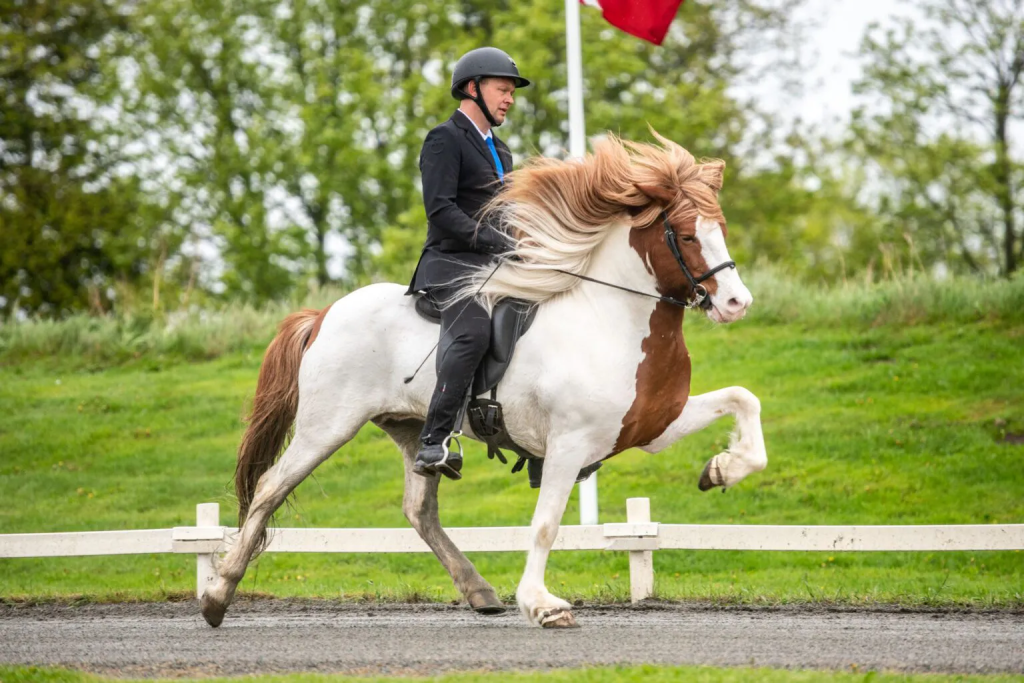
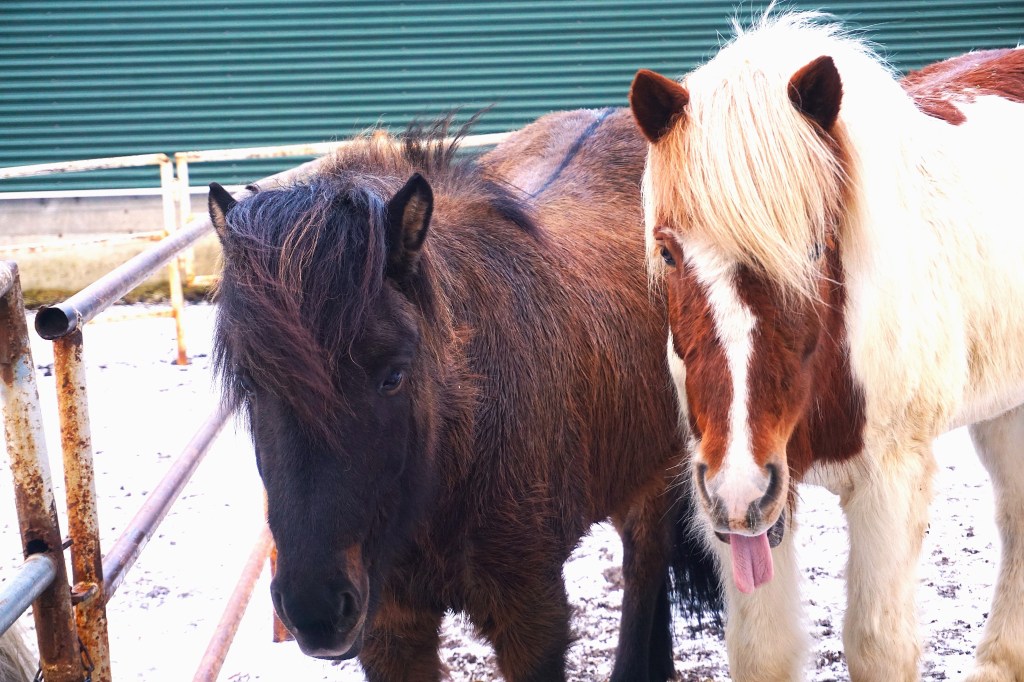
Icelandic horses have been on the island for more than 1,000 years. They are a resilient breed known for their adaptability, more than 40 diverse colors, and gentle temperament. They are rarely taller than 13 hands (54 inches), have short legs, weigh between 700-800 pounds, are particularly hairy with a full long forelock, mane, and tail. Bred to be sure footed and steady, it is the only horse breed in the world that can perform five gaits: the walk, the trot, the canter and, uniquely, the tolt and the flying pace. The tolt? Icelandic horses lift their front legs up high, and only one foot touches the ground at any time. The four-beat, incredibly smooth gait is useful for the uneven ground of Iceland. We were delighted to watch one of the horses give a demonstration of each of the five gaits.

Nah, I Didn’t Take This Picture – Just Wanted To Show The Tolt

Bidding farewell to our new equine friends, bellies full of tomato soup, and with today’s memories of the sites of the Golden Circle, our first day in Iceland was coming to a close. We checked into our hotel, and after a brief time to put our feet up we had a delightful dinner – finally getting to spend some time getting to know our traveling companions amidst lively conversations about each of our homes, our first day’s adventure and wondering what the following days would bring. Oh yeah – the 3-course meal was absolutely delicious.

Barbara and Brian

“It’s not what you look at that matters, it’s what you see.“ – Henry David Thoreau
CLOSING OUT OUR ALIYAH

Let’s see…Tiberias – check. Jaffa and Tel Aviv – check. Old City Jerusalem – check. The Dead Sea, Judaean and Negev Desert, Zin Valley – check.

June, 2023

We may have visited the Holy Land in June, but it is during October, 2023 that we are writing this blog, and today is Day 7 after the cowardly attack on Israeli civilians by Hamas terrorists. As war rages and sides are taken it is clear to us that the bottom line is that this horror is not about Palestinian or Israeli rights. It is about the singular mission of Hamas to murder Israelis – to murder Jews – and their total disregard for the fate of their own people. We pray that war shall be no more, and that the murder of innocents should forever cease – swords should be beaten into plowshares. The world must unite and must condemn and never, never tolerate actions such as these. All the peoples’ of the earth should find God’s greatest gift – to live in peace – of shalom. Birkat Shalom

עוֹשֶׂה שָׁלוֹם בִּמְרוֹמָיו הוּא יַעֲשֶׂה שָׁלוֹם עָלֵינוּ וְעַל כׇל ישׂראל ואמרו אמן

Prior to our travel to Israel Brian had been in contact with Congregation Beit David, a reform Jewish congregation in Tel Aviv asking if we might attend Shabbat Services. Graciously we were invited to join the Congregation in worship. We made sure to return from the Negev in time for Shabbat, and Kea accompanied us as we arrived at the Synagogue just a few minutes prior to the beginning time of the Kabbalat Shabbat service on Friday at sundown. We were directed across the street to a public park – worship on this warm night was not in the sanctuary. The service was enriched by music and many of the standard prayers that are usually chanted during a worship service were sung to amazing upbeat tempos and rhythms. We felt pretty proud to be able to recognize the prayers and to the best of our abilities sing along. While we may have felt that Hebrew is Hebrew is Hebrew, American pronunciation and Israeli pronunciation is more than a bit different – and, oh by the way, the booklet serving as our Siddur for the evening did not contain any English or transliterations. Thankfully Kea, who has been studying Hebrew and is much more of a scholar than either of us, could keep us on track. Between prayers that were sung with musical accompaniment the Rabbi spoke so very quickly and in Hebrew that we rapidly became lost. But then the usual Shabbat prayers were recited by the congregation, and we participated! How honored we were to be welcomed and to be able to pray with this congregation as runners, walkers, men, women and families enjoyed the park, some stopping to join us in worship.

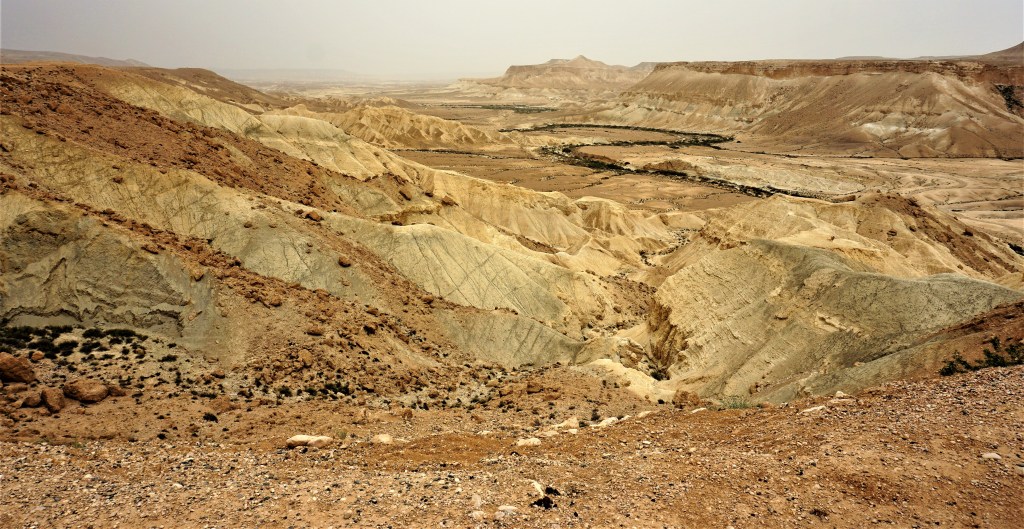
The Duckenfield Israeli Tour Company had spent the last week driving these tourists around the central and some of the southern regions of the Country – from Tel Aviv to Jerusalem to the Negev and Judaean Deserts, to a Kibbutz, Bedouin Encampment, Masada and Ben-Gurion’s grave and back again. Israel may only be 263 miles in length; however, the well-maintained roadways in the southern region are limited, and to get from point a to point b may be much longer than anticipated – for example it takes an hour and a half to travel the maybe 2 miles as “the crow flies” from the east to west sides of Masada as the road circles the perimeter of the mountain. Yup, when in the southern region of Israel, it is always the long way around.

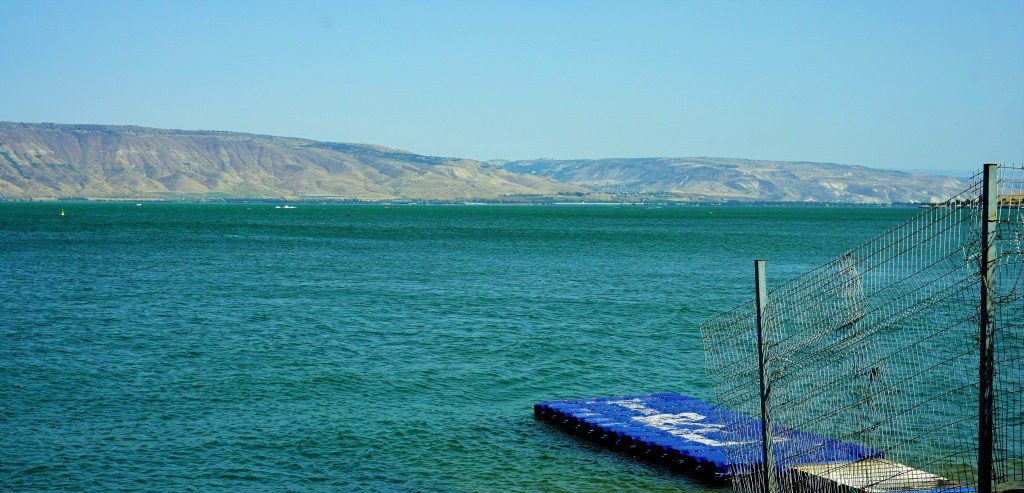
We expected a day of rest, but over coffee the DITC asked if we wanted to head out to the Galilee in the northern region of the Country. At the confluence of the Jordan River and the Sea of Galilee is the town of Tiberias.

Sea of Galilee
Gotta Take My Word For It – The Confluence Of The Jordan River and The Sea Of Galilee
Just Over Those Hills Is The Golan Heights

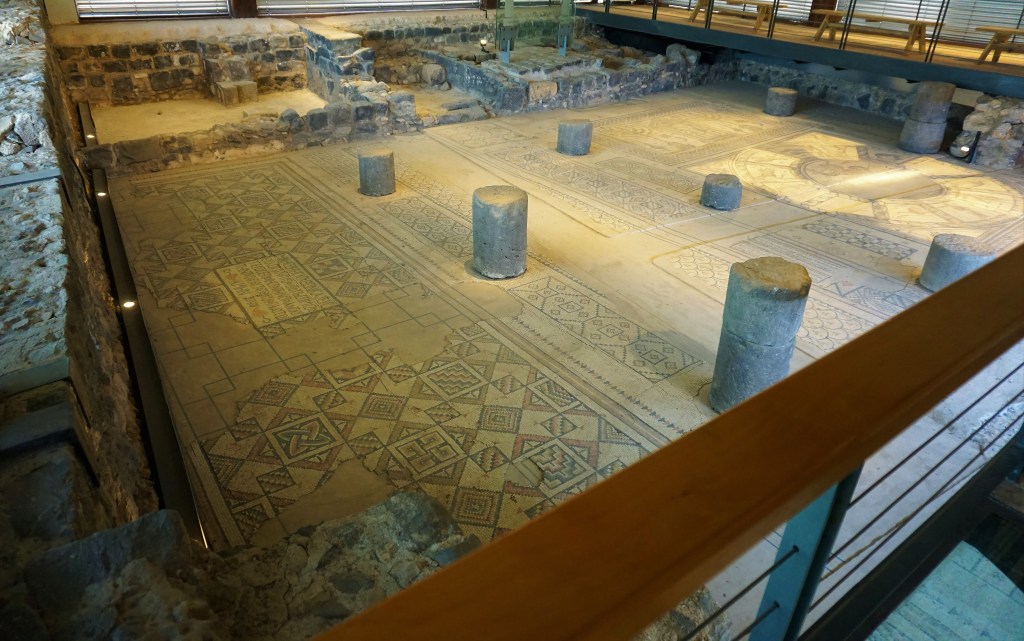
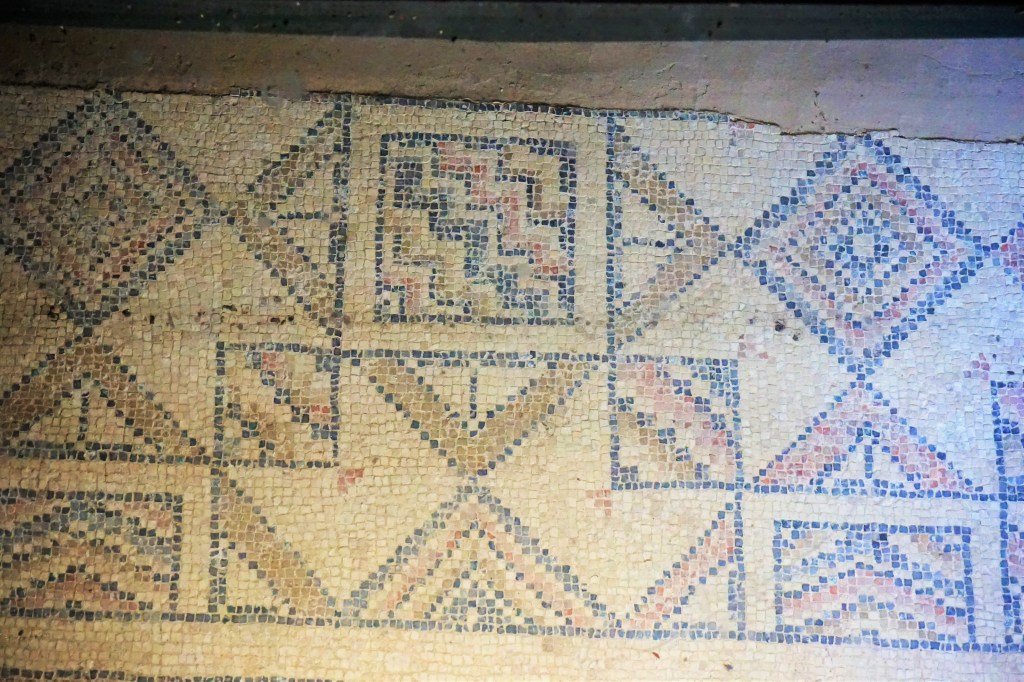
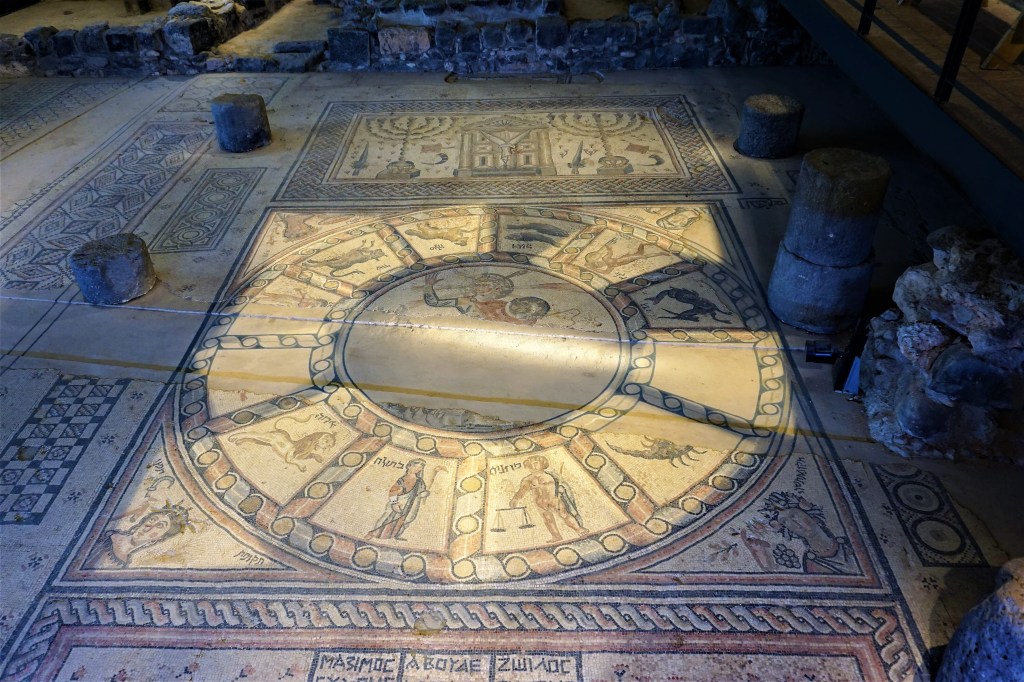
It was pretty cool to visit the Sea of Galilee, but, for us, the real attraction in Tiberias is Hammat Tiberias, a 4th Century CE synagogue. Little remains of the synagogue except some foundational stones and its magnificent floor mosaic. On one side of the floor the mosaic displays the traditional depiction of a Torah ark flanked by ceremonial menorahs, shofars (ram’s horns), and palm fronds. At another end, the names of the synagogue’s benefactors are written in Greek, the most used language of the time, surrounded by two lions.

The center panel of the mosaic is a magnificent zodiac wheel, featuring, among other pagan images — the wheel encircles a haloed Helios, the Greek sun god, mounted atop his chariot. Women representing each of the four seasons sit to the corners of the zodiac, with the accompanying Hebrew inscription of the names of the seasons. Pagan imagery in a house of worship would appear a flagrant violation of God’s injunction, “Thou shalt not make unto thee any graven image,” but similar synagogue zodiacs have been found at other sites. An oddity perhaps, but then again possibly a trend of the times?

The synagogue is part of a national park and just steps away is an Ottoman-era bath house – the natural springs bubble through cracks in the earth; temperatures can reach as high as 140 degrees Fahrenheit. Step-down pools are not as hot and are available to bathers.

Hammat Tiberias
Mosaic With Traditional Synagogue Icons
Greek Lions And Pagan Zodiac Wheel. Between The Lions And Written In Greek Are The Names Of The Synagogue’s Benefactors

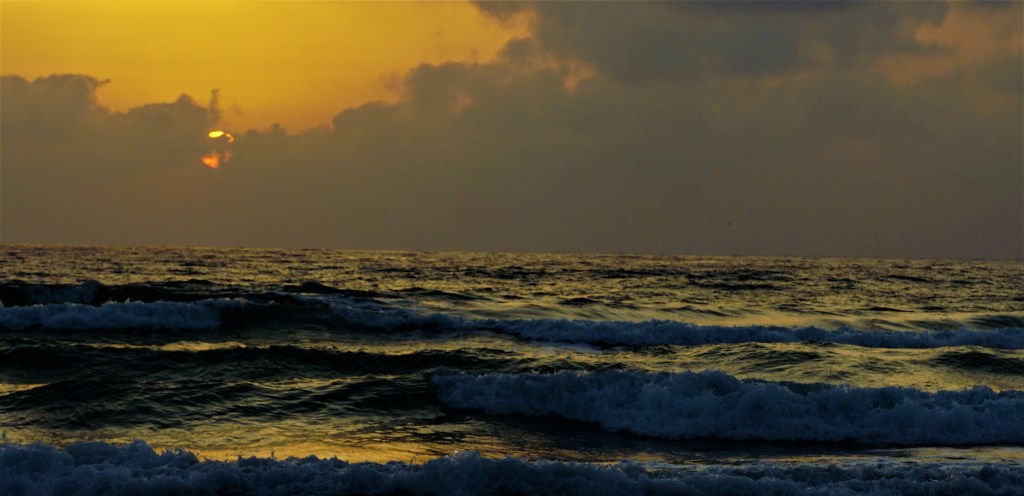
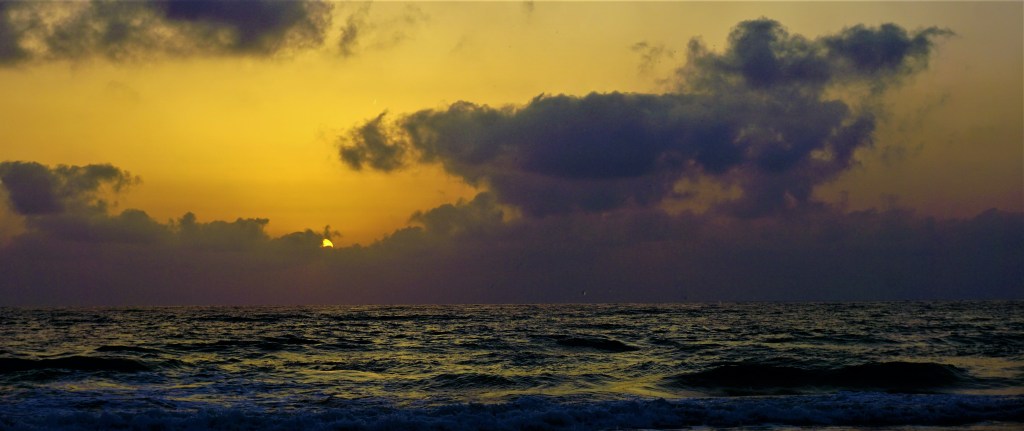
Although Barbara loves the mountains – she grew-up and lived in the Rockies for 42 years – she has discovered that she is drawn powerfully to the sea. She finds herself longing to be on, in or near the water, and can spend hours sailing or cruising or on a beach collecting shells or looking for sea glass. As long as she can walk along the beach, have the tide run over her feet and feel the sand between her toes she is one happy human. Israel, of course, is bordered on the west by the Mediterranean Sea…so down to the sea we went. We did collect a fair share of sea glass, some fossilized coral and a few shells, and as an added bonus it was sunset!

Barbara’s Picture!!

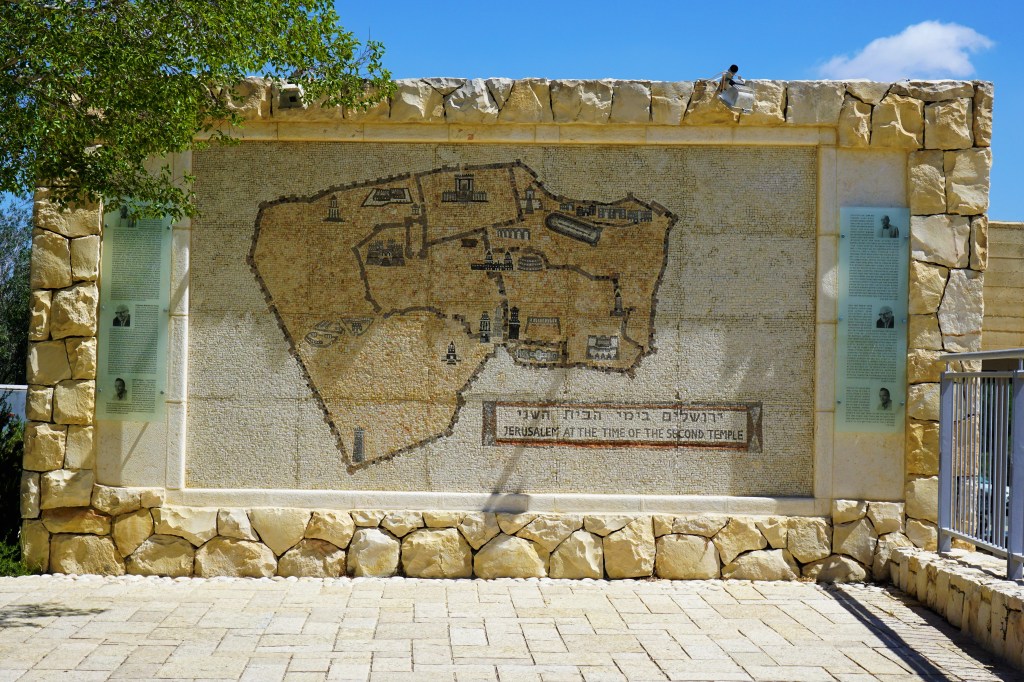
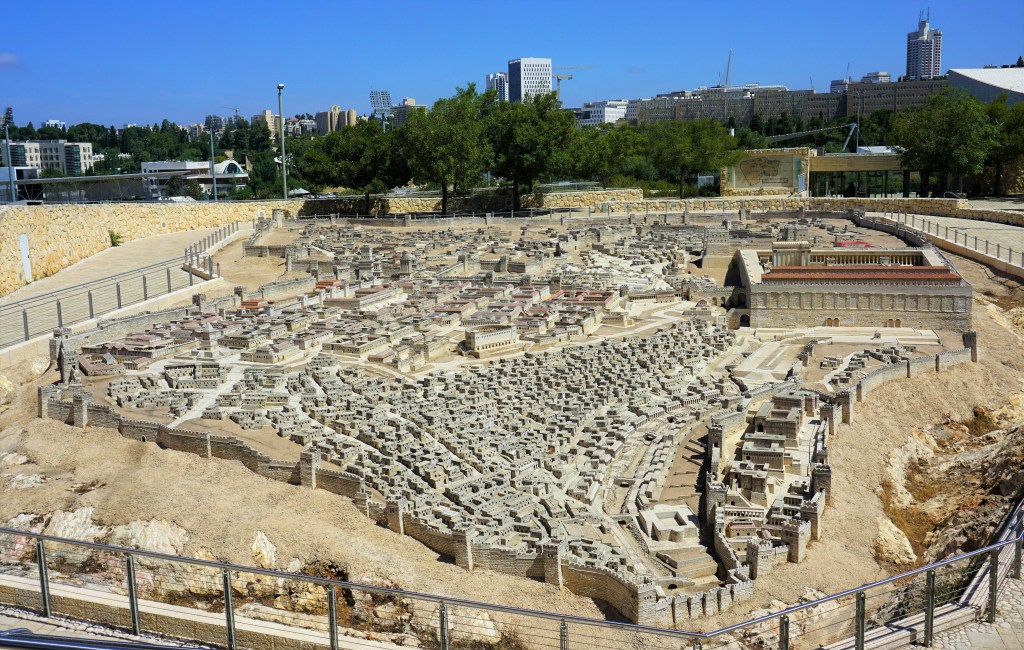
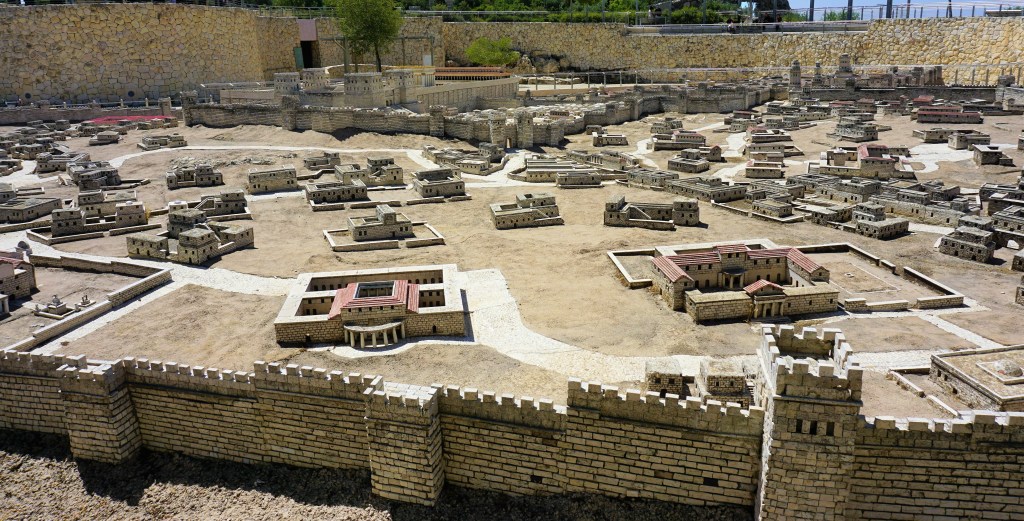
The Israel Museum is a historical, archaeological, and contemporary art and culture museum in Jerusalem. There were 2 exhibits drawing us to visit – a scale reproduction of Jerusalem during the period of the Second Temple, and the Dead Sea Scrolls.

The Second Temple Is The Large Building To The Top Right Of The Model
Scenic View From The Israel Museum Jerusalem

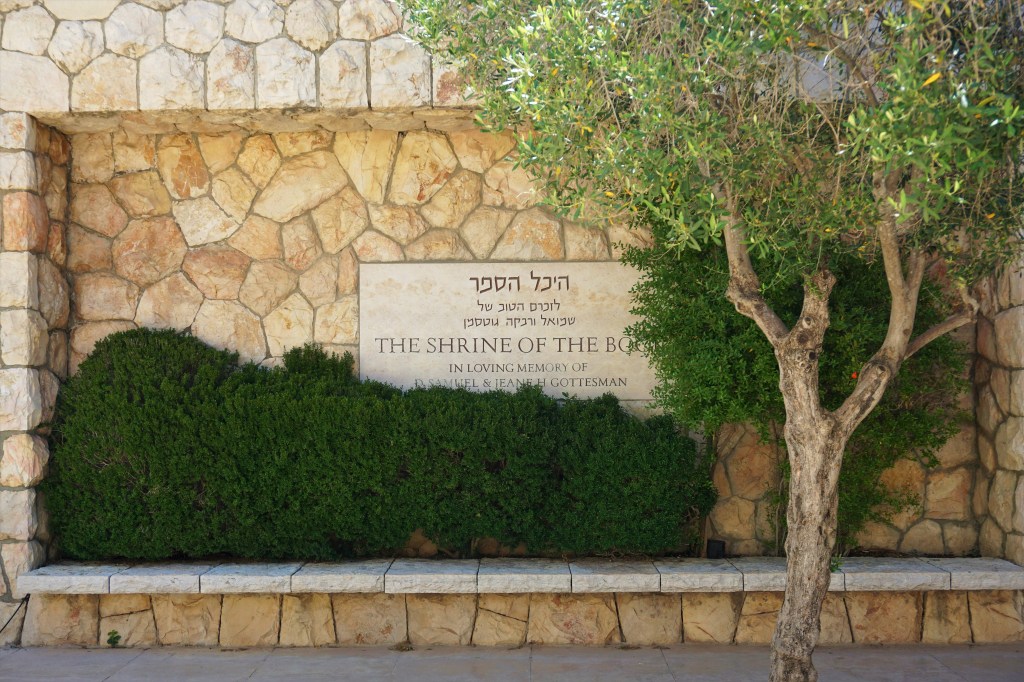
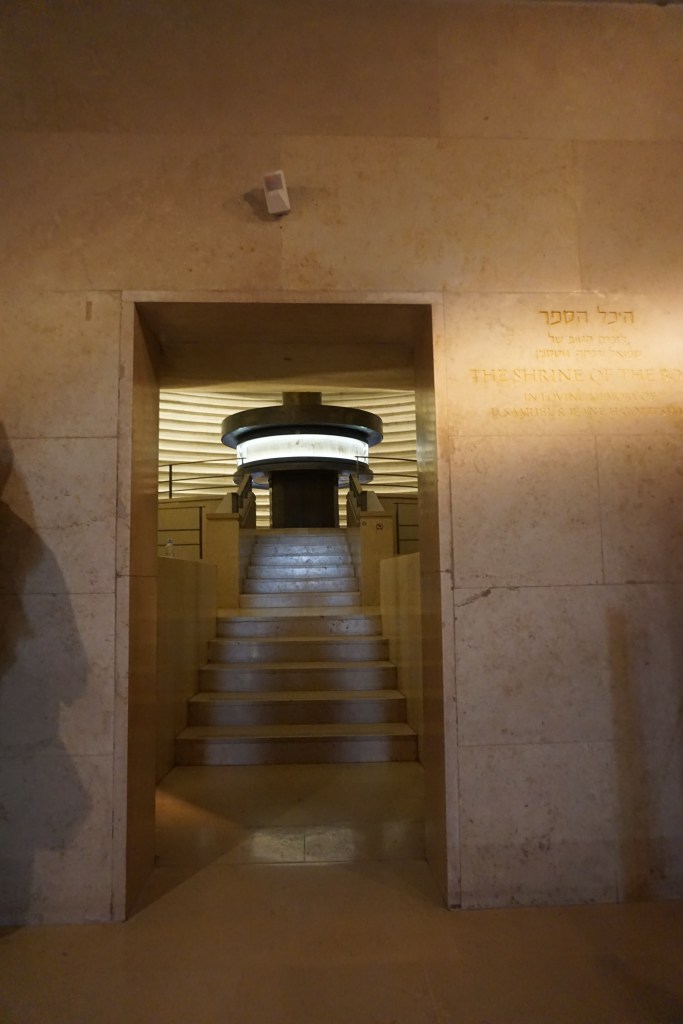
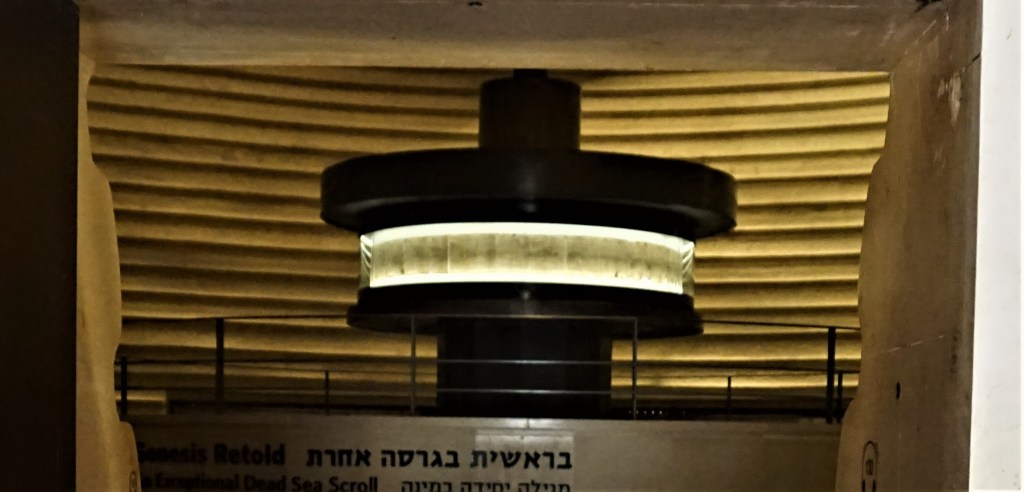
The Shrine of the Book houses the Dead Sea Scrolls and Aleppo Codex among other ancient documents. It is estimated that the Dead Sea Scrolls were written between the 3rd and 1st Century BCE, and are so very significant because they include the oldest surviving manuscripts of entire books later included in Jewish and Christian Scripture, as well as apocryphal and sacred books that preserve evidence of the diversity of religious thought in the late Second Temple period. There have been over 15,000 manuscripts and manuscript fragments found.

The Aleppo Codex is a medieval bound Torah – the Jewish bible. The codex was written in the city of Tiberias during the tenth century CE, and was authenticated by Maimonides (Jewish philosopher who became one of the most influential Torah scholars of the Middle Ages).

No pictures are allowed to be taken within the display room itself.

Meant To Give The Visitor A Sense Of The Caves Within Which The Scrolls Were Found
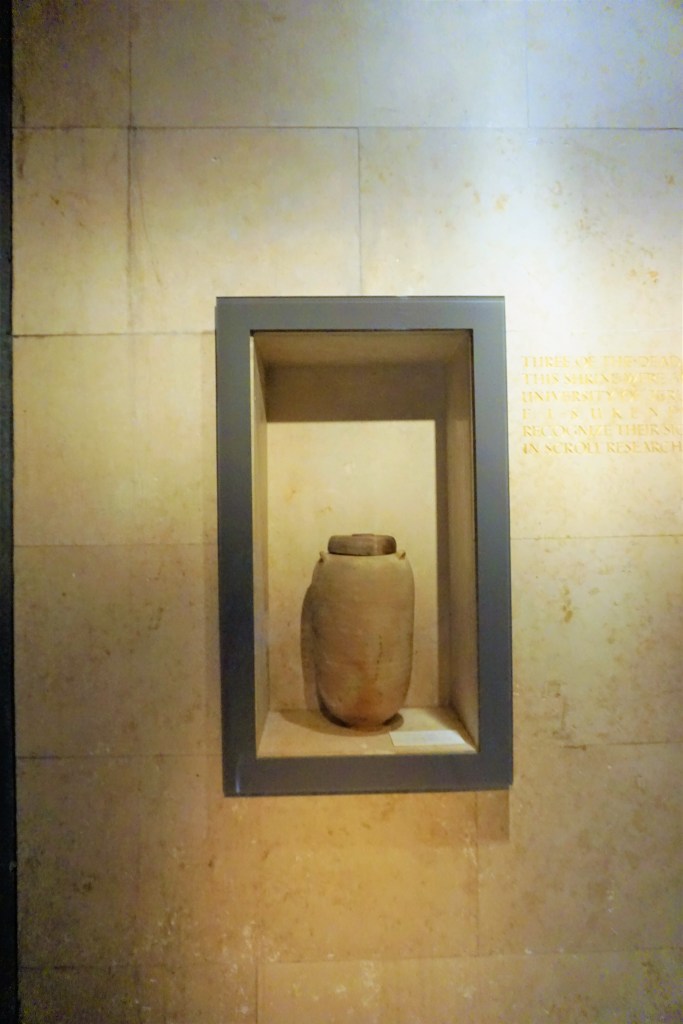
The Scrolls Were Found In Vessels Such As This One On Display

Our visit to Israel had to include honoring the 6 million slaughtered in the Holocaust. We looked forward to visiting Yad Vashem, the Holocaust History Museum. Located in Jerusalem, the museum traces the timeline of the Jewish peoples’ fear, terror and horror as the rise of antisemitism in Germany moved so very aggressively towards their agenda – the ultimate solution – not just annihilation of the Jews, but of anyone not determined to be of the Aryan Race. The museum made sure to address the culpability of the world in not acting sooner to the evident genocide.

A single exhibit shaped in the form of the interior of a furnace chimney with pictures and a brief biography of Jews put to death posted on the walls – men, women and children – took our breath away and brought tears to our eyes. In a separate on-grounds location the Hall of Remembrance gave us a chance to say Kaddish, remember, and pray for the coming of the Messianic era and for God’s greatest gift – peace for all mankind.

We were scheduled to return back to the US the next day, but had yet to have the opportunity to enjoy what some believe to be one of Israel’s national dishes. Kosher foods are milchig, fleishig or parve. Milchig dishes are made of or are dairy; eggs are usually considered milchig as well. Fleishig dishes are made of or are meat (there are other rules about meat protein, but not something to consider right now). And parve basically means neutral – vegetables, herbs and spices, fruits, beans, and grains – and can be consumed on their own, paired with or cooked with either dairy or meat. So we ate traditional Israeli dishes and meals – shakshuka, Israeli breakfast and lunch with so many small plates of parve or milchig dishes, and hummus and pita so far superior to what we might find at home. But we had not had shawarma – an overflowing fleishig pita wrap of marinated chicken (or beef or lamb) that has been stacked on a skewer and roasted prior to slicing, hummus, lettuce, tomato, onion, and harissa (chili pepper paste). On returning to the Duckenfield Estate Middle East we found that The DITC had taken care of us yet once again. The shawarma was delicious.

Our time in Israel came to a close, and we bid farewell to Paul, Kea and Dan. Paul dropped us off at Ben Gurion Airport in Tel Aviv around midnight – plenty of time for our 4:30am flight. We passed through security and customs quickly and boarded the first leg of our journey home. From Tel Aviv to Frankfort, Germany – a 2-hour layover – and then from Frankfort to Chicago. total travel time in the air was 17 hours. Our return flights on Lufthansa Airlines were quite a letdown compared to our incoming United Airlines flights. The seats were smaller, electronics and entertainment not always in working order, and the food served, well, was an example as to why travelers complain about airline food.

We easily passed through US customs, called for the hotel shuttle to pick us up in order to fetch our car and headed home. Some fool decided that a 5-hour drive after long air travel would be ok – might have been but for the traffic in and around Chicago. Nah, lesson learned. It would have been much better to spend the night, and head out for home in the morning.

We experienced only one small glitch in our travels. Brian was concerned that the tahini we had purchased would not fare well in checked baggage so Barbara ended up putting the quart jar in her carry on. No problem with Israeli security and customs, but we had to go through security and customs again in Frankfort where the jar of tahini was confiscated. What we later found out was that pastes such as peanut butter, nutella, and, yes, tahini fell into prohibited items of “not more than 3 ounces” classification. Apologies to the Bullock and Umstattd families.

Oh yeah – remember we experienced no jet lag traveling to Israel? Well, that nasty bugger does exist. Both of us were physically out of sorts for about 2 days.

There were some aha moments during our time in Israel. **The West Bank is 81 miles long – that’s almost 1/3 the entire length of Israel. There are both Israeli and Palestinian communities and cities in the West Bank; you can tell the difference – the Palestinians build out and the Israeli’s build up (high rises). **The Golan Territory (Golan Heights) is Syrian and includes the NE part of the Sea of Galilee and the entire Sea borders directly with Israel. There are terrorist group enclaves all along the West Bank, and terrorist groups as well as Syrian armed forces encamped in the Golan. **In biblical times there were only cart paths until the Roman’s built roads. Nonetheless imagine being (9 months) pregnant or elderly or infirmed or just simply having to walk or travel on the back of a donkey/in a cart to report for the mandated census count…it’s 94 miles from Nazareth to Bethlehem. Is the story of Joseph and Mary biblical apocrypha or reality? And for perspective it’s 68 miles from Jerusalem to Masada. Just how long did it take the Jews fleeing Jerusalem to reach the community at Masada? Remember they had the best of the Roman army on their heals. **What if the Hebrews didn’t “go up to Jerusalem” and turned left at Mount Nebo and into the desert? The land of milk and honey or the land of thirst and scorpions?

There are so many memories of a lifetime, so many emotional moments, and such wonders to reflect upon from our visit to the Holy Land. There are also so many places we did not visit, and some to be revisited in order to sit, reflect and involve oneself in contemplation that we hope we can return.

For Brian making Aliyah became an unexpected reconnection to and strengthening of his Jewish identity – the religious impact was tremendous and soul-deep. It was so wonderfully rewarding to meet and talk with Israelis – to hear their stories and their experiences as a Jew living in this land. He’ll be forever grateful to Roni, Danella, and the Israeli soldiers with whom he was honored by that took their time to share a lunch hour for their conversations – common experiences yet 5,700 miles or so apart as well as eye-opening glimpses into Israeli culture. Chance encounters with Jews in The Great Synagogue of Jerusalem, 2 shop owners at Mahane Yehuda Market, the woman at the light rail station, and so many others helped him become enveloped in Israel.

For Barbara, the excitement of going to Israel fulfilled a much-anticipated desire to feel the promise of a connection with the land and the Jewish people. The bonus was getting to spend time with Paul, Kea, and Dan whom we had not seen in person since 2019. Words of gratitude to the Duckenfields for giving us the Israel experience of a lifetime. Thank you for making our visit the experience of a lifetime. We have bragged about our visit so often to friends and family, folks are wondering if you’re willing to give them the same unbelievable adventure!

Every day was new and with no expectations, I began to feel, understand and appreciate the Israeli passion for life and what it means to live every day with intention. We felt genuinely welcomed by all of the people we met and thoroughly enjoyed the lively discussions we shared. We came to appreciate the hustle and bustle of the freeway system; the crowds in the markets; spending time exploring in cities, old synagogues and structures that are thousands of years old; enjoying the delicious, delectable and incredible food experiences. Traveling with family to explore amazing landscapes, museums, a kibbutz and archaeological sites filled me with awe. Seeing The Old City of Jerusalem was humbling and spiritually rewarding. While our goal this first time in Israel was focused on a religious experience, it became so much more.

Israel has a beauty that changes depending on where one is – desert and rolling hills to the south, the sea and a lush coastline to the west, the almost tropical terrain and hills in the central part of the Country, and the greenery that increases and becomes denser the further north one goes. There’s the vastness and saltiness of the Dead Sea, the freshwater Sea of Galilee, the oases and waterfalls found in the desert, underground rivers, flora we’ve never seen before and houseplants that thrive and become massive outdoor displays in the Israeli climate. There’s evidence of humanity and organized religion dating back millennium, there’s the city that’s the holiest of holies for the world’s three great religions, the Country has a history unlike anywhere else in the world, there’s an ancient fortress which holds sway on the great religions, there’s an ancient fortress with a deep harbor and narrow cobbled streets still available to the visitor and resident alike. The Country has been subject to invasion and conquest after conquest after conquest after conquest – wars still being fought over a piece of land 260 miles long and no more than 80 miles wide at its greatest width. Whether Jew or Palestinian or Christian, Israelis are passionate and loudly outspoken, but most of all welcoming. Israel has great national pride, and the Country is both ancient and modern at the same moment. Going to Israel is not like going to one of those “most beautiful places on earth not to be missed.” There are no vistas so beautiful that your breath is taken away. However, it’s beauty is all of these things, and transcends a single definition. It is simply humbling to experience.

Barbara and Brian

“It’s not what you look at that matters, it’s what you see.“ – Henry David Thoreau
THE LAND OF MILK AND HONEY?

Israel’s National Bird – The Hoopoe

June, 2023

Israel stretches 263 miles from north to south, and its width ranges from 71 miles at its widest point to 6.2 miles at its narrowest. The geography of Israel is very diverse, with desert conditions in the south, and snow-capped mountains in the north.

So imagine the newly freed Hebrews leaving Egypt with a promise of a land of milk and honey. Imagine that after their escape from Pharaoh and with God’s help in crossing the Red Sea and with 40 years wandering about in the Sinai they finally climb to the top of Mount Nebo, on the border of modern day Jordan and Israel. Imagine that on the top of Mount Nebo Moses says to the no longer just Hebrews but soon to be Israelites: “Go on…I brought you here, but I can’t go on with you.” And as he points he says: “There’s your land of milk and honey!” And the soon to be Israelites see…the Dead Sea, desert and scorpions to the southeast, and to the east the Holy City Jerusalem and its surrounding greenery, pine and palm forest, date palm and olive tree groves.

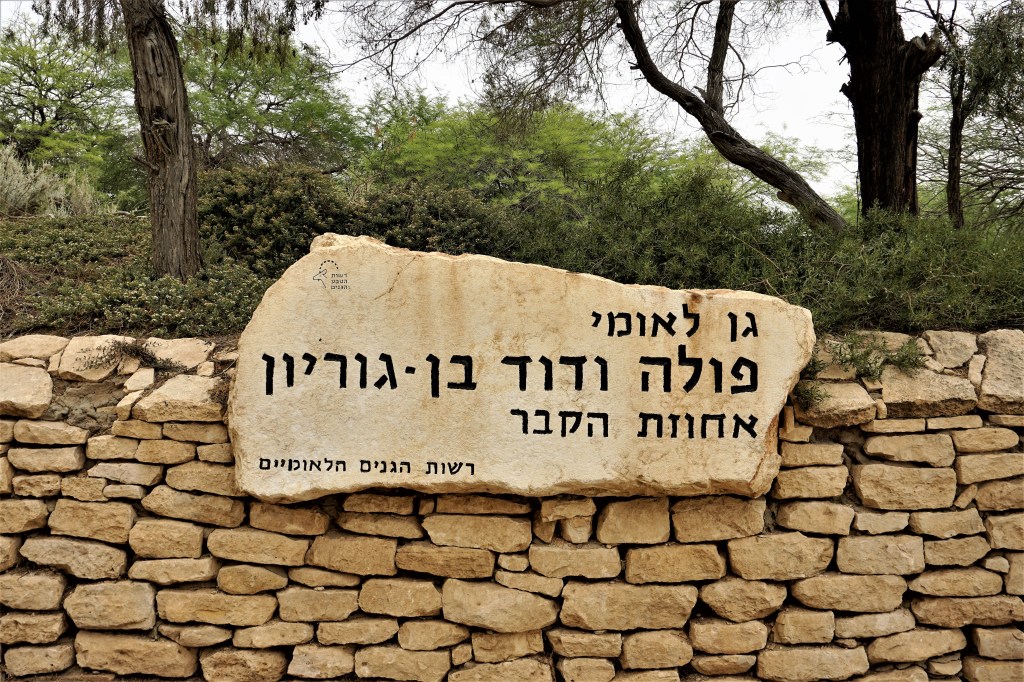
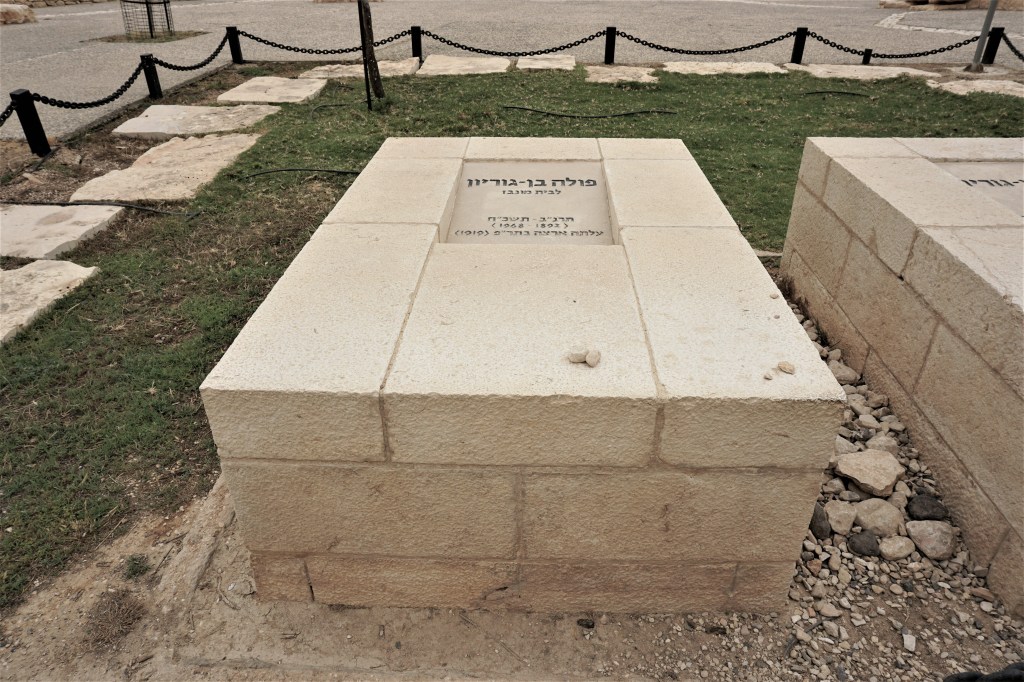
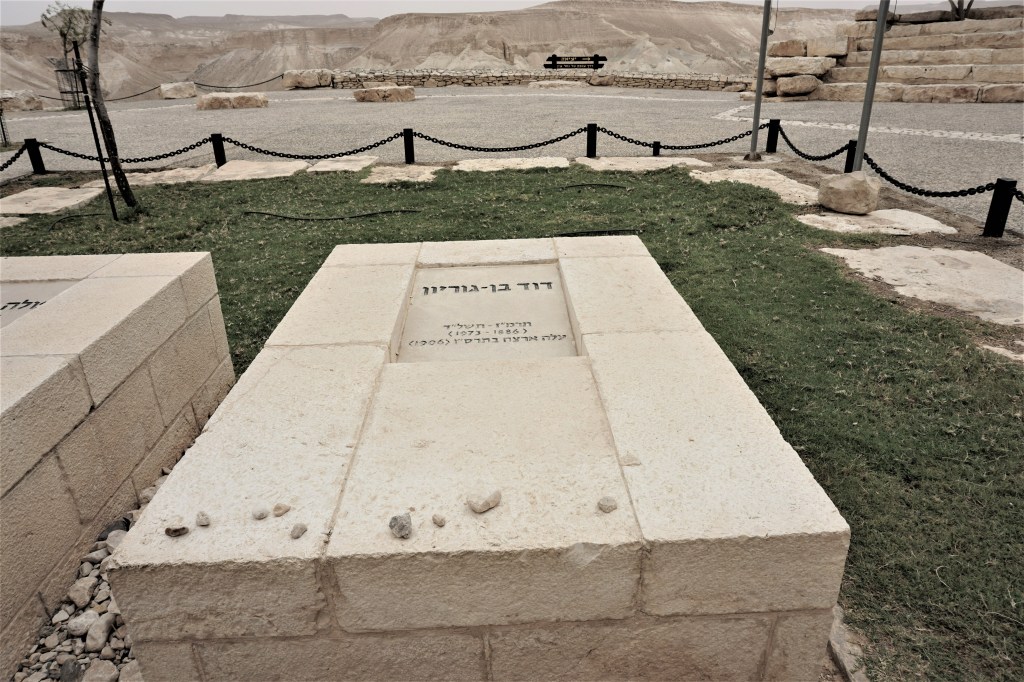
We left Jerusalem on our way to the Negev desert to visit Kibbutz Ein Gedi, and En Gedi Gardens, to spend a night in a Bedouin camp, pay our respects to the heroes of Masada, float in the Dead Sea and give honor to David Ben-Gurion and his wife, Paula.

Kibbutz Ein Gedi is a 3,500-acre botanical garden located on the edge of the Judean Desert and on the west coast of the Dead Sea. The kibbutz has supported itself since its founding in 1953 with the business of growing date palms, farming, harvesting and selling dates. The kibbutz brings in water from a spring about 1 1/2 miles away and in the hillside. This magnificent botanical garden is possible only because of the spring’s abundant water and is now home to over 900 plant species from around the world. Kibbutz Ein Gedi is the world’s only populated botanical garden, home to 588 inhabitants.

Daniela and Tehuda Cohen have been members of Kibbutz Ein Gedi for over 50 years. Daniela is a native Californian who visited Kibbutz Ein Gedi as a young adult, fell in love and married. Tehuda is the manager of the date farm, and Daniela gives a most excellent tour of the Kibbutz.

Date Palms – Long In The Distance
A Little Better Look At The Date Palm Grove
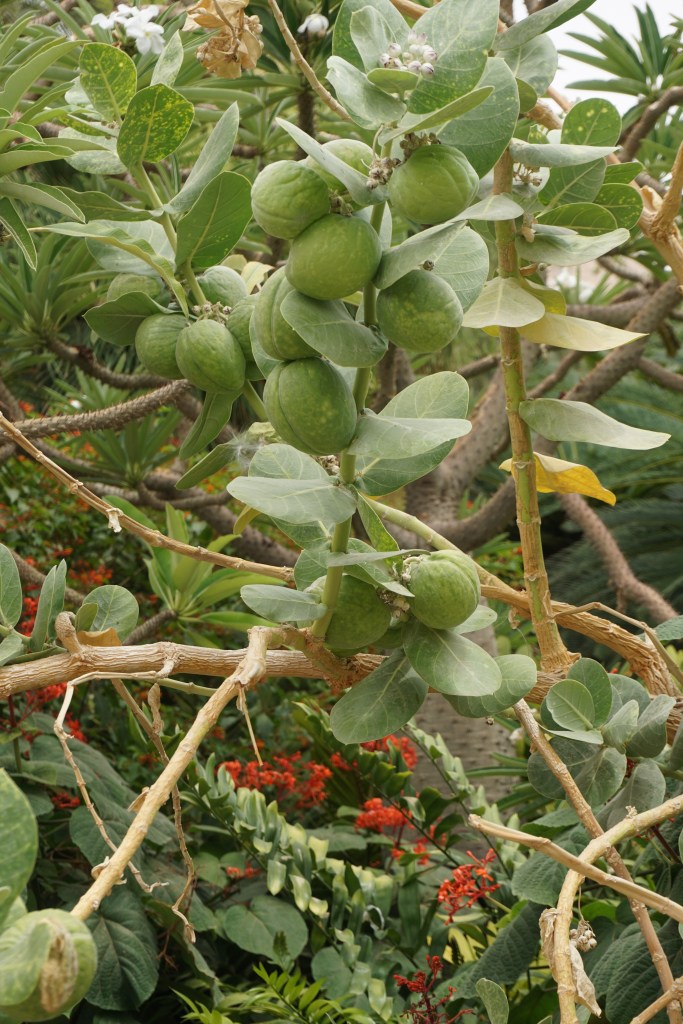
Ponytail, Bottle-Palm, Elephant-Foot-Tree
Madagascan Ocotillo
Pomelo
Variegated Croton Or Sloppy Painter
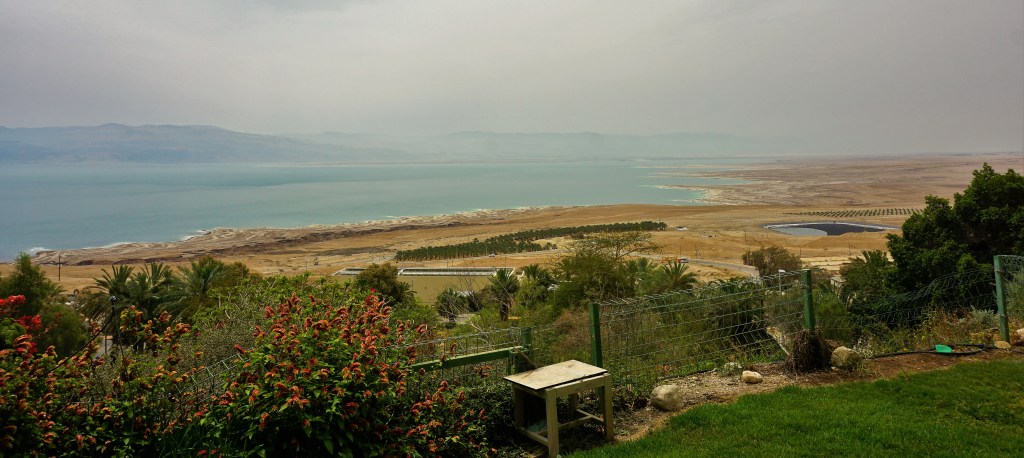
The Dead Sea

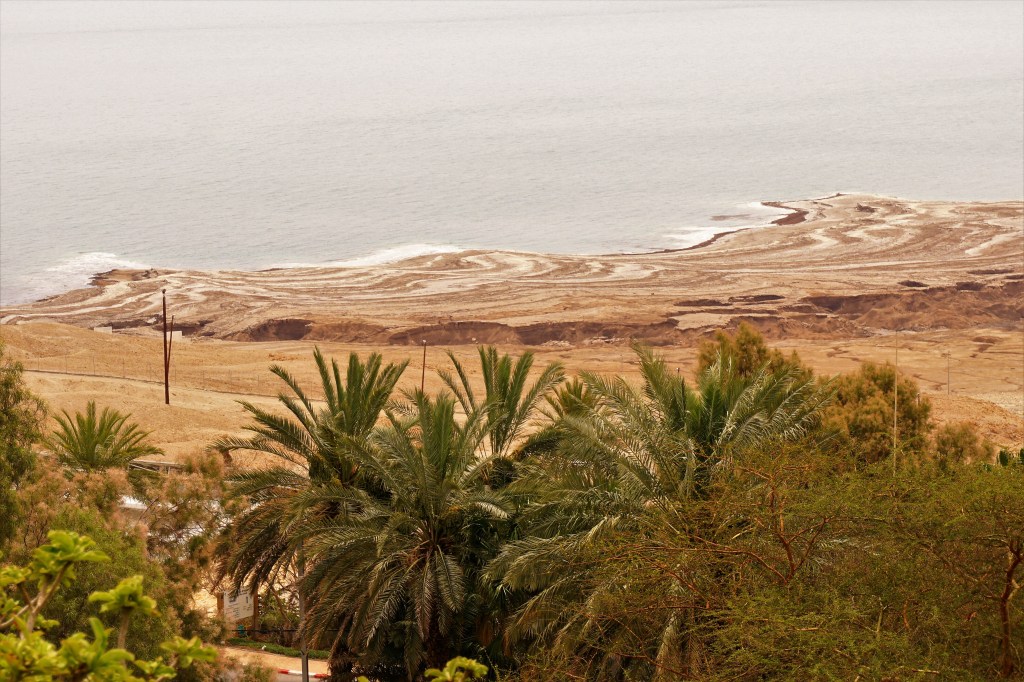
Every year hundreds of sinkholes open along the banks of the Dead Sea, some as deep as a two-story building.

Dead Sea Sink Holes

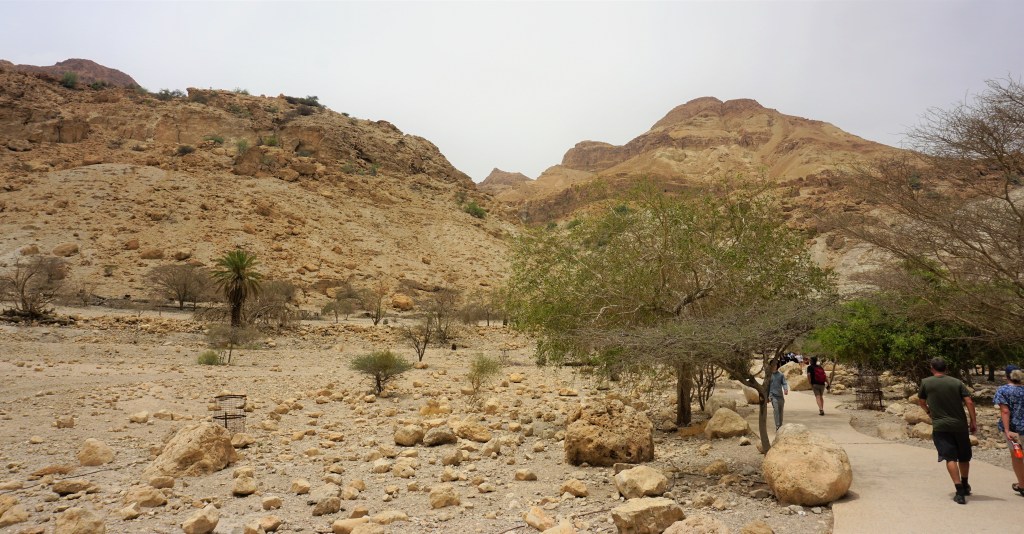
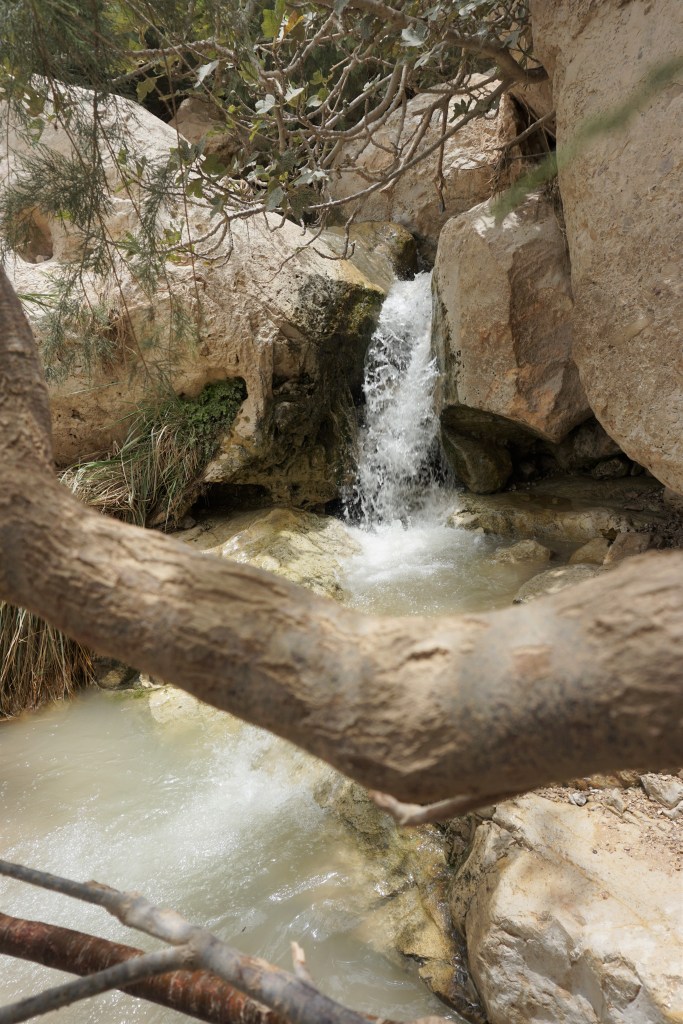
En Gedi is Israel’s largest oasis and is located in the southern region of Israel – a region of the Country that receives less than 2 inches of rain per year. However, four spring-fed streams flow year-round generating approximately three million cubic meters of water annually feeding En Gedi’s springs, waterfalls (!) and flowing brooks at the foot of its cliffs. It is home to the Nubian ibex and rock hyrax – the ibex is a species of wild mountain goat.

Biblically, Ein Gedi was a favorite hiding place for David and his army during their war with King Saul. The high elevation of caves in the surrounding area afforded a strategic advantage point above the desert below as well as an “invisible” location from which an advancing army could be easily seen. Of course, water was plentiful – water in the desert is as essential as air to breathe.

Definition Of Desolate?
Ibex
Rock Hyrax – aka Rock Rabbit

During the day the Negev has the possibility of 2 temperatures – hot or hotter! There is some “shade” in the vegetation surrounding the waterfalls, and walking into the pools at the base of the waterfalls or standing directly under the amazingly cold water is a way to cool off temporarily – BUT, otherwise there is little shade along the waterfall trail It was a moderate hike to view 3 of En Gedi’s waterfalls. The climate and terrain was prohibitive to viewing the remaining 4 waterfalls.

The Dead Sea is a salt lake bordered by Jordan to the east and the West Bank, and Israel is to the west. It was once connected to the Sea of Galilee, about 100 miles to the north, by the Jordan River. Today, only the Sea of Galilee is still “fed” by the Jordan River. The Dead Sea is approximately 1,400 feet below sea level, making it the lowest place on earth.  It is the world’s deepest hypersaline lake and is so salty that nothing can live in it – hence its name. The salt and minerals found within makes the water very dense, eventually taking one’s feet out from under her/him and allowing people to float easily on the surface. It is mentioned in the Bible as the place where Lot’s wife turned into a pillar of salt. The Dead Sea is facing environmental challenges due to human activities (mining) and climate change. The water level is dropping at an alarming rate, threatening its existence and ecosystem.

We couldn’t pass up the opportunity to experience floating in the Dead Sea. We’re not sure you can call where we entered the Dead Sea a beach. Yes, there is salinized sand, yes, there are sunbathers, and yes, there are high-powered public showers when done bathing to wash the remaining minerals and salt from your body or to flush your eyes should the waters splash them – the burn is pretty intense. Bathers cover themselves in mud from the bottom of the Dead Sea – we guessed this was a way to open pores and detox the body. We changed in the bathhouse and followed a boardwalk into the water – the boards felt incredibly slick/slippery. We didn’t experience that feeling of our feet going out from under us, because in ankle deep water we simply sat down and let the floating begin! Of course, in the course of paddling around we ended up accidentally splashing water into our eyes. Time to get out and flush, but Barbara couldn’t get her feet under her in order to stand. A helping hand from Brian got the job done, and after a short while under the flushing waters we were back on our backs floating around – a lot more carefully. Barbara enjoyed the novelty of floating in the Dead Sea, but Brian found a rare (for him) peaceful place in which he could have floated forever. Hmmm, wonder what that was about?

What an introduction to the Negev Desert – the Southern Region of Israel. It was a great day – a long drive along the western coast of the Dead Sea, the chance to talk with someone who has lived on a Kibbutz for most of her life and seeing the Kibbutz’s amazing botanical garden, being in yet another place of Israeli importance – sharing a place and walking in the shadow of King David (how awesome!), and, of course, floating in the Dead Sea. Next stop? Bedouins and paying honor to the heroes of Masada and the first Prime Minister of Israel. Stick Around…

Barbara and Brian

“It’s not what you look at that matters, it’s what you see.“ – Henry David Thoreau
OF BEDOUINS AND HEROES

By The Way – Most Camels Are Owned By Bedouins

June, 2023

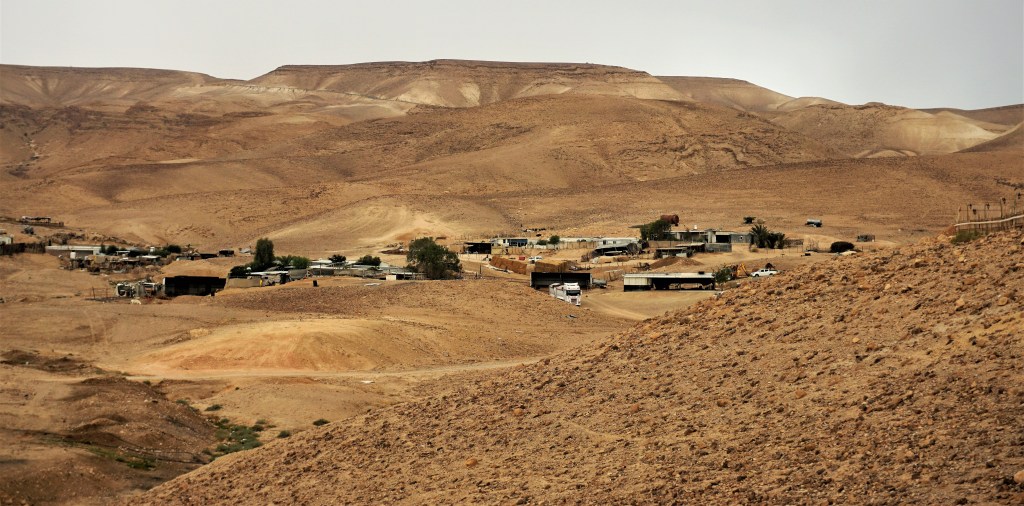
Bedouins are desert peoples and extraordinarily independent and nomadic. They live in clans, and are traditionally herders – tending to camel, sheep, goats and cattle. Bedouins living in Israel migrate deeper into either the Negev Desert or the Judaean Desert during the rainy season returning to their more cultivated home areas once the rains have subsided. Some Bedouins have left their nomadic culture and moved into the cities assimilating into urban life.

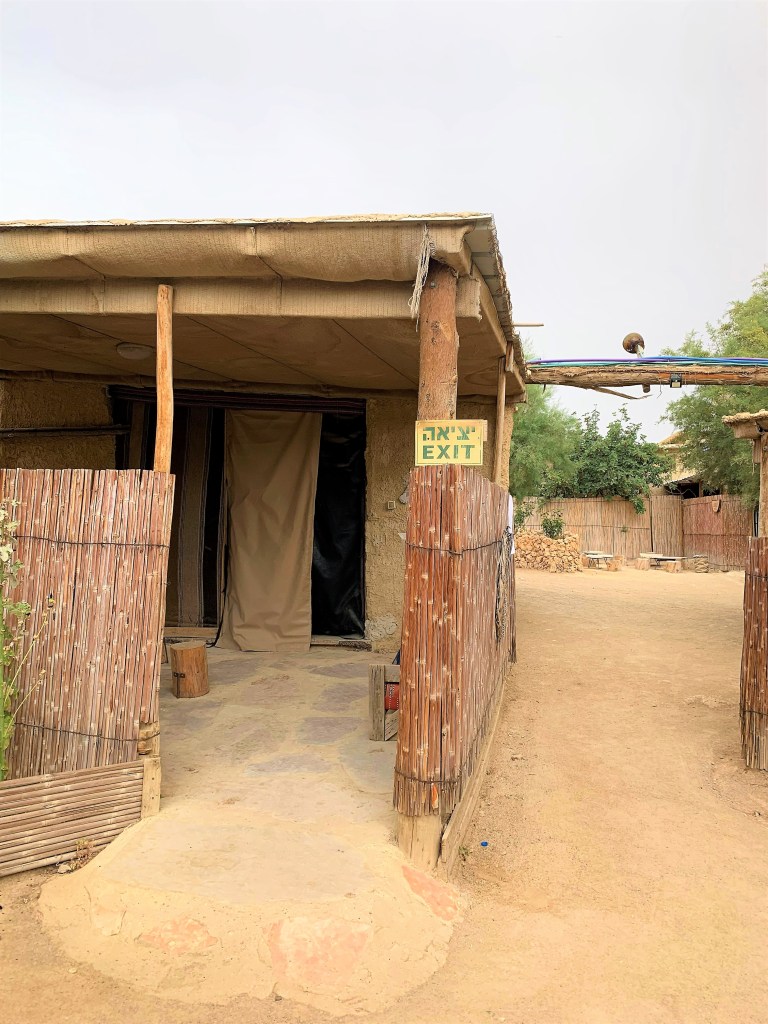
We had the good fortune to spend an overnight at Kfar Hanokdim (translation: shepherd’s village), a Bedouin camp in the Judaean Desert. The Duckenfield Israel Tour Company had booked us into a sukkah – a large tent covered in goat’s wool fabrics with a floor paved with wooden decking. It had sleeping futons, bunk beds and air conditioning (!). Close by were communal toilets and showers. The camp includes a centralized kitchen and dining hall, large open spaces for gatherings, meeting rooms, and has available a herd of camels used for excursions into the desert.

After checking in and stowing our gear we were escorted to a communal tent and welcomed by a local Bedouin Chief, who described the life of his clan. Bedouin clans are extremely hierarchical and patriarchal – many Bedouin men have more than 1 wife, and the Chief’s power is absolute. Marriages tend to be within clans and “arranged.” If not herding animals for food or sale, income is derived from jobs that may be obtained in small cities throughout the desert. The Bedouins diet is very high in animal protein.

Bedouins are required to welcome the stranger as travel in the desert may be complicated with a lack of water, food and/or shelter. A stranger approaches the Bedouin encampment and stops some yards away seeking permission from the Chief to enter. Permission is granted and tea is offered; however, the cup is filled about halfway. The stranger holds his cup out for a refill or shakes his cup to signify no refill. The stranger will also be given a cup of coffee. If given a full cup the stranger is expected to leave immediately! Thankfully we were treated to half-filled cups.

Dinner was what we had come to know as a traditional middle eastern meal. A never-ending assortment of small plates and pita followed by an incredible platter of rice, vegetables and animal protein. Breakfast was a buffet, not served, but the assortment of foods was nonetheless expansive.

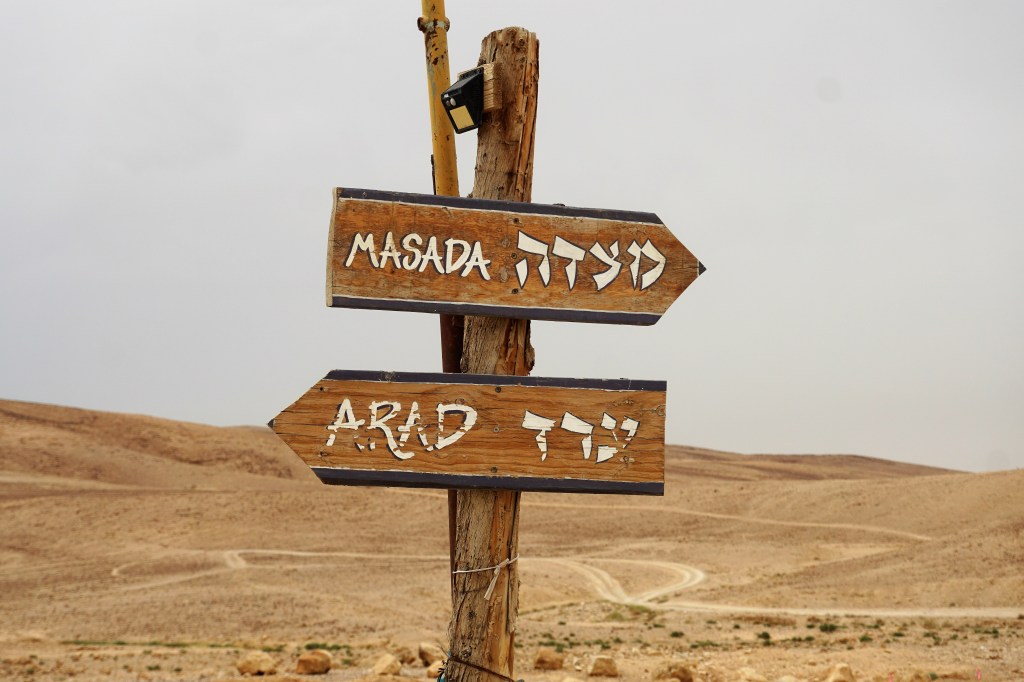
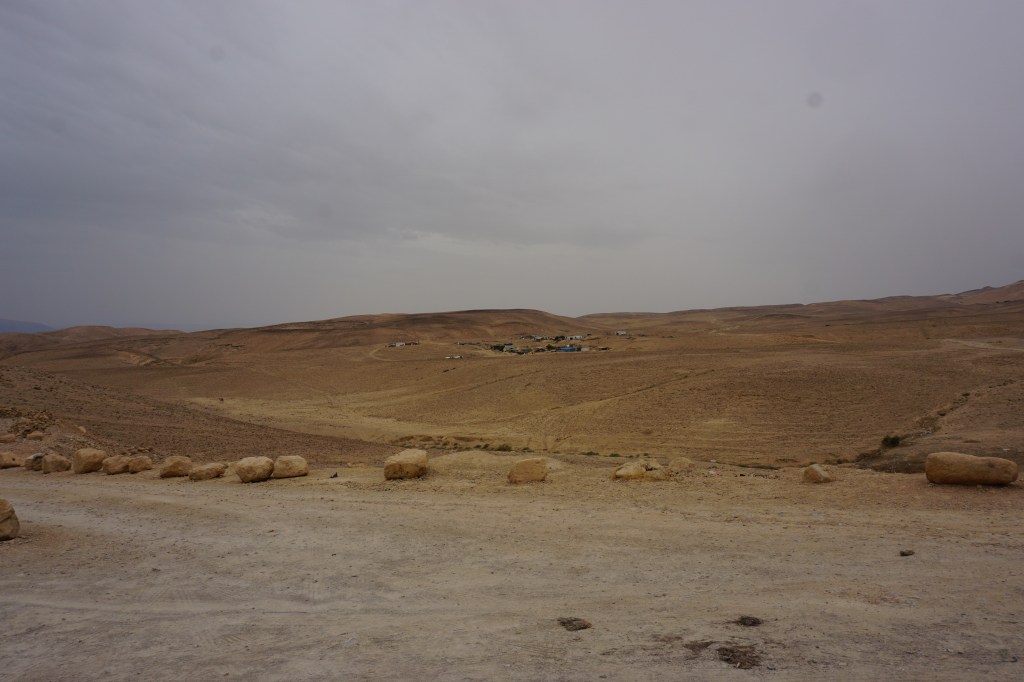
Kfar Hanokdim Is Between The City Of Arad and Masada National Park
Entrance To Our Sukkah
Dining Hall
Judaean Desert
Bedouin Encampment

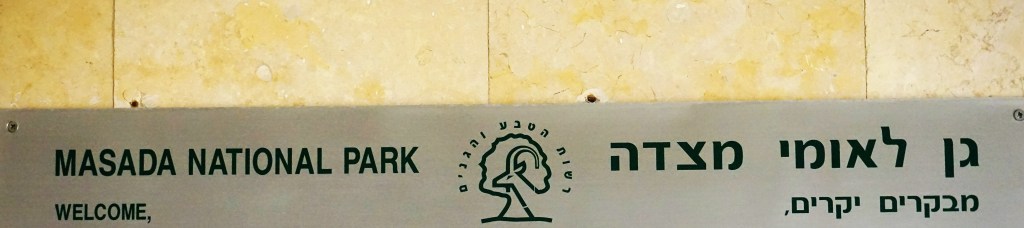
Masada National Park was on our list as one of our “top things to do while in Israel.” We were treated to an “at the park” night show about the Jewish-Roman war, which tried to help set the tone for the next day’s visit to Masada. While the light show was pretty cool and the dramatization pretty good, we personally found the show lacking in emphasizing the importance of Masada to Judaism.

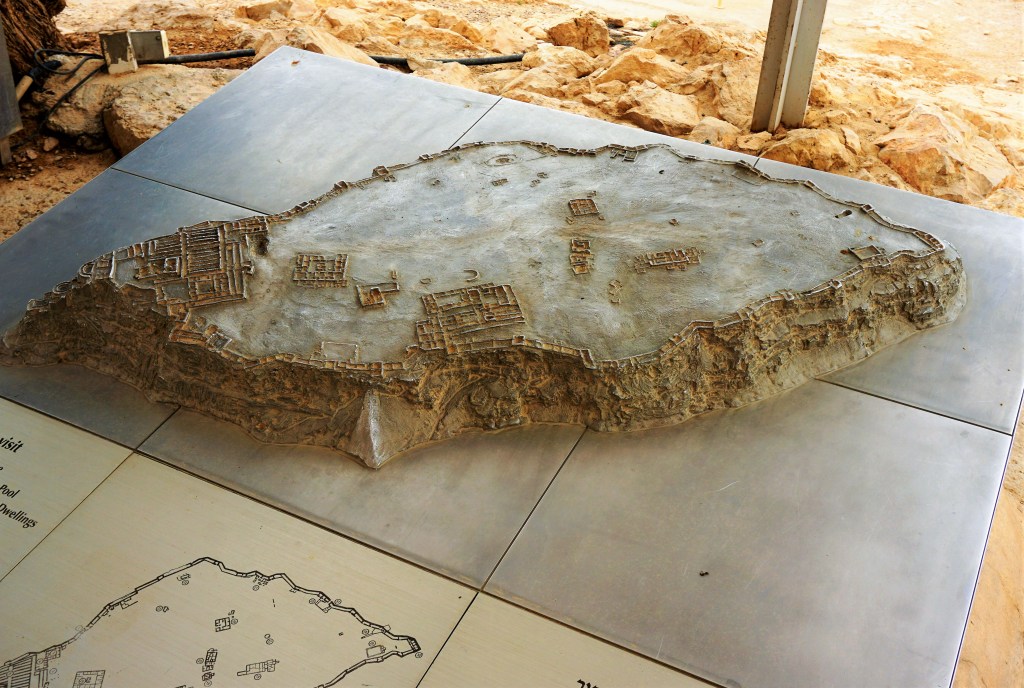
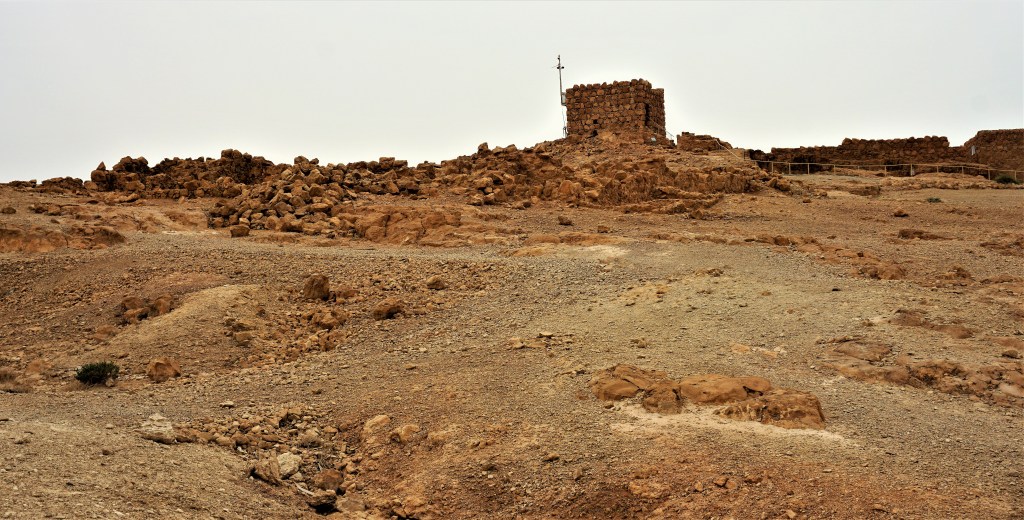
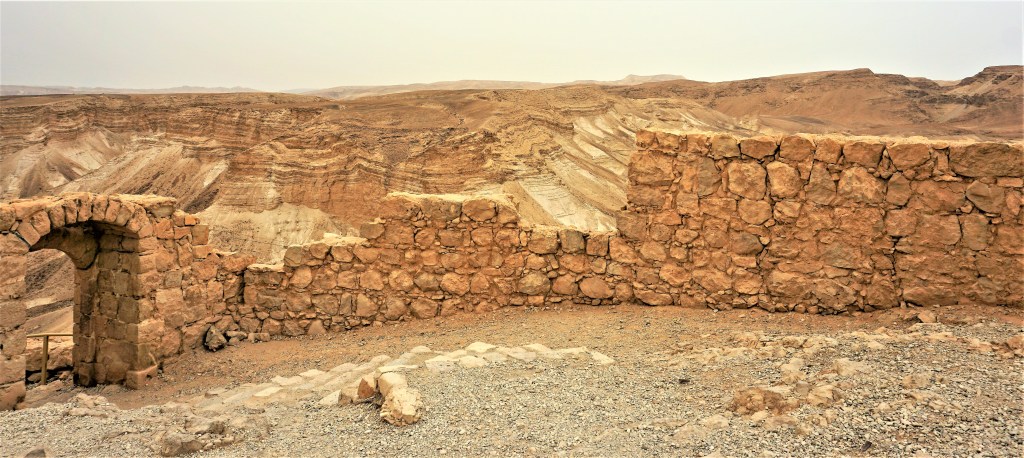
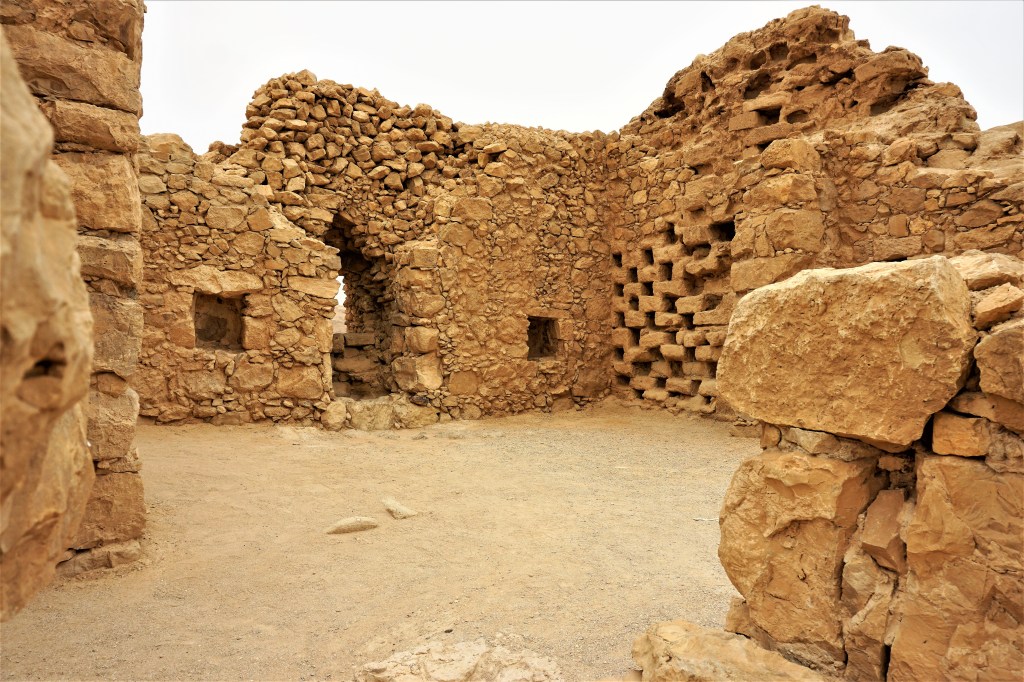
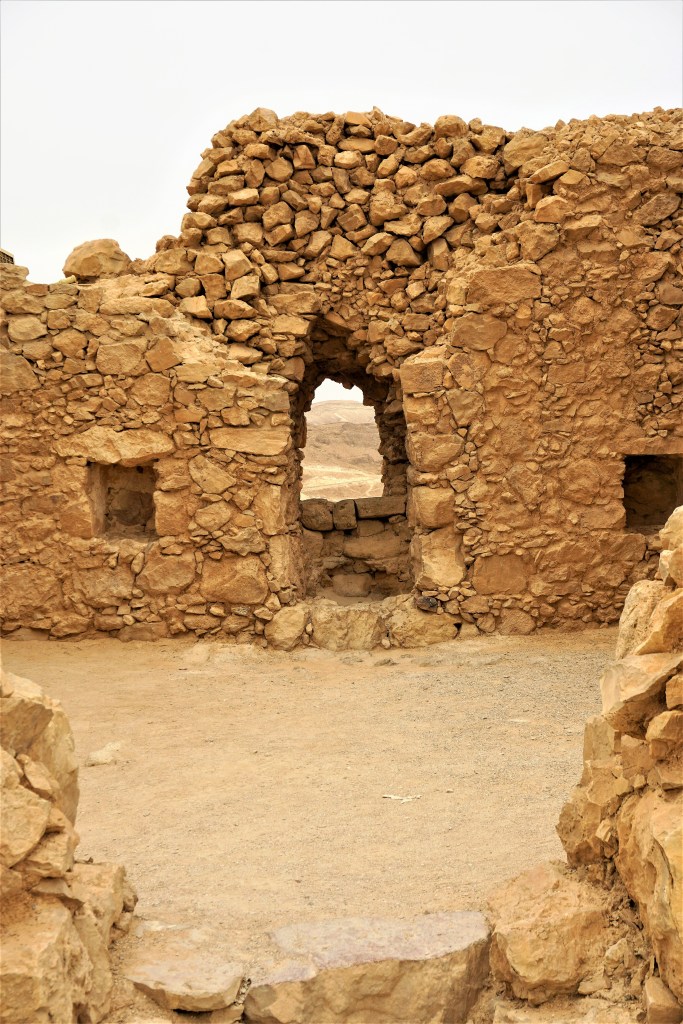
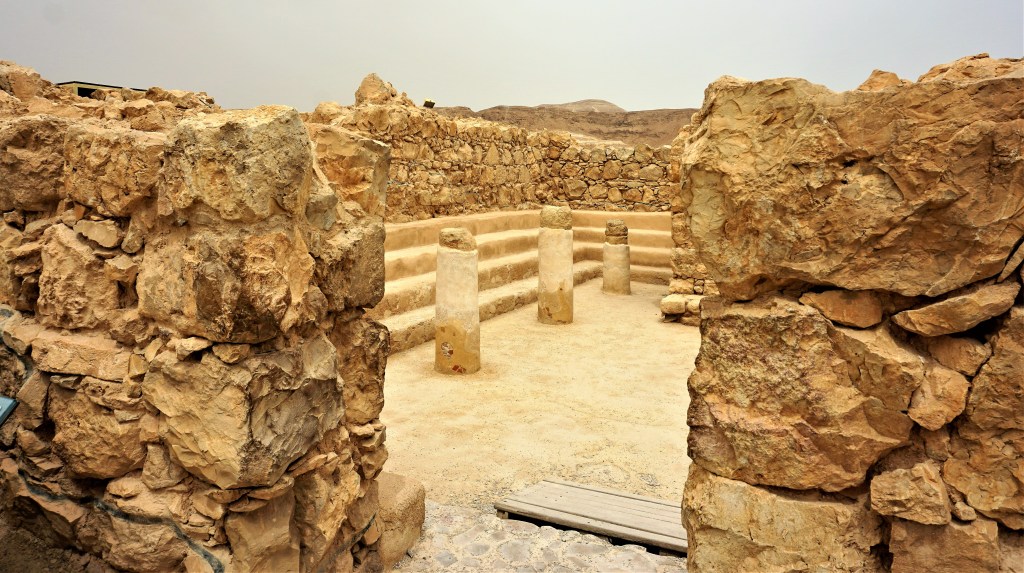
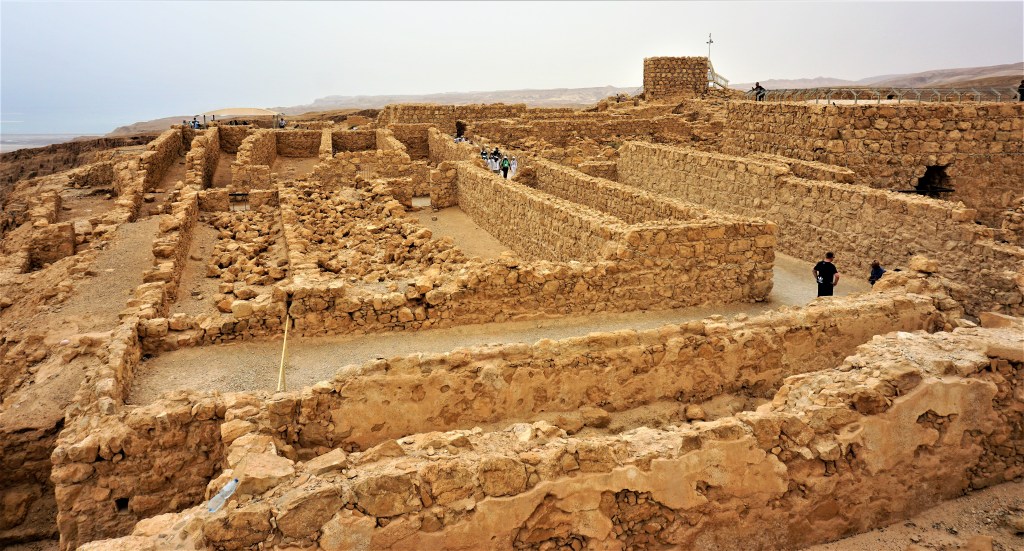
Meaning “strong foundation or support” in Hebrew, Masada is a natural fortress built on top of a barren mountainous desert plateau thousands of feet above the Dead Sea. Masada has been described as “a lozenge-shaped table-mountain” that is “lofty, isolated, and to all appearance impregnable.” For many, many years the fortress could only be reached by a single pathway that was too narrow for men to walk abreast. This pathway was named “the Snake” for the way it twisted and zig-zagged to the summit. Today there is a second, less formidable path to use to hike the top, or visitors can simply opt for a cable car to the summit and back.
Masada was built as a castle complex in the last century BC by Herod the Great, King of Judea, (ruled from 37 to 4 B.C.) who recognized the defensive advantages of Masada. Herod built his complex there as a winter escape and haven from enemies, complete with castle, storerooms, cisterns and a foreboding wall.

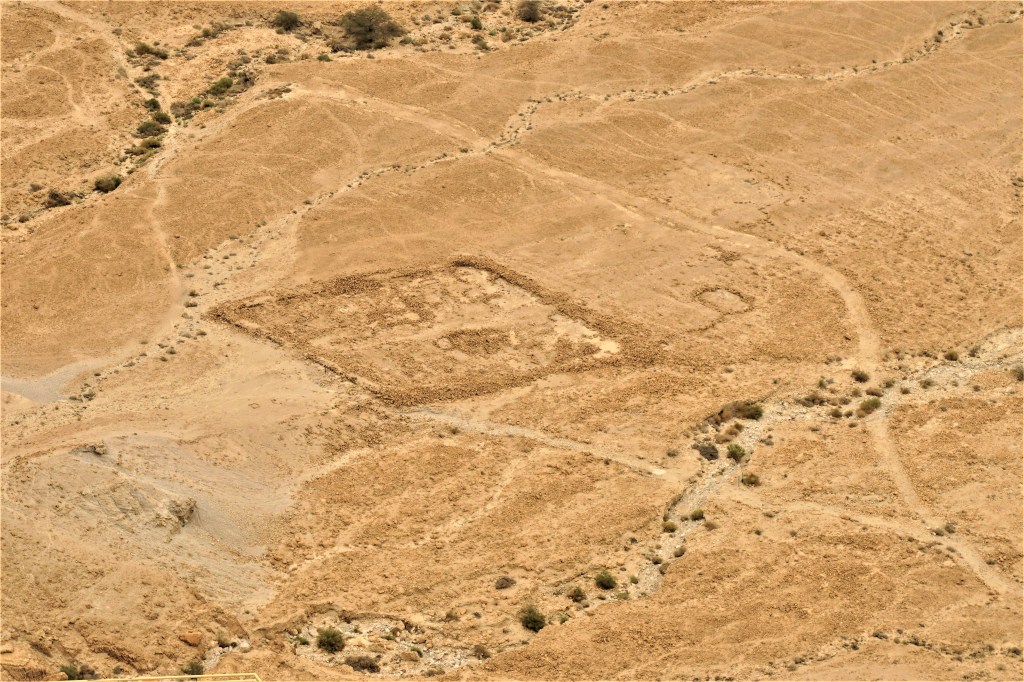
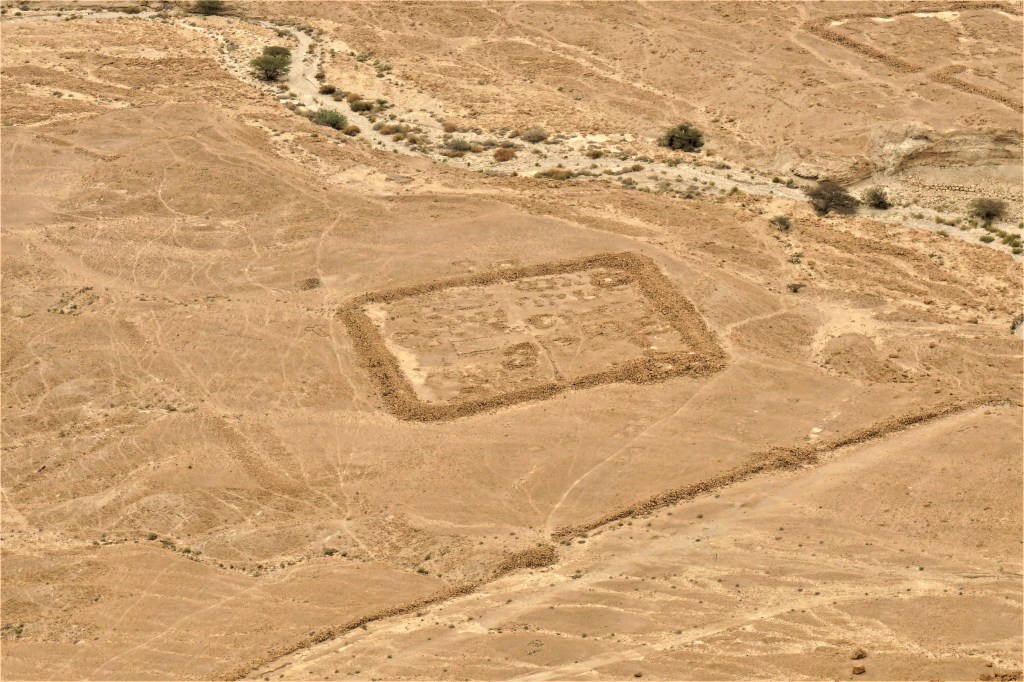
Whether the end of the story of Masada is apocryphal is unimportant. The facts are anchored in the First Jewish-Roman War (72-72 CE) as recorded by Flavius. The accounting begins with Jewish rebels having to flee Jerusalem with a Roman legion in pursuit. The rebels purposely found their way to the Jewish encampment at Masada and were taken into safety by the residents. The Roman legion laid siege, and after 3 years won the battle; however, (and here’s where some historians find Flavius’ story sketchy) on searching the grounds found no one alive. It wasn’t the Roman archers who shot down the Jewish warriors, nor was it their blades. Jewish belief is that the Jews had chosen to die by their own hand rather than lose their freedom – the men being slaughtered, and the elderly, women and children enslaved. However, 1 woman and 2 children hid from the Romans, were able to tell the story of Masada, and kept the memory of these Jewish heroes for generations to come.

The siege of Masada is revered in modern Israel as “a symbol of Jewish heroism,” and is felt to have played a major role in “forging a national identity” of courage, strength and conviction of Jewish belief – values held essential to this day.

The story of Jewish freedom is part of our DNA since the time of Moses and the exodus from Egypt. It is no surprise that the residents of Masada would not permit themselves to be enslaved. But genocide, suicide or genocidal suicide, the action of the Jews of Masada, is prohibited by Jewish law. How to understand the difficult lesson of Masada should be studied by now and for generations to come – perhaps freedom is given us by God to be revered above all other human traits or virtues.

Those that sacrificed and died here are heroes of Israel. Kaddish was said in their honor.

From The Summit Looking Down To The Visitors Center From The Cable Car Landing. Yes, That’s The Dead Sea In The Background
Looking Southeast Towards Jordan
Scale Model Of The Encampment At Masada. King Herod’s Castle And Compound Are To The Left. The Buildings Towards The Bottom Center Were At The Apex Of The Snake Trail.
Looking Over The Wall Southwest Into The Judaean Desert
Thought To Be The Temple
Snake Trail
Remains Of Herod’s Castle
Either A Roman Encampment Or A Livestock Corral From The Time Of The Siege
Mocking Bird

Traveling the road back to Kfar Hanokdim the night before we encountered a herd of goats – too dark for a picture and best to keep focused on driving. However, in the daytime we did have to be at the ready for livestock in the roadway as well. It is suspect that Bedouins were looking for their goat herd and donkeys! We never did see any camels on or near the roadway.

For our last stop we journeyed south and a little bit east from the Judaean Desert into the Negev Desert to pay respect to David Ben-Gurion, Israel’s primary national founder and first Prime Minister. Born of Polish Jews in Plonsk, Polish Russia, he immigrated to the Palestine region of the Ottoman Empire in 1906. Adopting the name of Ben-Gurion in 1909, he rose to become the preeminent leader of the Jewish community in British-ruled Mandatory Palestine from 1935 until the establishment of Israel in 1948, and he assumed leadership of the fledgling nation until 1963. He was known for his uncompromising vision of Jewish unity and statehood, and a genius for pragmatic political and military tactics and solutions. These traits centered the young State of Israel and formed a guide to help handle the social, economic, and military challenges of its early years. 

Sculpture Of A Vulture In The Parking Lot – David and Paula Ben-Gurion’s Grave Site
The David Ben-Gurion Heritage Institute
Paula Ben-Gurion’s Grave
David Ben-Gurion’s Grave
The Zin Valley – Negev Desert View

We continue to have the experience of not just completing our checklist of things to do in Israel, but to find ourselves walking the very paths of those who have come before us, to give respect and acclaim to ancestors of the Jewish peoples, and to immerse ourselves in observing, seeing and learning. We can ask no more of this journey.

Barbara and Brian

“It’s not what you look at that matters, it’s what you see.“ – Henry David Thoreau