Posts

WHAT’S A MILE AND A HALF LONG AND HAS 4 LEFT TURNS?

See the source image

March, 2021

Once chronologically an adult a trip to Vegas with your boys ought to be about booze, broads, and (not) bowling as the Canadian Group Moxy Fruvous penned in 1989, but about, well, booze, broads and gambling but then again most of us (except for the trumpster and his misanthropic followers) dislike the misogynistic term broads preferring the term “not boys”, so when Mark called and said “saddle up the horses we’re off to Vegas for the Las Vegas NASCAR 400” who was Brian to say no?  Then again if you were to put together a list of the bottom things Brian wouldn’t watch on TV and would never think about attending in person, a holiday parade and NASCAR, events kicked out of the Olympics like croquet, cricket, jeu de paume (?), pelota (?), roque (?) and rackets (?), as well as standing in line and being on hold would be somewhat more interesting and higher on the list, but then again he and his beloved attended the Macy’s Thanksgiving Day Parade in The Big Apple in person and IT IS PRETTY COOL IN PERSON after all.  Could he be equally as wrong about NASCAR when there with your boys in Vegas and The RACE is part of the experience or after The RACE will NASCAR still stand for Non Athletic Sport That Centers Around Rednecks in his mind or will there be a new respect for the National Association for Stock Car Automobile Racing? 

Exterior Night Image of Planet Hollywood Resort and Casino hotel in Las Vegas, Nevada

If “what happens in Vegas stays in Vegas,” the big question is how will Mark, Jay, John and Brian make the most of their brief 36 hours in Sin City (with apologies to Frank Miller)? Mark had a plan for exactly that since his high roller status with Caesar’s Entertainment comp’ed him (us) a suite (!) at Planet Hollywood, 3 additional individual bedrooms, dinner at The Strip Steakhouse with transportation and club level (food and drink included) tickets to The RACE the next day.  Throw in some alcohol and gambling, a modicum of sleep overnight, and naps in the car back from Vegas and would all be good come Monday am?

Every hotel and casino in Vegas is fairly much the same – hotel rooms, casino floor, restaurants and maybe a food court, bars, nightclubs and performance venues, and conference/special event rooms. The sophistication of the venue depends on whether or not it tries to cater to families or couples or singles or bachelor/bachelorette parties or whether or not its on the Strip or on Freemont Street or perhaps on the reputation of who plays in the high roller room, whether or not the venue has or will host the WSOP, is the home of the Raiders/Knights/UNLV/Aviators/NASCAR home teams, and, of course, the rep of management. Some of the hotels and casinos have a glamorous lobby that engenders luxury, some lobbies are a throwback to the time of mobsters and the era of Bugsy Siegel and Meyer Lansky, and then there are those lobbies that are functional and pedestrian and Planet Hollywood is one of the latter as a place to check in although that’s not necessarily a bad thing since the rest of the joint may be exquisite.  Brian was duly impressed when the desk clerk called Mark by name, asked about the family, told him she’d let his “host” know he had arrived, handed him the packet of stuff for dinner and The RACE, and had our keys prepared for an easy peasy check-in. 

Planet Hollywood Resort and Casino hotel lobby in Las Vegas, Nevada

“Take the correct elevator boys” Mark commented…”we’re on the 36th floor in an Apex Suite and only 1 bank of elevators makes its way up to our rarified air” overlooking a large portion of the strip with the highlights being a magnificent view of the strip after dark and an eagle eye view across the street of the famous Bellagio fountain water, music and light show that still in this time of Covid takes place every half hour during the day and every 15 minutes at night. 

In we walk to the 1800 square foot suite whose central living space looks just like the room in “The Hangover.” To the left a kitchenette, bar and dining/conference table, in the middle 3 semi-circular couches fronted by a 2-foot high 12 foot across “strippers table”, to the right a clear glass shower complete with strippers pole, and 1 bedroom and full bath down a small hallway – alas, and if you remember the movie, there was no tiger in the bathroom. 

See the source image

Taking in the scene, Brian’s mind kept drifting off to an era gone by (?) of crazy parties until dawn, guys and dolls, zoot suits and 99-cent buffets long before the corporate conglomerates took over and Vegas became “legit.”

“Go downstairs and get a drink boys” – Mark suggested – “I’ve got to make couple of calls and will join you in a minute, but sit at a gaming table and your drinks are free – don’t go into one of the bars!” And off we went to the land of slot machines and blackjack tables, craps and roulette, of texas hold ’em and other forms of poker, the constant ringing from the slots, modern music pipped in at just a couple of decibels above the level needed for a conversation, no clocks, oxygen rumored to be pumped into the darkened gaming floor populated by all manner of humanity in all manner of undress (or is that dress?) with dealers chosen for their inscrutability and/or cleavage, and a main bar complete with scantily clad women dancing on the top of the bar ala the era of the gogo dancers all in a wholesome smoke-free environment (sic).

Take 3 boys waiting on their leader and the thought that they would follow any decree let alone one about not going into the bars has little or no chance of being followed. 2 beers, a mixed drink and a double with a shocking $71 (gasp!) plus tip bar tab later, Mark had his chance to remind us of his directive but oh – well it was time for dinner and the lemmings followed him up the escalator. We wandered into The Strip Steakhouse; Mark has eaten here numerous times and had nothing but good to say.

“Order up boys…it’s on the house!”  The Dark and Stormys and beers began arriving as Brian made up a series of stories about the scantily clothed women posed in black and white photos on the walls throughout the restaurant as the boys contemplated their appetizers, entrees, and wine selection.  Our waiter was just the best and one step ahead of, well, anyone in the place – it was like he could read our minds, figure out our personal preferences, and assure that a surfeit of food and drink would continuously arrive until the boys cried UNCLE!  An order of oysters, 2 shrimp cocktails, glazed bacon, and another round of drinks arrived and everyone copycatted the other ordering 20 oz bone-in ribeyes in varying degrees of doneness (it is a high end steakhouse after all) – 2 with lobster tail, and sides of au gratin potatoes, creamed spinach, and sautéed mushrooms.  Perfect ordering, or so we thought.  There may be other stuff on the menu, but high-end steakhouses do one thing and should do that one thing especially well…sides should never, never taste like they came from a steam table, au gratin potatoes should not be gummy, truffle enhanced creamed spinach should not be bland, a better quality red wine should not be served chilled (ever!, and with an explanation of “that’s the way we store and serve it”?), steaks should be cooked properly and a more skilled manager could have made us feel right about choosing this steakhouse.  It didn’t take much to figure out that our $800 dinner bill would have been better spent somewhere else. But our bellies were indeed full.

Brian and John had half expected the group to meld into a modern day Rat Pack carousing and carrying on, casino hopping until the wee hours, but it was not to be as the siren’s song of the casino bells and lights and the Planet Hollywood high roller’s card pulled Mark to the craps table.  John disappeared, and Jay and Brian tried to find a more reasonable minimum bet blackjack table where both could sit down.  Jay was kind to his elder and gave Brian a single open blackjack seat, where he sat until a string of pushes with the shoe had him walking away up a few bucks.  The boys saw little of each other until breakfast the next day.

On to The RACE!  

Easy enough to head out to the west side of Vegas, enter a parking lot the size of Rhode Island, and walk the half mile or so to the staging area, which was decked out with merch trailers representing the more popular drivers, food trucks, some cars from yesterday’s race and a couple of classic midgets.  Only 12,000 fans were permitted to attend allowing for a decent amount of social distancing, and the cross-section of people milling about taking in the sights included families with small and not-so-small children, couples of all ages, and studs like the boys many of whom wore the colors of their NASCAR hero – true fans of the sport.  For them it was time to get their grease on…all of the essential food groups fried up and served with some type of sugar disguised as a condiment, grilled and pulled meats, and the requisite grease of the cars themselves.

Getting through the gate was easy, a quick temperature check and showing of the wrist band and we were off to find the elevator to take us to the club level.  It’s pretty impressive walking out of the tunnel and viewing the track for the first time.  The stands and seating area stretched for what seemed to be forever around two thirds of the banked mile and a half oval.  Central to the stands and on the infield was the track’s offices; the rest of the infield was filled with semi tractor-trailers meant to haul the cars, tires, parts, assorted other pieces of equipment, tools and stuff needed to race and care for the cars, motorhomes serving as rolling motel/hotel rooms for the drivers and crew all centered on more garage bays than the Pep Boys ever thought of franchising. 

The “pit area” runs just inside the track itself and before the race was lined with today’s array of Fords, Chevys, Chryslers, and Toyotas, a veritable multi-colored army of 38 “stock” cars waiting for the inevitable “Gentlemen, Start Your Engines!” 

Our seats on the club level were on the main straight away just left of the start/finish line.  After settling-in with snacks and a cold one of choice, Mark and Jay went off in pursuit of headsets so that we could listen to the announcers calling the race, and maybe be able to listen in on a driver or 2 talking with their pit crew, which we hoped would assure us of some colorful NARCAR-style language.

The wait was over, a squadron of jets out of Nellis Air Force Base graced us with a fly-by…

…and the command to “start your engines” was uttered! Cars moved out single file for their pace laps with sound gradually increasing at each turn, fans got up on their feet, and as the cars came out of the last turn the sound became deafening (literally feeling it in your chest) as the green flag came out, the pedal was to the metal and the race officially started.  Cars nose to bumper flew by amazingly without incident (damn!) reaching speeds in excess of 150mph before the first turn.     

The race was run in three parts of roughly equal segments (something about points towards an overall yearly standing for a driver’s place at the end of each), pit stops were made between segments and during the race as necessary, and three and a half hours later, one spin out without incident (damn!), 4 yellow flags, a bunch of lead changes, amazing pit crew performances, and the race was over. 

The headsets brought the race to life and it was fun to listen to the race through the announcers’ eyes; drivers’ language and behavior was unfortunately mature.  Kyle Larson in Car #5 won the race, and the winner’s spinout capped a most enjoyable afternoon.

Neither the Macy’s Thanksgiving Day Parade nor a NASCAR Race were on my bucket list.  I don’t believe that I’d purposely plan on experiencing either again…that is unless it was all part of the adventure.

Brian 


ZOOLIGHTS

December, 2020

During December, 2019 our dear friends from Calgary, Alberta, Canada, Bob and Marlene Gill, invited us on a double-date for a fine evening at ZooLights – Phoenix Zoo’s annual Holiday lightshow and charity event. The proceeds help defray the cost of animal care and vital operations for the Arizona Center for Nature Conservation/Phoenix Zoo. We had posted a blog about last year’s enchanting adventure.

ZooLights displays occur in many communities across the Country, but for the uninitiated and as a refresher: On display are “millions of twinkling lights, dazzling animal sculptures and a wildlife lantern safari.” Brian particularly likes the wildlife lanterns – painted silk canvas stretched over a wire frame and lit from the inside.

We so enjoyed ourselves last year that attending ZooLights in 2020 was on our must-do list, and we wanted to share this year’s trip with friends. Sadly the pandemic has kept Bob and Marlene at home in Canada, but we gathered up Dee, Kent, Dave, Elfy, David, Glo, John, Cheryl, Jerry, Barb, and Angie for a night at the Zoo.

As in last year as we walked in we were handed a pair of carboard glasses whose lens’ refract light creating an almost hallucinogenic visual field – we ambled through a tunnel of amazing colors and distortions…Welcome To ZooLights!

Slowly walking around the paths within the Zoo we had the chance to enjoy the displays as well as the company of and conversation with dear friends.

Appears To Be The Evil Stay Puff Marshmallow Man – Ghostbusters Anybody?
Keep On The Lookout For That Colored Globe Later On. It’s almost as alluring as the Epcot “Ball”
Yeah – This One’s Real
Wildlife Lantern
Gotta Love Mom’s Expression – Content With Her Cubs
We Wondered Whether Or Not The Millions Of Lights Were Kept Up All Year Long? Who Inspects The Light Strands? Who Has To Replace Burned Out Or Broken Bulbs? We Figured That It was Pretty Intensive Work To Install And Remove.
Love The Reflections

If near a Zoo with a Holiday ZooLights display and you haven’t gone, we thoroughly encourage and recommend you gather family and/or friends for your own safari.

Barbara and Brian

WONDERSPACES 2020

December, 2020

We visited Wonderspaces during our wintering expedition of ’19-’20, and were mesmerized by the display of avant-garde art – aesthetic innovation and viscerally evocative use of shapes and design, in many different media to draw one out (in?) emotionally. The gestalt, the play of figure and ground or perhaps the whole being greater than the sum of its parts or perhaps the binding of the eye to color or shape defines the artwork. It’s in your mind’s eye to determine…

Wonderspaces is an evolving showcase of extraordinary art to new audiences – or is it new art to extraordinary audiences?

This work is a 4 minute animation of morphing pictures in which figure and ground change with frequency to create many, many different pictures. We’ve all seen something like this along the way…so what do you see in each of the following?

The Face Is Pretty Obvious, But Are Those Legs And To What Are They Attached?
Two “Faces” About To Embrace Or?

This piece starts with a monochromatic white room, moves through the “red” space, and ends with a ROYGBIV rainbow room which includes cylindrical objects affixed to the ceiling.

A favorite otherworldly creation playfully using mirrored light reflection to focus and dazzle.

Can You Find Barbara In This Photograph?

Pure whimsy? Realism?

We sat down to absorb this piece with Brian in the corner of the room directly across from the center of the display and Barbara in the middle of the wall to his left. Imagine this – Barbara didn’t “see” Mount Fuji from her perspective – her focus was drawn to the bamboo, and she only discovered its central importance to the piece when seeing Brian’s photographs!

The “igloo” invites you into its core – sit or lay down, and take in the changing colors and patterns…

Experiencing Wonderspaces is a stimulating and evocative adventure in genres of art not often sought by the usual museum goer. There’s nothing done in paint, and therefore no paintings. There’s no sculpture in marble or bronze cast. And art work is not collated into an exhibition of 1 genre of art or a featured artist and disciples. Each display stands on its own, and we asked ourselves what we would take away from each artist’s work. Nothing short of marvelous as a beginning thought comes to mind.

We’ll be back for more as the exhibits change.

Barbara and Brian

PHOENIX OUTDOORS!

September – December, 2020

We have been captivated by street art and murals. Austin got us started searching for the planned, unplanned, pop-up and gonzo visions of artists equipped with a paint brush and cans of latex and/or enamel paint, spray paint, and even at times a handful of sharpies. Tucson got us excited about the variety of expression, the whimsy, political, cultural and philosophical statements, the wide array of drawing styles, and color used in murals. We’ve found street art and murals in unexpected places like Boulder City, Tucumcari and Tijuana, and enjoyed the hunt for art in Las Vegas, Flagstaff, and now Phoenix. Every place is a little different, and each has its own idiosyncrasy.

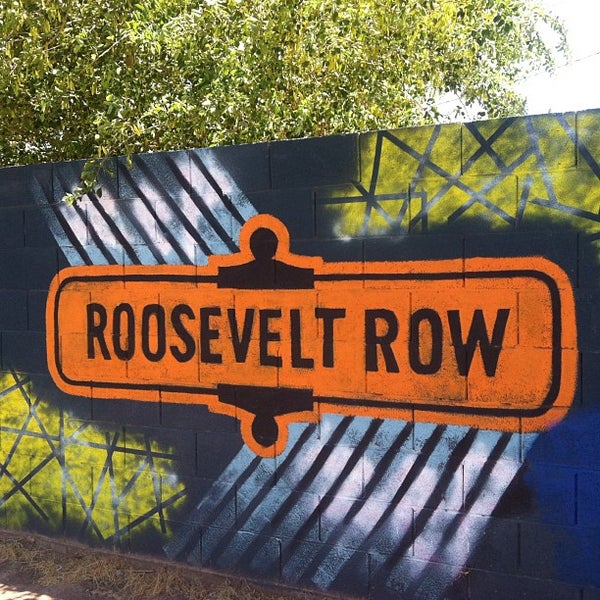
The epi-center for Phoenix street art begins on Street One and 1/2 (!) – also known as Roosevelt Row.

See the source image

We started searching out murals and street art in this museum of sorts in the Coronado neighborhood of Phoenix. One and 1/2 Street is a quiet little stretch that’s part street, part alley, and covered in dozens of colorful murals by local artists. We traveled down the street and then sought out additional pieces by walking around the neighborhood, expanding our search a little further to explore the Oak Street Alley murals nestled between 14th and 15th streets. Into our car for our own treasure hunt. Enjoy.

Oh yeah…let’s us know of your favorite(s).

Not Sure What This One’s About
The Lady Or The Tiger?
Can You Imagine The Story Behind This Piece?
Mural At The End Of One And 1/2 Street
What Catches YOUR Eye?
Amazing Crazy Detail
Dig The Reflection
That’s A Watering Can In The Child’s Hands
“Patriotism Means To Stand By The Country. It Does Not Mean To Stand By The President”
Teddy Roosevelt
“This Country Will Not Be A Good Place For Any Of Us To Live In Unless We Make It A Good Place For All Of Us To Live In” Teddy Roosevelt
Brian’s Favorite

While we didn’t leave ourselves enough time to forage about to find and experience the more than 90 murals in downtown Phoenix what we did find was pretty cool.

Barbara and Brian

MESA, CO-VID STYLE

See the source image

September – December, 2020

We found wisdom early on in the horror of the pandemic and delayed our trip to the Pacific Northwest until the summer of 2021.

It’s been a while since this journal has been updated with our further adventures. The last several blogs documented our successful summer anchored in Williams, Arizona. Amazing to think of all the hikes accomplished in Williams, Flagstaff and Sedona. We biked in Williams, Flagstaff and at the Grand Canyon. We learned to play disc golf. Amazing to remember our visits to Great Basin, Channel Islands and Death Valley National Parks, and our re-visits to the South Rim of the Grand Canyon, and Petrified Forest and Painted Desert National Parks. What fun feeding the donkeys of Oatman, seeing snakes, osprey, and heron, taking a jet boat trip from Laughlin to Lake Havasu, seeing our friends Tom and Kelley in a deserted Las Vegas, wine tasting in Cottonwood, and spending a little time in Holbrook, Prescott, Payson and Show Low. Anchoring in Williams also allowed Brian time to rehab his surgically repaired quadriceps tendon working with a fabulous PT Group in Flagstaff. Everyday was full. But all summer long we wished we could get Aimee back on the open road.

By late-September we were ready for our return to Valle del Oro Resort. Yes, it was still over 100 degrees fahrenheit in Mesa until the middle of October (can you say record setting number of days over 100 degrees, can you say record drought?). And yes, we were contracted as workampers for another winter season at the resort. But then throw in pickleball, table tennis, softball, water volleyball, time in the sewing room, bocce ball, renewing friendships from last season, making new friends, and an occasionally happy hour within our safe group and the Fall has gone by very quickly.

This Fall we got our nature on with hikes at Silly Mountain Park and the 40th Street Long Loop and a return trip to the Desert Botanical Garden. A second journey to ZooLights and WonderSpaces was on our agenda, and we were negligent at chasing after the murals of Phoenix the last time we were here. We’ll save on reporting on those events for subsequent blogs.

Silly Mountain Park is only about 6 miles east of our campground (Resort, please!) in Mesa. Officially part of the city of Apache Junction parks and rec, the hike is a 2.2 mile loop with a slight 500 foot elevation gain. There are 4 named trails that are only fairly well marked, but they are groomed and it was easy to follow in the footsteps of the many who had been here before us over the years. It was a gloriously beautiful day and we felt wonderful to be out and about hiking in the desert…the views definitely reminded us of how desolate this “neck of the woods” is when not in a more gentrified urban area.

How Many Genre Of Plants Can You Identify?
I Think You Could Lose Your Dog For 2 Days And Still See It!

We blogged about the Desert Botanical Garden during our ’19-’20 winter stay. As a reminder we were so enamored by our 1-day stroll through the property that we converted the day pass to an annual membership. With the limitations of the pandemic our annual membership was extended for 6 additional months…guess there is sometimes a sliver lining even in the worst of circumstances. A return visit was definitely in order. We were impressed with the Garden’s enforcement of co-vid safety rules, and enthralled with the comprehensive and cleverly organized display of desert plants once again.

See the source image
Seed Pod Or Angry Insect?

We started the day aiming to hike to the summit of Phoenix’s iconic Camelback Mountain for the quintessential view of The Valley of the Sun. Hikers have the choice of 2 trails; the immediately and severely steep climb and scurry over slick rock difficult and breath depriving 1 1/2 mile hike that begins at the Camelback Mountain trailhead parking lot -or- the more moderate 1 1/4 mile and 1/2 mile of steep hell Cholla Trail hike that requires street parking, and a quick city sidewalk 1/4-1/2 mile walk to the trailhead. The Cholla Trail which was obviously our #1 choice was closed, and the parking lot for the main trail was full – no more hikers allowed. Bad planning on our part; however and with a little stumbling around we found the 40th Street Long Loop Trailhead (thank you Barbara and Google).

The 40th Street Long Loop is an 8.2 mile hiking trail that starts out relatively flat, but depending on the route taken may stay easy or become moderately challenging. While ideal for hiking, the trails are also used by mountain bike enthusiasts. Social distance is easy to keep in the desert. So off we went for what we expected to be a most pleasant hike….

…have you ever heard the legend of the jumping cholla? Us neither, but turns out that it’s not a legend at all. Dig this: some types of cholla cactus will purposely shed their pads (kinda like a limb) and when animals (read: humans) come near the pod it attaches itself (jumps onto) to this convenient transportation in order to spread its seeds “far and wide.” According to several websites including gardenguides.com: “The plant has pads that separate easily from the main stem. The pad’s spines easily attach to your clothing, your skin, your shoes. Since the plant is covered with spines, it’s difficult to grab and dislodge the pod that has found a new home with you. Unlike other varieties of cacti with solid spines, jumping cholla’s actually have hollow spines. Because they are hollow they can easily attach to whatever they touch with their needle like sharpness. If there is moisture, such as with skin, the tips actually curve once they have made contact, locking their spines in place just underneath the skins top layer (!!)” Ask us why we care or how Brian knows these facts. Or is it obvious by now?

While hiking Brian spied a cholla with an incredibly dark red flower and wanted to take a picture.

And in the process of backing away from the vicious aggressive nasty little booger, a pod attached itself to Brian’s ankle and another to the tip of his shoe. He could actually feel the spines pulling deeper and deeper through his sock and into his flesh. What to do? Can’t grab the thing, it’s more than a mile back to the car and walking was painful, and the spines are embedding themselves for the long haul! Down he sat, removed his shoe, and then pulled the sock away from his ankle dislodging the pod, but leaving a dozen or so spines behind, which after another 5 minutes were pulled out one by one. By now Barbara had removed the disagreeable and abominable little spud from his sock…sock and shoe went back on and the hike was continued. Sorry no pictures – honestly it was a painful encounter with one of Mother Nature’s creatures, and the concern was, well, getting the darn thing out of Brian’s ankle.

It’s astonishing to think that a few miles away from urban and suburban hustle and bustle an expansive desolate and beautiful desert exists. Let’s think about this though: should humans and our ancillary complications evacuate the area for perhaps a generation, the desert environ that has been simply waiting will take back that which is rightfully its. Could be interesting…

Barbara and Brian

MURALS, MOSIACS AND ART IN FLAGSTAFF

See the source image
Louie The Lumberjack – Northern Arizona University, Flagstaff

August-September, 2020

There are any number of great cities across the United States where you can see amazing street art, just by driving around.  Cities that spring to mind are Philadelphia, Austin, Tucumcari and Tucson.  Now we can add another one to our list:  Flagstaff, Arizona.  We decided to spend one day exploring and photographing as many cool murals, mosaics and art as we could find. 

Like Tucson, Flagstaff’s Visitors Center has a “Public Art Map” that will guide you to the location of each piece.  Flagstaff is unique in that in addition to murals, mosaics and “three-dimensional” art, the map will direct you to photography, the “Paws Project”, interactive art, bas-relief and ephemera. 

We usually challenge ourselves to find these often-hidden gems using our bicycles as biking offers a great balance between exercise, map reading, dodging assorted vehicles in motion, and treasure hunting. 

We decided to pick a section of the city near Bushmaster Park for our first adventure.  Like many of the parks in Flagstaff, green open space is plentiful, and families can play and have fun; it’s also where we found our first mural:  Community Reflections (2017), a Mural Mice Universal and local community effort. 

Mural Mice Universal is an Arizona-based artist collective that specializes in creating public and private art. The word “mice” refers to “community moralists who work to engage others in creating meaningful public art for the sake of community.”  The goal of the Mural Mice is to beautify a public space as well as to provide educational resources.  “Anyone can become a Mural Mouse…”

Coconino Community College is home to one of the artfully decorated mountain lions that can be found in and around Flagstaff.

This art project was the brainchild of the Coconino Coalition for Children and Youth (CCCY), and it is known as the PAWS Project (Promoting Assets With Sculpture).  Sculptor Dion Wright created the prototype for the 17, 40-carbon composite, life-sized mountain lion sculptures that can be found all over the city. Once a sponsor has been identified by CCCY, a local artist is invited to work collaboratively with a local youth group to decorate a mountain lion sculpture, focusing on a “developmental asset” that has been identified as essential for the success and wellbeing of a child.  Begun in 2009, the project has realized a lot of support from the community.  It costs $5,000 to sponsor a mountain lion sculpture, and the CCCY is open to working with groups or businesses, encouraging them to come together to do fundraisers to raise the money. 

The next set of murals we discovered were at the Puente de Hozho Bilingual Magnet School on North Fourth Street.  The school is a trilingual language school that includes two dual-language programs comprised of a Navajo Immersion Language Program and a Spanish-English bilingual Program.  With the help of renowned landscape artist Bruce Aiken, Native American artist Shonto Begay, David Grandon and art teacher, Craig Bowie, these murals reflect important aspects of Arizona as well as elements associated with the cultural lives of the children who attend this unique school; the murals are whimsical, and every student had a hand in their creation.  

Just around the corner from the magnet school we sought out two more pieces:  the New Jersey Pizza Company Mural  and the Montessori School Mosaic (2011). We were disappointed to discover that the mural at the pizza restaurant had been painted over.  However, the incredible and cheery detail of the mosaic at the entrance to the Montessori school made us smile.

The next set of murals took us down narrow streets in a local neighborhood.  Each house was clearly prepared for the monsoon season in Arizona (June 15-September 30) that brings the potential for heavy rain, lightning, hail, high winds, and flash flooding as well as 40-50% of the City’s annual precipitation.  Storms during these months are not continuous; they usually come in the form of afternoon and evening thunderstorms.  Monsoon season in northern Arizona for the past two years has been dry and uneventful, a “non-soon.”  Given the lack of rainfall, it was surprising to see how many homes had stacked banks of sandbags around the edges of their property. 

The first mural, La Hoya de Sunnyside (2004), was painted on the exterior of what appeared to be a daycare center that is part of the Sunnyside Neighborhood Association of Flagstaff.  The playful designs painted on sky blue walls included images that appeal to youngsters:  rainbows, cartoon animals, numbers and letters as well as figures honoring local culture and historical figures. The mural wraps itself around the entire building.  What a joyful place for children to spend the day!

As we ventured further into this sketchy neighborhood we found two more murals.  A portion of Protect the Sacred (2013) had been painted over, and yellow police tape was strung across the mural with a message that the artist had broken the law.  As we stopped to take pictures, a police officer drove up to ask us if we were lost.  Nope.  Just on a bike tour of local street art.  Okay. Have a nice day.

Just around the corner was Taala Hooghan Murals, an artfully decorated old building that had seen better days; it currently housed the local neighborhood food bank.  We asked permission from volunteers to take some pics, being careful to avoid people who were driving by to pick up a bag of groceries.  The volunteers were so excited to see that their building had been included in the public art tour, they offered us a bag of apples!  We politely declined. 

Just before we rode out of the neighborhood we were delighted to discover a new mosaic that was not on our Public Art Map.

Back on our bikes we headed to Route 66 and up 4th Street for four more murals.  The first mural,The Bus Stop Garden Mural (2003), was located on the corner just outside the offices of the Arizona Cooperative Extension Services.  Much like the offices of the Pennsylvania Cooperative Extension Service in Nazareth, small raised beds were established with native plants and a bounty of marigolds that attracted helpful bees and butterflies. 

It was a challenge to get a good photo of Arizona North Mural (1999). Hidden behind trees and shrubs and fighting with late-morning light, this emblematic landscape has withstood the harsh climate of Arizona.

Just up the road and at the end of the parking lot for a local organic grocer we found another undocumented mural. Both of us remarked that the young man in the mural reminded us of our grandson, Dan.

The next two pieces we hoped to see were inside the Flagstaff Aquaplex:  Aquaplex Mural (2008) and Paws No. 28 (2014). The Aquaplex was closed due to COVID-19, but Brian was determined to photograph the mountain lion sculpture, even if he had to take it through glass.

On the way back to Bushmaster Park Brian spied a mural in the courtyard of Satchmo’s, a BBQ and jazz joint.

Following our relaxing lunch we headed downtown.  Historic Flagstaff, referred to by locals as “Flag”, has a wonderfully walkable downtown that caters to the students, staff and employees of Northern Arizona University. We started at the visitors center located in the historic Santa Fe passenger train depot on Route 66.  The most prominent mural can be found on the low wall that is on the north side of the train station.  The Centennial Wall Mural (2012) is the work of Navajo artist, Redwing Ted Nez who came to Flagstaff from Winslow in 1976 to work as a welder and iron worker.  Today he is a noted local artist.  Redwing Nez’s submission was selected from a group of eight artists by a nine-member commission that included Grand Canyon artist, Bruce Aiken. The Centennial Wall Mural is a 100-foot section of the Flagstaff Urban Trails System (FUTS) that runs alongside the train station, commemorating 100 years of the cultural, historic, natural aspects and the rich heritage of Flagstaff. The mural is about 60-feet long, and it is five feet tall at its highest point. The mural was completed by Redwing Nez, three other artists, and Nez’s son, Eli, and is a delightful and welcoming piece that greets all visitors to Flagstaff.  Visitors can enjoy other pieces of Nez’s work at the Museum of Northern Arizona. 

Two more Mural Mice community projects can be found at the visitors center:  on the tarmac in the parking lot is the infamous Route 66 Street Mural (2017)…

…And indoors is the Visitor Center Mural (2016). 

The three master works are intended to leave a legacy for future generations of visitors and residents of Flagstaff.

As we wandered the charming streets of downtown, we came upon Mother Myth Mural (2014), designed and illustrated by local Mural Mice Universal artists R.E. Wall and Margaret Dewar.  It reflects the history of Route 66 in Flagstaff from 1920-1980, from the construction of the Mother Road through the Great Depression, WWII and the birth of the Interstate Highway System. This mural serves to remind us of the romantic legend that is Route 66 that lives on into the 21st century.

See the source image

All From a Moment Alive (2007) can be found on the side of a bicycle shop.  It’s one of those feel-good murals that just makes you smile when you see it. 

Piano Room Mural (2010), True Blue NAU Mural (2012), and The Veridic Gardens of Effie Leroux (2000) are all on North Leroux Street.  The piano mural is interesting in that it looks like the work was designed around some exposed bricks when in reality the bricks were created as part of the painting. 

The True Blue NAU piece highlights the sports and many of the traditions and symbols that are a big part of the culture at Northern Arizona University (NAU), including Louie the Lumberjack, the mascot for NAU since 1915.

The veridic gardens mural was tucked away in an alley in Heritage Square near the former Peso Brothers Pizza. You can still get a burger and a drink while you enjoy this interesting piece.  The large-eyed children look a bit mischievous and a bit creepy; they reminded us of fanciful illustrations from a children’s book.  The vacant stares and unsmiling faces were kind of unnerving as we wound our way around the cylindrical base to a car park ramp. A tiny version of Klimt’s “The Kiss” is rumored to be hidden somewhere in the mural. 

Close by was another statue that is part of the PAWS project.

History of Flagstaff (1998) is one of the city’s oldest murals. The recreations of early life in Flagstaff are depicted in panels, and we would have missed the whole thing if we hadn’t looked up.  This mural is located on the East wall of the Orpheum Theater.

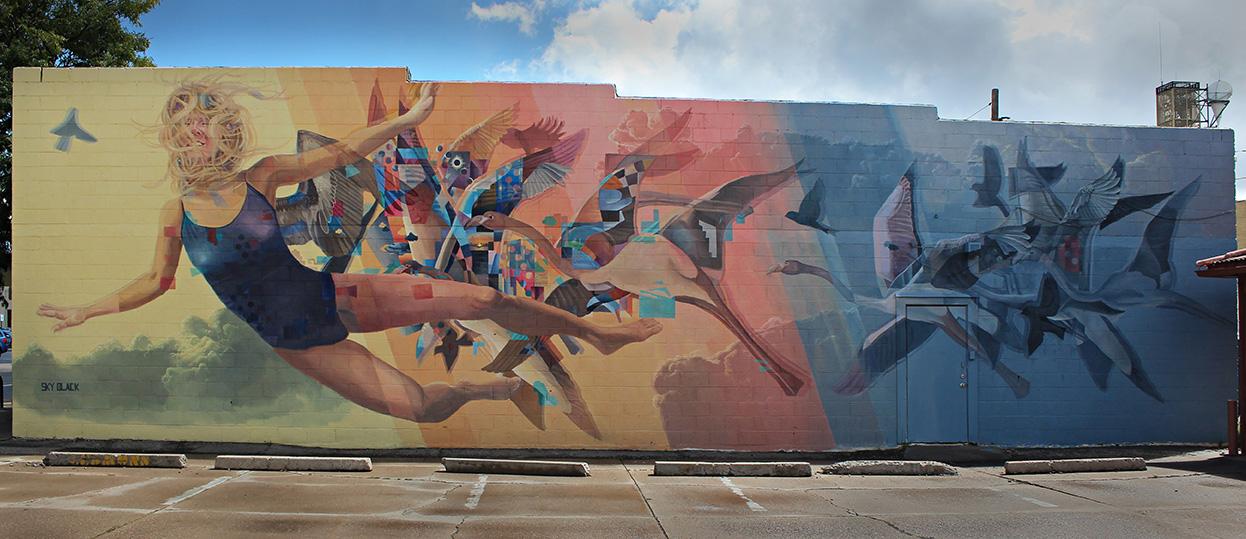
And speaking of the Orpheum Theater, Barbara’s favorite mural, The Sound of Flight (2015) designed by the visionary Sky Black and brought to life by Mural Mice Universal graces the exterior of the theater.  It is a city-block long incredible masterpiece, and it was by far the tallest and the longest mural we encountered.  The surreal vision of the designer leaves everything to the imagination.  If there would have been benches, we would have spent a long time taking in all that is reflected in this colorful and beautifully executed piece.    

The Mancuso’s Boots (2002) is a memorial mural to George L Mancuso, and it is an awesome tribute to the man and the incredible Grand Canyon. 

Flagstaff Brewing Company Mural (2012) and Runners Mural (2013) were both discovered around the corner and down an alley and a side street.

Flagstaff Brewing Company Mural

One of our favorite parks in Flagstaff is Wheeler Park.  It’s conveniently located near the Library and City Hall on the corner of Humphrey and Birch streets.  After hiking in the area, we often had lunch in the shade of some of the beautiful old trees in this idyllic city park. Another of the PAWS Project mountain lions graces the parking lot. 

Just two blocks west of the park on Birch Street is a cleverly designed and colorfully painted fence (2017).   Enormous flowers, butterflies and other creatures demand your attention as they float merrily along on this block-long mural.

 Two blocks east of the park we discovered The Flagstaff Portal (2013) and Learning to Fly (2017), displayed on opposite sides of the same office building.

The Flagstaff Portal
Learning To Fly

Several murals appeared on our map that we could not find, and some were not on the map at all. We loved the face on the child depicted in Aspen Machine Murals (2016).

Unity (2018) is another collaborative work of local artists seeking to honor diversity. The “rich tapestry” of our country is reflected here with five hands of different skin tones spelling unity in American Sign Language with a rainbow starburst. The mural beseeches people of every race, creed, gender, ability or disability to come together as one.

The Coconino Center for the Arts was our next stop…

Four Seasons (2013) feature children in four panels engaged in the performing arts throughout the year. 

Spirit Line (2016) honors the Dine weavers, and the spirit line refers to the intentional defect that weavers leave in an otherwise perfect weaving. This small imperfection allows the weaver’s spirit and creativity to escape to create more rugs; symbolically it reflects the tenuous balance between beauty and imperfection. 

We regularly drove past The Flagstaff Arts & Leadership Academy (FALA) on our way to hikes in the forests around the Snowball ski area.  We finally had a reason to stop and explore the campus.  FALA is a public school/charter school and describes itself as a “school of choice”.  The school has no sports or gym or school nurse and does not provide transportation.  Students in grades 6-12 who are dedicated to academics as well as the arts are encouraged to enroll.  The Executive Director, Eli Cohen, greeted us warmly, and he was surprised that murals from the school were included in the Public Arts Map.  Students are not attending classes right now because of COVID-19 so we were free to explore and photograph at will.  

Most of our day was spent identifying and looking for murals and mosaics.  However there were a couple of sculptures we decided to include as well.  The first, Progression (2016) is a 10-foot sculpture by Hopi artist Dan Namingha, located at the south entrance to the Museum of Northern Arizona.  Yellow is the Hopi directional color for North, and the piece honors Namingha’s great-great-grandmother, Nampeyo.

The second was The Guardian (1984) tucked away in a corner on the grounds of the Flagstaff Medical Center. 

As we started to drive back to Williams, we found the last mural we were looking for:  Jetsonian Optimism (2015) located in the parking lot of the Travelodge Motel on Route 66.  In the tradition of honoring the memory of Route 66, sometimes called “The Mother Road” because it was the first highway to link Chicago to Los Angeles, this famous highway has inspired several generations of artists.  The large abstract piece pays homage to the flying fins and gleaming grills of the cars of the 1940s and 1950s that traveled Route 66 in its heyday.  Route 66 is uniquely America, not just for the landscape or the tchotchkes travelers can find as they drive this historic highway.  It’s an American legend.  Choosing style over substance, the “retro-futuristic” theme of this colorful mural depicts the optimism that was prevalent in America following World War II.

We will be traveling back to Mesa for the winter at the end of September so we’ll have to make a special trip back to Flag to see the changing of the leaves. 

We thoroughly enjoyed our Summer here in Northern Arizona, especially all of the adventures we have had in and around Flagstaff:  hiking, biking, learning to play disc golf – it was a great place to be!

Barbara and Brian

UNEXPECTED DEATH VALLEY NATIONAL PARK

September, 2020

Pop Quiz, Hotshot. Where’s the last place you’d want to be in the Western United States with COVID-19 still not contained, economic distress, social unrest, the West Coast on fire with over five million acres burned and burning, and record temperatures that are beyond stupid hot?  We know!  Death Valley National Park, where the AVERAGE daily temperature is at least 110 degrees Fahrenheit and overnight temperatures MAY drop into the 90’s.

We wanted one more adventure before we headed back to Mesa on September 25th for the fall and winter, and figured that Death Valley National Park, being an easy 300-mile drive from our Williams summer home would be perfect. But what about the heat? While making our plans we were pleasantly surprised to find out that historically the average high temperature in September is 95 degrees Fahrenheit and 83 in October…so we figured that during mid-to-late September the heat would be more than manageable.

Well, like everything else in 2020 the predicted temperatures in Death Valley National Park in mid-to- late September were twisted. It was expected to be more furnace-like than more manageable; expectations of highs around 115 degrees Fahrenheit or higher (does it matter at that point?). We had pretty much exhausted our options in the Williams/Flagstaff/Sedona area and undaunted by the threat of HEAT we decided to go for it, packing our bags and driving to Beatty, Nevada, “The Gateway to Death Valley”. 

Every wondered why it’s called Death Valley?  Legend has it that a group of pioneers got lost in this God-forsaken land in the winter of 1849-1850 and were sure this paradise would be the site of their graves.  By the way, if we haven’t mentioned it by now, Death Valley National Park is the lowest, hottest, driest place in the United States.

Love This Sign

Our five-hour drive took us out of Williams and west along Interstate 40, north on US 93 through Kingman and Las Vegas, and finally north on US 95. We pulled into Beatty about 3:00pm, quickly unpacked our bags, and began following the tremendous plan Barbara had mapped out – our first stop would be Darwin Falls (!) in the Panamint Mountains.  It was about a 90-minute drive up into the mountains to the turn-off onto the road to the trailhead.

Heading Into Death Valley National Park – This Is Corkscrew Peak. Our First Indication Of Haze From the California Wildfires
First Views Of The Park
In The Panamint Mountains

We hoped to be able to hike to the falls and back with enough time left over to drive further into the mountains to Rainbow Canyon at Father Crowley Vista Point for sunset.  We had been experiencing some minor troubles with the Jeep so we had rented a car for the trip, and unfortunately, the rental didn’t have the same clearance as the Jeep so the 2.5-mile ride over a grated bumpy road from the turnoff to the Darwin Falls trailhead took us longer than anticipated.  It was about a mile or so from the trailhead to the falls. 

Darwin Falls epitomizes a great paradox. Sitting within the boundaries of Death Valley National Park this is a year-round 25-30 foot waterfall and oasis. How crazy that such a place could exist in such a harsh desert landscape, and how wonderful to think of visiting a waterfall as our first memory of Death Valley National Park! By the way we were at an elevation of 3,129 feet and the temperature was in the 80’s. Amazing.

The closer we got to our destination, the more challenging the hike became.  We found ourselves backtracking over, around and through a lush ravine filled with tall grasses, pussy willows, shallow streams from runoff from the falls, and giant slippery boulders. 

This Is Death Valley?

We hoped the waterfall would still be active and we were not disappointed.  A young group of guys were just leaving as we arrived, and they had collected watercress to take home. 

Darwin Falls
Grotto At The Base Of Darwin Falls

We did our best to get to Rainbow Canyon at Father Crowley Vista for sunset. We were about 15 minutes too late but the fading light provided an incredible view.

Twilight – Father Crowley Vista Looking Into Rainbow Canyon
Sunset – Father Crowley Vista

Back to Beatty and deciding where to have dinner – the Happy Burro Chili & Beer, of course!  We each had a bowl of delicious chili and split a cheeseburger accompanied by cold beer.  It hit the spot after our long day of driving and our short hike to Darwin Falls. 

See the source image

The next morning we left Beatty about 8:00, heading to the Ubehebe (you-bee-hee-bee) Crater.  Leaving Beatty it was already 85 degrees and we watched quietly as the temperature gauge in the car slowly ticked up to an outside temperature of 94. 

To be in a park as diverse as Death Valley is so rewarding.  From a waterfall last night to the crater left by a volcanic explosion a “mere 2,000 years ago” was remarkable.  The belched-up molten rock and solidified hot ash can be seen for over six miles from the rim of the crater. 

Ubehebe Crater
Looking North From The Crater’s Rim

Next stop?  The Racetrack.  We were intrigued to see the playa (a dry lakebed) about three miles long and two miles wide that is famous for its strange moving rocks. Erosion causes large rocks from the surrounding mountains to find their way to the Racetrack, where they move across the level surface of the playa leaving trails as evidence of their movements.  Reports of large rocks traveling 1500 feet is not unheard of. Research notes that a rare combination of rain and wind conditions is what causes the rocks to move.  As little as a half-inch of rain can wet the surface of the playa resulting in a firm but very slippery surface.  Strong winds of 50 mph – sometimes more – push the rocks along.  We wondered if we would see anything this time of year, expecting the most activity probably occurs in the winter when there is a higher probably of rain, and at times a thin coat of ice on the playa. 

See the source image
Picture With Permission Of earthtrekkers.com

As mentioned we planned this trip with our Jeep in mind – the road to the Racetrack is unpaved, and Park signs highly recommended using 4×4 high-clearance vehicles.  We were driving our rented Toyota Camry.  The 27-mile drive on Racetrack Road was going to take us at least two hours one-way, traveling at 15 mph. There are few visitors to this off-the-beaten-path location in the Park, and there is no water, shade or cell phone coverage. We proceeded super cautiously.

At about mile 5, something caught Brian’s eye.  It turned out to be one of the smallest owls either of us had ever seen.  It looked to be about 10″ tall; it didn’t seem particularly spooked by us, but it was watching us quite intently.  We didn’t dare roll down the window for a photo.  We got lucky with a single shot through the window – the owl didn’t hang around long.

Nestled in the foothills of the Panamint Range, and plodding along the long and winding road allowed us to appreciate the constantly changing terrain that is such a big part of this national park.  We drove slowly past huge swaths of Joshua trees that gave way to acres and acres of barren rocky land. 

Evidence Of Volcanic Activity?

We tried to imagine what drew the Timbisha (“red rock face paint”) Shoshone Band of California to this land over a thousand years ago, and we were surprised to learn that a small number of Timbisha Shoshone (between 50-60 people) continue to live in the heart of Death Valley in Indian Village. 

After traveling for 90 minutes, we came to the famous Teakettle Junction.  What a treat!  Little did we know that others who had made this hazardous and challenging trip thought to bring along a teakettle to add to the growing collection that hangs from the crossroads marking the intersection. 

Wonder If Don and Kelly Left One Of Their Wedding Presents?

We met a fellow traveler who regaled us with tales of his adventures coming to Death Valley for over 10 years, and we exchanged stories of our travels over the past two years.  We had encountered a couple of other cars along the way, but this was the first person who had actually stopped to enjoy seeing the teakettles. From here it was six more miles to reach the Racetrack, but we didn’t want to press our luck with a car that shouldn’t have been on Racetrack Road in the first place.  So we headed back to Ubehebe Crater. 

Driving back to Ubehebe Crater we truly saw how much the smoke from the fires on the West coast has impacted Death Valley.  To see a smoke ring hanging like a pale translucent gray fur collar in the distance gave us pause.  We knew we were going to be driving into that mess and there was no alternative road.  We kept our air conditioner circulating the air inside the car, and for once we were glad we had masks to wear when we ventured outside.  

We had four more stops to complete before we headed back to Beatty, and the temperature in the lowest part of the park was already approaching 116.  Lunch was peanut butter sandwiches, dehydrated fruit, chips and protein bars.  We had packed the cooler with cold water and a power drink in anticipation of the heat.  Despite signs that tell visitors to limit hikes to the hours before 10:00 am, we hydrated ourselves and set off for a short walk into the Mesquite Flat Sand Dunes. After all we only have two-and-a half days in the park.

Check Out The Far Ground – Haze From The California Wildfires

Next stop on our agenda was the Salt Creek Interpretative Trail – a half-mile loop on a wooden boardwalk through a salt marsh.

At certain times of the year there is pooled water at the far end of the boardwalk supporting the desert pupfish who make their home in this section of the park.  Pupfish are small – usually about three inches in length, and are found no where else on earth. We were fortunate last year to have seen pupfish at a nature center just east of the Park’s border, but while we did see three or four very pale lizards hanging out in what little shade was available, it was too hot and dry to do any intense searching for the pupfish.  Suffice it to say, no water, no fish.

The Mojave Fringed-Toed Lizard. Legs Adapted For Scooting Across The Desert Sands.
Staying In The Shade – Smart!

The Artist’s Drive is another distinct attraction of the Park and a treat for the eyes.  A one-way, 9-mile roller coaster road takes you down, around and through some remarkable canyons and towering mountains.  It’s stunning to see what Mother Nature has done to “paint” the sandstone in this part of the desert.  Rich metals and elements found in the ground have oxidized the clay creating a palette of reds, yellows, blues, greens and purples. Because there were so few visitors in the park, we stopped to take photos.  The most colorful stop was Artist Palette at about mile 5.

This image has an empty alt attribute; its file name is dsc00319-2.jpg
This image has an empty alt attribute; its file name is dsc00289-2.jpg
This image has an empty alt attribute; its file name is dsc00318-2.jpg

Our last stop for the day was Badwater Basin located just south of Furnace Creek. This was a recommended place to catch a spectacular sunset. 

Badwater Basin is the most visited place in the Park, and it is here that visitor’s can experience the park’s highest temperatures. As we pulled into the parking lot, waiting for sundown, we rolled down the windows, relaxed and let the oppressive heat weigh down on us.  We dozed and sweated, waiting for the sun to set.

This is the lowest point in North America and was formed by movement of the earth’s crust – Badwater Basin is 282 feet below sea level. Visitors tend to stare out at the salt flat and jagged formations, and you can walk out a mile or so. But turn around and there is a sign about half way up the side of the Amargosa mountainside announcing the location of Sea Level.

The White Rectangle Notes Sea Level – From The Parking Lot
We’re About 1/2 Mile Out On Badwater Basin
As The Sun Was Setting Behind Us – About A Mile Out

Badwater Basin got its name from the “bad water” that comes from a small spring-fed pool found next to the road.  If you contrast Great Basin National Park, an exorheic basin (surface water runs into the ocean or into another body of water having a connection to the ocean), with Badwater Basin, you learn that Badwater is an endorheic or terminal basin with no outflow to rivers or oceans.  Given the accumulation of salts in the surrounding basin, the water becomes undrinkable.  You would think that nothing could exist in such an arid environment and yet pickleweed, aquatic insects and the Badwater snail thrive. 

This image has an empty alt attribute; its file name is dsc00323-3.jpg

As we ventured out onto the griddle hot basin, waves of heat emanated off the hexagonal honeycomb shapes of the thin salt crust that crunched beneath our feet.  We were conscious of the paths that millions of park visitors have created over time on this fragile landscape and yet it continues to exist.  Miles and miles and miles of vast salt flats.

Brian had hoped that the smoke from the California wildfires might enhance the colors of sunset, but overall it was pretty disappointing.

Back to Beatty for a shower and dinner at Gema’s Cafe for a delicious meal.  Described as a “Hispanic twist to the traditional cafe,” it lived up to it’s hype.  Barbara had comfort food:  meatloaf, mashed potatoes, gravy, mixed vegetables and a side salad.  Brian had carne asada. The food was fresh, made to order, the service was terrific and we got fed for under $25.  If we had another day in Beatty, we would have gone back for breakfast. 

Gemas Cafe.jpg
Artist’s Rendering Of Gema’s Cafe

We decided to follow recommendations and visit Zabriskie Point (part of the beautiful Amargosa Mountain Range) at sunrise.  We staggered out of bed at 5:00 to get to our destination by 6:30 – about 10 minutes before sunrise. Zabriskie Point is 45 miles from Beatty; 30 miles to the park entrance and then another 15 miles south to reach the view point.  We arrived on time, and found several other early morning, coffee-mug-carrying, adventurous masked (!) visitors who had made the trek from the parking lot up the steep paved pathway to the view point.  As the sun began to rise, the badlands exploded into a maze of wildly eroded and vibrantly-colored mountains.  This whole area used to be underwater, and over several millions of years, weathering and alteration by thermal waters created the variety of colors visitors see today, and lava from volcanic eruptions has created a hard lava cap that retarded erosion in many places. This cap can be seen most prominently at Manly Beacon, the highest outcrop at Zabriskie Point. The temperature was a tolerable 95, and a gentle breeze was much appreciated. What a peaceful and amazing way to start the day.

Looking East At Sunrise
Looking West At Sunrise
That Peak Right Of Center Is Manly Beacon
Looking West Southwest
Looking West – A Little Later Into Sunrise
Looking Southwest

We hustled ourselves from Zabriskie Point to the Golden Canyon Trail trailhead in order to complete the 3-mile round-trip hike to Red Cathedral and back ahead of the heat of the day.  We had the whole place to ourselves. 

The Canyon is a marvel, and the scenery during the slow easy uphill grade held us captive. Every turn was as breathtaking as the previous one, and Barbara’s pockets were soon bulging with rocks she found too irresistible to leave behind.  At about a mile into our walk we saw the signpost directing us to Red Cathedral.  We had seen glimpses of the cathedral rocks and now they were in full view. Stretching from the floor of the canyon, these majestic red icons were beautifully lit by the early morning sun and they served to deepen our appreciation for this incredible park. 

Entering The Canyon
Wonder Why It’s Called Golden Canyon?
Managed To Catch The Sun Rising!
First View Of Red Cathedral

We had experienced the heat and believed the signs that cautioned visitors to keep their hikes to the early hours – before 10:00 am. But we figured the short hike to Natural Bridge Canyon would be doable anyhow. 

As the name of this Canyon indicates, the main attraction is a 50-foot tall bridge that was naturally created by the erosion in the canyon walls. The round-trip hike is a little over one mile and it was pretty cool just to walk under this amazing bridge. In addition to the bridge are a number of “dry falls” that seem to pour into the Canyon.  A stream flowed into the canyon thousands of years ago, and the long vertical chutes were created when the canyon eroded much more rapidly than the stream bed above.  What was equally impressive as we hiked back to our car was the remarkable view of the south end of Death Valley and the massive salt flats with the towering (if haze-covered) Panamint Mountain Range looming in the distance.

Natural Bridge From The “Back” Side
Can You See The Face In The Rock?
See the source image
A Dry Falls

We took a quick trip to see the Devil’s Golf Course – an immense area of rock salt eroded by wind and rain into jagged spires so incredibly serrated that “only the devil could play golf on such rough links”.

Our farewell to Death Valley National Park would be taken from the overlook at Dante’s View.  At 5,476 feet it was almost refreshing to step out of the car into 85 degrees after the blistering heat of the Valley.  It took us a couple of minutes to realize that the view we were seeing from the top of the Black Mountains was Badwater Basin.  We were looking out over the side of the mountain where we had been looking up at the Sea Level sign just yesterday!  If you have ever tried to imagine how big Death Valley is (over 3.4 million acres), the view from Dante’s View staggers the imagination with its stunning panoramic views of the entire valley. From the parking lot there are a number of paths to various viewing points that allow visitors to fully appreciate so much of the beauty and wonder that Death Valley National Park has to offer. 

And for all of our nerd friends:  Yes.  We learned that Dante’s View was the film location for the 1977 “Star Wars” movie.  For 10 extra points, can you name the scene that was shot from this Death Valley location?

This landscape is home to more than 1000 plant species that can flourish in this stark and barren land. We may not have seen them, but it has been reported that this is home to desert bighorn sheep, desert cottontail rabbits, roadrunners, the mojave fringe-toed lizard, the desert tarantula, coyotes, bobcats, nine bat species, great horned owls, burrowing owls, gophers, kangaroo rats, badgers, ringtails, the kit fox, and even some mountain lions.

Death Valley National Park is everything we thought it would be and more. Sure it was beastly hot in the valley, and it’s supposed to be so. The salt flats, desert environment, sand dunes, and canyons that make up the valley have a uniqueness not found anywhere else we know. But on each side of the valley and well within the boundaries of the Park are mountains with their own beauty and vistas at 5,000 feet or higher that are begging the visitor to ascend, feel the coolness, and take a moment or more to look down upon the valley itself. And then there is the waterfall!

We know we didn’t get to see and do everything there is to experience in Death Valley National Park; the extreme heat and the wildfire-induced smog curtailed our daily activities.  We loved it all and wonder what it would be like to go back in the Winter – would we experience the Park differently?

As we’ve said all along…stop, look around and be amazed at what you find. You’ll certainly find more than the expected at Death Valley National Park.

Barbara and Brian

Brian notes that he does, on occasion, enhance or mess around a bit with the color in some photographs; however, the light in Death Valley National Park can change so rapidly and a picture with warm tones may become bleached out in 2-3 minutes (Mesquite Sand Dunes) or colors may change with elevation and the sun’s angle on the photograph (Ubehebe Crater – each of the 3 pictures of the Crater were taken 100 feet in elevation apart) or the colorfulness at sunrise at Zabriskie Point becomes bland and washed out an hour or so after first light. He promises that he did not mess around with the colors and that all of the photographs were included to represent this phenomenon.

Rhyolite, Nevada is 4 miles west of Beatty, and is home to a ghost town and an unusual museum that is free and open to the public. A must stop if in the neighborhood. 

The mining town of Rhyolite got its name from the silica-rich volcanic rock in the area.  The history of the place credits two prospectors who discovered “free gold” in the quartz and soon the gold rush was on. The town enjoyed a boom period beginning in 1904 and grew to more than 2,500 people, but the town went bust a mere 10 years later. Tourists can visit remnants of Rhyolite’s glory days. 

The unusual museum is the Goldwell Open Air Museum – a 7.8-acre outdoor sculpture park. 

Goldwell Open Air Museum is a nonprofit museum that was established in 2000 following the death of Albert Szukalski, the Poland-born Belgian artist who created the site’s first and most popular sculpture in 1984. 

The piece that attracts the most attention is The Last Supper, a life-sized recreation of Leonardo da Vinci’s famous painting, only Szukalski’s interpretation consists of ghostly forms arranged like the iconic Apostles. Trust us:  this sculpture will be forever seared into your brain.  Szukalski created these freaky forms by draping plaster-soaked burlap over live models until the plaster dried enough to stand on its own.

Visitors will also find two other Szukalski ghost-like figures:  Ghost Rider holding a bicycle, and a whimsical ghostly figure that looks like an artist holding a palette of colorful paints. 

Additional sculptures include Belgian artist Dr. Hugo Heyrman’s giant garishly pink woman figure, Lady Desert:  the Venus of Nevada.  The full radiant pinkness of this piece stands in stark contrast to the more subdued and muted colors of the desert. The sculpture looks like a naked, blonde, 25-foot tall Lego-like lady, complete with breasts and blonde pubic hair.  So much for folks who may think this is a religious park! 

Additional sculptures include a 24-foot tall prospector and his penguin sidekick made out of rusted steel, and a mosaic sofa which visitors are allowed to sit on – albeit carefully.  Make sure it’s not too hot!

Barbara and Brian

Additional sculptures from the Goldwell Open Air Museum

CO-VID SUMMER 2020: PRETTY PICTURE EDITION I

June – September, 2020

See the source image
Yellow Springs, Ohio…2017

We’ve taken to a certain style in writing our blog, attempting to paint a mental picture of our adventures, to tell a story of our adventures, using photography as the anchor to create a memory of the journey at that time and place. But honestly we sometimes forget to jot down where we’ve been, why we went there, why we went on that specific hike, where a picture was taken, or what month it might have been.

This blog is a photographic compilation – pictures of flowers, insects, lizards, birds and amphibians that we feel are pretty cool. Some were taken while hiking in Flagstaff, Williams, and Sedona. Some were taken in an arboretum, some by the side of the road. All we remember is that they were all taken the summer of 2020.

Red Winged Black Bird
Barbara Just Loved This Tree’s Bark
Check Out That Scarecrow!
Heron In A Tree?
Yup – In A Tree

We feel as if our life is not big enough, that there is just not enough time, nor hours in the day to find and share all of the glorious panoramas, the wide spaces, the hidden loveliness and quirkiness that reward us as the searchers…but we’re sure as hell gonna try.

Barbara and Brian

SUMMER FUN IN THE NEIGHBORHOOD 2020

June – September, 2020

AS the old saying goes: “in for penny, in for a pound.” Railside RV Ranch is home this summer. RVs come and go from the campground. Most of our fellow campers are from from the stupid hot Valley of the Sun in and around the Phoenix metroplex, some are from California, and a few from other points, usually passing through on their way to someplace else. There’s even a couple of other full-timers who, like us, are hanging out here for the summer season. Those that are travelling are not typically going long distances…weekend jaunts over the summer months to beat the heat by being in the mountains or going short distances from their permanent homes to see the sites, and we’re pretty sure there are a few with long distance plans in mind as well.

We have to admit that by late August it was getting harder and harder to resist not breaking camp to go somewhere – not sure where, but just a sense that we’ve been here long enough. However, we’ve committed to being here this summer season – our trip to Las Vegas to hang with friends from Bethlehem, PA, our visits to Great Basin and Channel Islands National Parks, and our planned trip to Death Valley National Park (did I mention that on August 17, 2020 at aptly named Furnace Creek in Death Valley National Park it was 131 degrees fahrenheit?) will make the time go quickly enough, we hope!

But there’s lots of fun to be had in the neighborhood if you just take a look. By the way, please take your time – there’s lots and lot of photographs…

We’ve spent a lot of time in Flagstaff hiking, riding our bikes, going to PT appointments, shopping, tending to vehicle maintenance, and returning to our enjoyment of viewing a movie seated in a theater.

We had driven by the Museum of Northern Arizona a dozen or so times…it was time to stop and see what it was all about.

The Museum was founded in 1928 by Harold S. Colton and Mary-Russell Ferrell Colton and was established to protect and preserve the natural and cultural heritage of Northern Arizona and geology of the Colorado Plateau. It is dedicated to expanding knowledge of its beauty and diversity through collecting, studying, interpreting, and preserving the region’s natural and cultural heritage.

There are 2 permanent exhibits, each packed with an incredible array of information and artifacts pertaining to the longitudinal geological development of the Colorado Plateau, the culture of the ancient Hohokam and Sinagua peoples and the present day culture of the Chemehuevi, Chiricahua, Cocopa, Apache, Havasupai, Hopi, Hualapai, Maricopa, Mohave, Navajo, Southern Paiute, O’odham, Quechan, Tewa, Tohono, Southern Ute, Xalychidom, Yavapai, and Zuni Peoples. Dr. Harold Colton worked closely with tribal council’s in order to properly display and represent those cultures, and to assure that native peoples were integral to the operation of the Museum itself.

Display Hall Representing Tribal Culture Of Different Native Peoples

The Museum has 2 galleries with changing exhibitions…

…Women took the lead in developing the arts of the region from 1900 to 1940, and “Liberating Landscapes” displays the work of six women artists: Nampeyo, Kate Cory, Mary-Russell Ferrell Colton, Nora Lucy Mowbray Cundell, Harriet Morton Holmes, and Lillian Wilhelm Smith who were inspired by the dramatic landscapes and people of the American Southwest.

…Star Wars holds a special place in the soul of native peoples, and the Museum has on display an exhibition featuring works by 15-20 different contemporary Native artists who have been influenced in their creative process by Star Wars; the display explores the reasons it resonates with them.

Check Out The Autographs

How crazy is it that in Arizona’s high deserts there are not one, not two, but three major grape-growing regions? These are Sonoita (southeastern), Willcox (east central), and Verde Valley (northern). Since the 1970s, these locally made wines claim to have earned international acclaim, won numerous awards, and have even been served in the White House. So off we went on a blistering Saturday afternoon to try some Arizona wines.

Cottonwood is in the Verde Valley, considers itself the heart of Arizona wine country, and is home to no less than 9 vineyards…well at least their tasting rooms. The town is delightful and quaint, if not a little touristy, and has a great main street. Cottonwood is a small town (population 12,000 give or take) about 20 miles southwest of Sedona.

Cottonwood Mural

The pours at each of the tasting rooms we visited were generous, and tasting flights were drawn from 12-15 varieties of wine. A flight consisted of 6 pours; however, at 2 of the tasting rooms our sommelier had some “specials” that were added for our enjoyment. Even with a snack ordered to enhance our palate and to help soak up some of the alcohol, 3 tasting rooms were plenty for this trip. A walk along main street and some window shopping finished off a great afternoon.

See the source image

The reds offered by Arizona Stronghold were most pleasing and we found ourselves walking out of a wine store bottle in hand!

See the source image

Ever been to Prescott, Arizona? Did you know that Prescott is pronounced PRESS-kit? We had spent a day in Prescott in August, 2019 and really liked the hometown feel of the downtown area so it was a natural to re-visit.

Looking Down Main Street

Our plan was for an afternoon of wine tasting (again!), but we didn’t check closely enough – the tasting rooms were closed the day of our visit. However, the meadery was open, and sampling mead became the day’s objective…well, they had a hard cider or 2 on the tasting menu as well. Just for reference mead is made by fermenting honey and water, and hard cider is the fermented product of apple juice – flavor it anyway you like, but that’s the basics.

Our tasting flight consisted of 12 different generous pours (is it something to see if us old folks get tipsy?) of mead and hard cider. Different flavors and alcohol content were represented on the flight; for example Tahitian Honeymoon at 13.5% alcohol (26 proof) is described as a semi-sweet mead aged on tahitian vanilla beans on new American oak; Barrel Aged Ragnarok at 15% alcohol is described as classic mango mead aged in port barrels for 26 months, and Blueberry Spaceship Box at 5.5% alcohol claims to be the top-rated hard cider in the world. Barbara’s favorite was the limited fermentation Heavenly Breakfast, 17.5% alcohol – a maple syrup mead aged in bourbon barrels for 1 year. A bottle is sitting in our fridge for that next special occasion. What a great way to spend another hot afternoon!

“Let’s check out the disc golf courses in Flagstaff” she says, and off we went to McPherson City Park in Flagstaff hoping that we could rent discs and figure out whether or not the game suited us. Well, there’s no “clubhouse” at McPherson Park (or any disc golf course), but we did get a chance to watch some folks play the game. It looked cool enough for us to head over to a Big 5 Sporting Goods Store and buy ourselves each a set of discs – yup, a set of discs. A beginner’s set consists of a driver, mid-range, and putter disc; each thicker than the other – the driver thinnest of all.

Hole length varies between 250-400 feet; a little less or a little more than the length of a football field. McPherson Disc Golf Course has been cut out of pine forest, and the game becomes an interesting balance between making a good throw and avoiding the large number of trees down each of the fairways. We’re in it for the exercise (almost a 3-mile walk for a round of 18) as well as fun, and we’ve been playing about once a week.

See the source image

Along Interstate 40 and on our way to the Petrified Forest National Park we found ourselves intrigued by two gigantic arrows on the south side of the highway, and had to stop. Turns out that the arrows and a dilapidated building covered in graffiti are all that remain of the Twin Arrows Trading Post, once a thriving business along the Mother Road.

Also on the way to the Petrified Forest National Park it’s a short detour off of Interstate 40 to take some time to visit Holbrook. Why? Well, check this out…

Dig The Classic Cars!

…and “around the 1880s the town of Holbrook was a wretched hive of scum and villainy where outlaws and cowboys could indulge their drinking, gambling, whoring, and general rakishness.” Needless to say, gun fights were frequent and casual.  Amidst this atmosphere, Terrill’s Cottage Saloon was able to distinguish itself as particularly violent. It was in this grim watering hole in 1886 that a gunfight took place that ended in so much death that the floors were said to be slick with a “bucket of blood.” Later in its history Terrill’s Cottage was renamed the Buckets of Blood Saloon.

Commemorating Terrill’s Cottage Saloon

…or how about this rock shop from which Barbara purchased quite a few pieces of petrified wood…

If you’re in the neighborhood, Holbrook is worth a stop – maybe even an overnight!

See the source image

Show Low, Arizona got its name when two ranchers felt that life in the territory was getting a little too crowded. The men, Marion Clark and Corydon Cooley, decided to settle their differences with a card game named Seven Up. Whoever drew the low card won. At one point Clark is thought to have said, “show low,” and Cooley turned up the two of clubs. Cooley won, Clark moved further down the road, and the main street in Show Low is now named Deuce of Clubs.

Main Street, Show Low, Arizona

So the directions are fairly easy…Interstate 40 to exit 201, US Highway 89 north as if you’re going to Page (Antelope Canyon, Horseshoe Bend, Lake Powell), and 100 yards north of mile maker 443 is the Wupatki Spirit Totem. We drove by it twice before Barbara finally spotted it on the eastside of the highway.

The totem is on the edge of Navajo Lands in an area called Deadman Flats. No one seems to know the origin of the spirit totem nor exactly how long it’s been around. 

Ever wonder where in the world the scientists at NASA would find a place they imagined would mimic the landscape of the moon? Ever wonder where the astronauts might get trained to complete their moon missions? Look no further than Cinder Lake Crater Field.

Literally in the shadow of Sunset Crater Volcano, the volcano’s cinders created Cinder Lake Crater Field. Chosen for its porous volcanic gravel, the cinder lake provided a more than suitable analogue for moon rock. However to accurately simulate the surface of the moon, scientists mapped a portion of the satellite’s craters and proceeded to create an exact replica of the pothole field. Using hundreds of pounds of dynamite, NASA scientists created an identical field of craters in a carefully ordered series of blasts. Once the fake moon field was constructed, the astronauts were free to try out their lunar rovers and other equipment from the safety of Earth’s gravity.

The entire area is now a State Park and is used by boondocking RV and tent campers as well as ATV/OHV enthusiasts. We took a ride through, and the entire Park does seem otherworldly…and best shot in black and white.

Having passed through Bullhead City and seeing the fun everyone was having on the Colorado River we had promised ourselves to return and rent a jet ski. Brian started looking at the reviews of the places that advertised jet ski rental and found many. many negative comments – comments stating that the reviewer had been ripped off by the company owner and that there were hidden costs in rental agreements that were not explained up front. Sure, it’s a buyer beware economy, but these reviews were most discouraging.

Thinking that there must be alternative ways to get out on the river we found a “jet boat” trip departing just across the river from Bullhead City in Laughlin, Nevada. A full 6-hour day excursion traveled down river to Lake Havasu City, gave the passengers an hour for lunch and hanging out, and then returned; a full 5 hours on the water. It was stupid hot on land and somewhat so in the boat on the return trip – the river was very busy with other boaters, but what a wonderful time we had on the Colorado River.

The Actual London Bridge Was Moved Brick By Brick To Lake Havasu City. Construction Was Completed In !971
Arch
Petroglyphs

Friends and fellow die-hard Michigan fans from Pennsylvania, Tom and Kelley, were married in Las Vegas, and return annually in celebration of their life together. Usually the trip is in June, but they delayed a month just in case things would loosen up; i.e., the corona virus infection rate would drop to a level acceptable for the Vegas entertainment machine to crank up once again. The Vegas shows remained closed, but they came to town for some R&R and their anniversary celebration. We decided to join them for a few days and then mosey on up north to Great Basin National Park.

Vegas was like a ghost town. We stayed at the Paris Hotel where the resort fee was more than the room rate (would you believe a 3 night stay for $142 total?). About 1/3 of the gaming tables were open, there were plexiglass dividers keeping players at proper social distance and isolated from one another, dealers wore both masks and shields, security guards made sure everyone was wearing a mask indoors (you could take your mask off to eat in a restaurant), and the slots and electronic games had unseen-before-now distance between machines. Some casinos and hotels are still not open.

So it’s July in Las Vegas…a town built in a desert known for its extreme heat. In July 105 fahrenheit during the day is normal and maybe, just maybe overnight it’ll drop below 90. So what to do in stupid hot temperatures? Well you could gamble – it is Vegas after all. Or you could get up early and take a walk along the Strip…nice to see Lady Liberty masked up!

,,,and you could visit the Mob Museum. The Mob Museum is a well-thought-out and executed examination of the impact of the Mob on America, and American Law Enforcement’s fight to reign-in the Mob’s criminal activity. If you visit we highly recommend participating in the hands-on interactive experience of working in a crime lab.

See the source image

…and you could see the performance of the Bellagio fountain, and the exhibition in the Hotel’s Conservatory…

See the source image
Chihuly’s Art Blossoms Greet Visitors To The Bellagio
Conservatory – Hello Kitty and Japanese Garden Theme
All Displays Use Fresh Flowers That Are Replaced As Needed
Calla Lilly

…and you just might decide to venture out of town and deeper into the desert – feeling like the stupid hot is worth tolerating to see a curiosity known as Seven Magic Mountains…

btw – can you find the 4 Barbara’s?

Not Fit For Man nor Beast

September 12th was Patriot’s Day in Williams, and a parade was scheduled for 11am. We decided to ride our bikes the mile and a half downtown and take in what we thought would be a brief celebration. Turns out that the parade lasted over an hour. This was an extremely positive and very touching event – a genuine heartfelt sense in the crowd that coming together at this time and saluting our Country was essential to us all. Cheers and applause for our veterans and our first responders, and for those that took the time to recognize America and our history marching along the parade route – just a few hundred people or so being proud to be together on a wonderful sunny day and most of all proud to be Americans.

Marine Corps Leading The Way
Founder Bill Williams’ Mountain Men
Representing Navajo Peoples Who Served Our Country In The Armed Services

We feel as if our life is not big enough, that there is just not enough time, nor hours in the day to find and share all of the glorious panoramas, the wide spaces, the hidden loveliness and quirkiness that reward us as the searchers…but we’re sure as hell gonna try.

Barbara and Brian

CHANNEL ISLANDS NATIONAL PARK

August, 2020

See the source image

The Pacific Ocean was beckoning us to find our way to Channel Islands National Park, a journey that would take us by ferry to two of eight uninhabited volcanic islands off the coast of California; five of these islands make up the National Park.  Our travel this Summer has been limited, but we felt safe taking this four-day adventure to one of the most remote National Parks in the continental United States. 

The Channel Islands are off the coast of California, stretching 160 miles from Santa Barbara to Huntington Beach. They appear to be giant rocks floating on the open ocean.  These islands were never attached to the mainland and rose from the ocean floor millions of years ago.  Plate tectonics, volcanic activity,  fluctuating sea levels, and expanding polar ice caps have all contributed to the creation of these unique islands.  The islands are rookeries for seabirds and sea mammals, including one of the major breeding colonies of California brown pelicans.  Dinosaur bones that have been found on the islands include a species of pygmy mammoth.

See the source image

The native gray island foxes flourish today on Santa Cruz Island, and they are known as effective beggars as well as pretty sneaky should you leave you lunch and snacks unattended. 

See the source image
These Small Foxes Are The Size Of House Cats

The wild and natural state of the islands has lead to a diversity of both plant and animal species that is rare; there are plants on the islands that are not found anywhere else in the world.  The land as well as marine ecosystems support a rich diversity of life, including the State Marine Fish, the bright orange garibaldi. 

See the source image

 The islands were home to a number of different groups of people who lived there over 13,000 years ago.  Indigenous peoples included the Chumash Peoples who settled in the northern islands (San Miguel, Santa Rosa, Santa Cruz, and Anacapa),and the Gabrielino/Tongva Peoples who settled in the southern islands (San Nicolas, Santa Barbara, Santa Clara, and San Clemente).  The two indigenous groups sustained their way of life by actively trading with each other, using purple olivella shells as currency. 

See the source image
Olivella Shell

Other explorers (Spanish, missionaries, and ranchers) found their way to the islands, and Captain George Vancouver named the islands in 1793.  In those early years fur traders nearly hunted sea otters, seals and sea lions to extinction. 

By 1822 most of the indigenous peoples had been moved (!) to the mainland to make way for fishing camps and ranching operations. In the early 1900s the US Military established encampments on the islands as Pacific Ocean lookouts, and targeted parts of the land for Army Air Corps bombing practice. The devastation from all of this non-native human activity and the introduction of alien plants and animals nearly collapsed the fragile ecosystem.

It wasn’t until Anacapa and Santa Barbara Islands were designated as the Channel Islands National Monument in 1938 that protection for the ecosystem was assured and recovery could begin.  And in 1980, Congress designated San Miguel, Santa Rosa, Santa Cruz, Anacapa, and Santa Barbara and the submerged lands and waters within one nautical mile of each island as Channel Islands National Park.  Six nautical miles from each of the islands have been designated a National Marine sanctuary. The Protected Marine and Conservation Areas preserve these unique and primitive islands for future generations. It has taken decades to reestablish the natural diversity of plants, birds, animals and sea life visitors experience today.

Channel Islands National Park is one of the 4 National Parks accessible only by boat or seaplane. Anacapa Island is closest to the California coast, a mere (?) 11 nautical miles west of Oxnard Harbor; at 65 nautical miles from the mainland, San Miguel Island is the furthest west of the Channel Islands.

Not Sure Why, But It Is Surprising That The National Park Service Has A Fleet Of Ocean Going Vessels

“The Channel Islands lie in a region between the mainland coast and the deep ocean known as the Continental Shelf.”  Ocean scientists have determined that the ocean floor consists of canyons, sea mounts, banks or underwater plateaus, escarpments and deep basins.  Did you know that Santa Cruz Basin is deeper than Arizona’s Grand Canyon?  Now you do!  Imagine the diversity of sea life that inhabits this underwater topography. 

We packed the Jeep and traveled the 495 miles to Oxnard, California.  It would take us seven hours to make the journey across Arizona in the midst of monsoon season and deadly high temperatures. We watched the temperature gauge in the Jeep climb as we drove through Kingman and Bullhead City, topping out at 108 or so by the time we got to Needles and the Mojave Desert.  We were grateful for our air-conditioned car and reminded ourselves how smart our decision had been to spend the Summer in Williams! 

See the source image

We arrived in Oxnard about 4pm, and checked into the Hampton Inn near the beach.  We had a lovely second floor balcony room overlooking hundreds of sailboats in the harbor, and we were welcomed by the cool ocean breezes and the sounds of barking seals and noisy seagulls. It was time to take a walk to stretch our weary legs; the helpful desk staff gave us directions to the beach and even made a recommendation for dinner. 

Gotta Love The Flowers We Saw Along Our Walk
Looks Like A Painting – No? I Promise It’s A Photograph
…A Flower Found Down By The Pier…
…And The Flowers At The Hotel…

The Pacific Ocean – what a welcome sight!  Crashing waves under blue skies, soft sand and warm salty ocean breezes. 

The Land On The Horizon Is Anacapa Island – 11 Miles Or So From The Beach.

We always carry a face mask with us but the beach was fairly empty; most everyone was headed home or they were strolling along the shoreline without a care as the gentle waves lapped at their feet.  What a great place to unwind. 

We wanted to be back to the hotel before sunset so we headed to the “fish place” for some fresh halibut and clam strips.  The family-owned restaurant offered take out only but the menu options included fried and grilled fish and seafood, sushi, and featured dishes made with fresh red sheepshead. The food was as delicious as promised.

As we got ourselves prepared for the first of our two excursions to the Channel Islands the next morning, we were treated to a glorious sunset that seemed to last and last, gradually changing from muted yellows and oranges to the deepest reds.  A perfect ending to our first evening in sunny California.

We arrived early at the offices of Island Packers in Ventura Harbor so that we could pick up our tickets and prepare to board the ferry to Santa Cruz Island. We enjoyed the antics and the noise of the young harbor seals as they playfully chased each other up and down the docks as older larger seals were sunning themselves on unoccupied docks where they were generally enjoying a brief rest from all the youthful activity. 

Island Packers Own The Excursion Rights To The Channel Islands

We had dressed in layers as recommended by the ferry company in anticipation of a chilly 26-mile ride to Santa Cruz Island, and because of the potential for rapidly changing weather conditions while at sea. We wore our swimsuits under our clothing and jackets. For our day on Santa Cruz Island we had scheduled a kayaking trip that was advertised to last a couple of hours; we figured we’d have lunch afterwards, and then have a chance to take an exploratory hike of the island.   

There are no supplies on any of the Channel Islands (water, food, other necessities) so we packed accordingly.  Several passengers boarded with back packs and plastic bins of camping gear.  We had read that there were primitive campgrounds for hearty souls who wanted the experience of camping on a remote island. 

Face masks were required throughout the ferry ride.  At 20 knots per hour the ride was fairly windy, but we ventured out onto the bow of the boat when a pod of dolphins was spotted by the ferry’s captain.  For landlubbers like us, it was a thrill to see these magnificent creatures bobbing along the surface of the water so close to us.

 It was also our first glimpse of the islands on the distant horizon. 

We docked about 60 minutes later, and the crew assisted the campers then the rest of us as we disembarked. 

We were greeted by the masked National Park staff who directed us to join the other masked kayakers.  The tall cliffs rising out of the ocean and the sandy beaches devoid of people gave us an eerie feeling like we were perhaps on one of those reality TV shows that requires survival skills in order to stay alive… 

Not to worry. The National Park staff reminded us that we were to wear our masks while on shore, and that we were responsible for our own safety while we were on the Island.  Any trash we created we had to take back with us because there is no trash service on any of the Islands.  We were also warned about poison oak and ticks, to avoid all contact with deer mice (hantavirus) and other wild animals, and please don’t feed the island fox. Oh, and don’t take anything (rocks, shells, plants, etc.) from the island.  As we have been repeatedly reminded along the way in the National Parks we have visited:  take only memories – leave only footprints.

We made our way to the staging area for our kayaking adventure with Captain John. There were four, two-seater kayaks in our group.  Some members of our group had previously kayaked; one young woman had never been in a kayak before but she was eager to try it.  We were offered wet suits (optional), a polyester jacket (optional), life vests and helmets (not optional), all of which we decided would be a warmer option than the clothing we had on.  Oh, and “croc sandals” (plastic shoes) in a dizzying array of colors and sizes just in case one didn’t own or bring water shoes. There were changing tents available but some people just disrobed and squeezed into their gear. 

Ever The Fashion Queen!

Like little ducklings, off we waddled to find our kayaks.  Captain John has been a kayak leader for seven years and he has visited Santa Cruz Island often over the past 40 years.  Santa Cruz is the largest of the five islands in the National Park; it is 61,972 acres, is 22 miles long and from two to six miles wide.  He told us that on one of his adventures it took him three days to kayak around the whole island; he is happiest when he is on the ocean in a kayak.  He showed us the best way to get in and out of a kayak; that the person in the rear of the kayak – usually the heavier of the two people – is in charge of steering the kayak (“they’re not necessarily the boss”); and what to do if you should fall out of your kayak or capsize entirely.  He engendered trust in us and we were excited to begin.  We pushed our kayaks out into the ocean and waded knee deep into the August-warm (?) water, and we each managed to successfully get into our kayaks on our first try. With further instructions about the use of the paddles we had been given, off we set to explore the coastline. 

What was billed as a two-hour trip turned into a three-and-a-half hour trip.  We were encouraged to stay close to the shore as we paddled into the westerly winds.  We were visited by seals who bobbed up out of the water to check us out; seagulls and pelicans accompanied us as they enjoyed the winds aloft.  We could see lots and lots of colorful garibaldi fish in the clear green waters, and the rocky coastline gave way to dark caves, blowholes, an amazing arch and other small beaches.  There are giant kelp forests all around the islands that help to feed the sea life, including blue whales.  We waved to people on sailboats who had set anchor in hopes of a quiet break from their workaday world.  Any fears or trepidation we may have had about being out on the open ocean in a kayak were soon quelled.

We Bought An Inexpensive Digital “Waterproof” Camera For Our Time At Sea…Great Memories
See the source image
Oyster Catcher
Yup – We Did Paddle through The Arch!
And Then A While Later Back Through! The Ocean Currents Did Turn Us Sideways!
Heading Back To Shore
The Fashion Queen Hard At Work?

Although we stayed about a quarter mile off shore in order to head straight back to the docking beach, kayaking back seemed to take no time at all – maybe we finally figured out how to make the thing glide through the water!  With the wind at our back and some favorable tides we arrived and disembarked safely.  Our sea legs recovered quickly as we were helped to return our kayaks to the shore.  Tired and hungry, we retrieved our clothing, backpack, phones and camera, changed our clothes and found a sunny spot for lunch.  It was after 3:00 and our ferry ride back to the mainland was scheduled for 4:00.  We didn’t feel we had enough time for a hike but vowed that we would return to Santa Cruz Island another day.

The trip back to the mainland was uneventful, and we were content to relax and enjoy the ride. 

Last View Of Santa Cruz Island

Re-entering the harbor after our day at sea we were greeted by seals and sea lions just hanging out – must be Happy Hour!

Tired after our incredible adventure, we ordered in so-so Chinese food and called it a night.

Bright and early the next morning, we checked out of our hotel and headed to Island Packers in Oxnard for the trip to Anacapa Island, the smallest of the Channel Islands.  Barbara’s sister, Meg, joined us for this excursion.  Even though Meg has made California her home for the past 50+ years, she had never been to the Channel Islands.  With face masks secured, the ride to Anacapa was fairly quick; it’s only 11 nautical miles southwest of the mainland, and we were happy to be escorted by pods of porpoises along the way. 

Anacapa Island is comprised of three small islets:  East, Middle and West.  The ferry docks on East Anacapa; there is a small beach on the West Islet called Frenchy’s Cove that can only be reached by boat. The Middle and West Islets are protected habitats for brown pelicans and sea lions.  

First Views Of Anacapa Island – Mysterious Looking Shrouded In Fog
Brian Loved The Arch

Anacapa is considered to be a “cliff island” so there is no access to the sea except at the Landing Cove.

Coming Into The Landing Cove
Landing Cove

As a cliff island, getting to the mainland requires a climb up 166 metal steps…

See the source image

At the top we were greeted by a National Park Ranger. We were offered a hiking map, told to stay on the designated paths and to be aware of poison oak, cholla cactus, ticks and scorpions.  The Ranger cautioned us to be careful at the overlooks and cliff edges, and to be respectful of the wildlife we encountered.  Interpretative guides are not available this season due to the threat of covid-19 exposure from groups of people, but the island trail proved to be very straightforward; a set of figure-eight paths meandering up, down, and around the coastline with spectacular views.

Welcome To My Home!

One of the first things you notice on Anacapa Island is the thousands of Western Gulls.  They’re a noisy smelly lot and they’re everywhere.  Some were large white and black creatures with a red mark on their beaks; others were smaller and brown. We presumed the brown ones were juveniles or maybe the females.  Like penguins who all look alike to us, we had a hard time imagining how the juvenile birds knew who their parents were as they begged to be fed.

See the source image
Feed Me!

The Western Gulls didn’t seem particularly bothered by visitors as we trekked our way up the hill to the lighthouse.

The Last Permanent Lighthouse Built On The West Coast Is Located On Anacapa Island.

Walking down from the lighthouse we were able to have a magnificent view of the entire eastern islet of Anacapa Island.

We Walked Past Permanent Structures Where The National Park Rangers Call Home
See the source image
…And We Walked Past Tents Set-Up By Intrepid Campers…
See the source image
A “Fairly Decent” Outhouse And “Bear Boxes” For Protecting Personal Property From Wildlife

We couldn’t imagine what it would be like to spend the night on the top of an island in the ocean, open to all of the elements in an ever-changing and unpredictable weather pattern, and, of course, to the constant squawking of the gulls. We could also imagine the magnificence of the night sky we would see. 

As we strolled the easy 4-miles around Anacapa Island we were awestruck with the views from overlooks…

Our Favorite View – Tip Of The East Islet – Middle and West Islets

…And we were delighted to observe sealions enjoying their swim

Throughout our journey we were able to admire all the unusual plants that we believe are found only on Anacapa Island and nowhere else in the world.

Giant Corepsis
Northern Island Tree Mallow
Gumplant
Small Flowered Iceplant
Mallow
Small Flowered Iceplant
Crystalline Ice Plant

The other remarkable creature that calls this place home is the California Brown Pelican. The West Islet is a Marine Conservation Area and Rookery for fledgling pelicans, and, except for the beach at Frenchy’s Cove people are prohibited.  Watching these majestic birds in groups of five or more, masterfully floating on the winds aloft, effortlessly gliding through the cloudless skies was mesmerizing. These pelicans are one of Brian’s favorite creatures; he took lots and lots of photos. 

The ferry back to the mainland was enhanced by a side trip to the backside of the arch and to a part of the island frequented by sea lions.  Giants of the sea, leisurely basking in the afternoon sun.  What a life!

Brian Couldn’t Resist A Couple More Picture Of The Arch!
Farewell Anacapa Island

We had the best views from the top of the ferry as we motored home; it gave us a chance to really see the California coastline and what appeared at first glance to be a “mushroom cloud” that grew and grew the closer we got to shore.  We later learned that it was a forest fire in the San Diego mountains.  California has not had much rain this Summer.

And as we motored back into our slip in Oxnard Harbor we were welcomed by a sealion swimming by and the cacophony chorus greeting of seals on the dock.

Our experiences on Santa Cruz and Anacapa islands will be remembered and talked about for a long time.  We have come to further appreciate our National Park system, and all of the individuals who have chosen a life of solitude and isolation for the protection and preservation of these incredible islands. We were humbled by the experience and have vowed to return in the not-too-distant future.

Barbara and Brian